Sunday, 2 November 2014

Blessed are the gentle

A talk prepared but not given . . .

Blessed are the gentle; they shall have the earth for their possession. As I read through this morning’s Gospel reading, that was the verse that caught my eye, though I have to confess it did so for a slightly unworthy reason. I was reminded of a poster I saw on a railway station platform, which simply said, paraphrasing that verse, “The meek shall inherit the earth.” Underneath, someone had written, one of the meek, presumably: “If that’s all right with the rest of you.”

For it does seem a bit far fetched, don’t you think, that the meek should inherit the earth. How’s that going to happen? If, for example, you take a very literal view of a re-created earth like the Jehovah’s Witnesses and the Christadelphians do, then yes, the gentle and meek are left to take possession of an earth just like this one but with all the bad bits taken out. That isn’t quite what I believe, but I’ll come back to that.

It seems to me that on the whole, religion these days is getting less and less meek. A hundred or more years ago, murders and bomb outrages were likely to be perpetrated by young atheistic anarchists, but now the bombs are liable to be planted by young converts to Islam, or perhaps young people converted within Islam to a form of the faith they believe to be purer and truer, and to a war which they believe – and are taught – God is requiring them to fight. The carnage their actions produce is they believe blessed by God, and they themselves are blessed by God, the more so if they die as martyrs to this holy cause. I find it hard to comprehend how anyone can choose to believe in a God who calls us to kill and maim and destroy; but when I said that to a non-religious friend he pointed out that the Bible is full of instances where God does seem to demand just that from his people.

So that caused me to think again. The Old Testament very vividly recounts occasions when people were slain in their hundreds and thousands, and whole families executed for what seem to us trivial reasons, and kings brought low for not slaying and destroying everything they should have. It can make uncomfortable reading for the naturally meek and gentle.

“This is the word of the Lord” we say at the end of a reading. But it doesn’t always quite feel like that. Or not always when it’s from the Old Testament, anyway. Someone asked me the other day whether I was a fundamentalist where the Bible is concerned, and my answer was “Yes and no”. Yes, in that the Bible is fundamental to my faith, and this is where I must go, and do repeatedly go, to discern the word and the will of God. But no, if what you mean by fundamentalism is the “every word is holy” attitude that has to give each part of this amazing collection of literature the same prescriptive power and authority.

In other words, I value and I use the Bible, but I’m not held prisoner by it. And more to the point, when I read the Bible I do so as a Christian; my beginning point is the Gospels, the story and the words of Jesus, and the New Testament provides the glass, the prism, through which I may read and understand the Old. Not rejecting it or throwing it out, for, difficult though they may be, these Old Testament verses are the scriptures that informed and empowered our Lord himself; but at the same time, not reading them and being bound by them as though our Lord Jesus had never walked among us and said and done the things he did. I think of the Old Testament as the winding quest of a people seeking to follow and serve and discover the God who is fully revealed in the witness of the New Testament, and in the person of Jesus. And whatever I read, I read from the foot of the cross.

There are many Christian martyrs, and indeed most I would think of the saints we honour at All Saints’ Tide will have died as martyrs. Nowadays martyrdom is maybe the ambition of young idealistic Muslim jihadis, but that’s a martyrdom achieved in the course of killing others: scandalously, all too often those who have never lifted hand against them, sometimes those who have actively sought to help, and indeed many who were themselves fellow Muslims. How does that compare to what we read in scripture? It’s maybe not too far from some of what we read in the Old Testament, but it’s a world away from the Gospels; and when we stand at the foot of the cross, and see the nails and the spear and the crown of thorns, what rules there is meekness and gentleness, and I am reminded of the words of Graham Kendrick’s lovely worship song “Meekness and Majesty”, or the immense words of Isaac Watts, “When I survey the wondrous cross”.

A number of the early Christian martyrs died not in the course of killing but because they would not kill, and many more because they would not speak against their Lord, or deny him, having given their lives to him. The hallmark of such people was meekness, but let’s be sure about one thing here: such meekness was not a wishy washy doormat sort of a thing, in which you let everybody walk over you because you’re afraid to stand up for what you believe. Not for a moment: what we see in the saints we honour today, and in the martyrs of our Church especially, is a tough meekness that knows what it believes, and will not let go of that whatever threats may be made. What these men and women have in common with today’s Islamic so-called martyrs is that they have found something that is to them of more value and importance than anything else, even than their own life; but for the Christian saint everything rests in Jesus, and the only way of life – or of death – is to be as like him as we can be.

I said “as we can be” to make the simple but important point that though we tend to reserve the word saint for specially good and holy people, in its original use the word was used for anyone who follows Jesus. If we use the word in that way, then we are all saints; and we should all aspire to the meekness and the gentleness we find in Jesus.

And in so doing we shall inherit the earth; or, in the version from which I read this morning, we shall have the earth for our possession. Here is what I think that means: it means that the things that will truly endure in this world are cross shaped things. It may look as though might will always win the day, and that those who by their guns and bombs instil fear in others, the tyrants and the terrorists, and for that matter the greedy and the grabbers, will always have the upper hand, but the reality is that nothing built on those foundations can last. As Jesus himself said, “Those who live by the sword shall die by the sword.”

In a way I feel sorry for the idealistic young men, young women too, who have been seduced into fighting for ISIS, or engaging in acts of more or less random terrorism, in the name of Islam and in the belief that they are serving and pleasing God. I mourn with a heavy heart for their victims; but I have nothing but contempt for the twisted and bitter teachers who hijack the name and the authority of imam in order to twist and poison idealistic young minds. These so called holy men bear if anything by far the greater guilt. These are men with hands covered in blood. They proclaim a god who loves the righteous and hates in the infidel . . . but what sort of righteousness involves a man covering his hands in innocent blood? We proclaim the God who from the cross proclaims his meek and gentle and forgiving love for all the world, and even for those who nailed him there and left him to die.

Those who live according to the Spirit of this man will always be life-affirmers rather than life-deniers. The offering of our own lives is not an attempt at earning or cadging our way into heaven, but our response to what has already been achieved for us, on the cross, and that what the cross stands for is not ours alone, but a message for the world, a word of love that everyone needs to hear.


There will always be those in the world who will stop their ears to it; for them, might is always right, and they will even find religious excuses for their cruelty and barbarism or to justify their greed. Often it will look as though they are winning, but nothing they build can last. Only in the meekness of the man who died at Calvary can we find the true majesty we take as our model of how to live, by his grace, and as givers and enablers and life-bringers. We honour this in the saints, men and women whose lives were transparent to that great example of love; may that same light shine also in us, and in the meek and courageous witness of his Church in all the world.

All Saints

A talk prepared but not given . . .

  I heard the other day about a type of cloud called a noctilucent cloud. Noctilucent means “shining at night”, and that’s what these clouds do. They’re very high clouds indeed, made up of ice crystals, and they appear to us when it’s dark, shining with a blueish or faint white glow. The sun is below the horizon, but it’s light still reaches that portion of sky, so that the clouds to glow in a way that’s quite different from the light on clouds along the horizon at sunset.

You think of clouds normally as blocking the light, but these ones shine instead. To see them you might almost believe they can somehow make their own light, but of course they can’t: they just take the light that is offered them, and then share that light with us the cloud watchers, somewhere far below.

Another cloud image that came to me as I was thinking what to speak about today is this; my particular story is located in the little northern market town of Glossop between Manchester and Sheffield, on a cold and grimy and grey winter’s day a few years ago. I’d gone there to walk up into the hills and take part of the Pennine Way. I arrived by train, walked from the station to the town centre, and couldn’t help but feel rather depressed, because it was one of those days when everything just seemed grey and dismal. Glossop was completely covered by clouds that seemed to start somewhere around chimney pot level. And everywhere was dripping wet, water dripped from every telegraph wire, down the drain pipes and the awning of the shops and the market stalls, and you got showered every time you happened to knock the branch of a tree. I trudged up out of the town and onto the Pennines, and as I did so, I reached a point at which the world was utterly and completely transformed. I came out of the clouds and into a magical and sunlit world on the hill tops, looking down now on the cloud in the valleys changed from dull grey into dazzling white.

On All Saints’ Day we celebrate and remember those who, as the Book of Revelation reminds us, are clothed in dazzling white. They have washed their robes and made them white in the blood of the Lamb. Like those noctilucent clouds, the light with which they shine is not their own, they shine with the light of Christ.

Another image that always comes to mind on All Saints’ Day is the stained glass window. Most stained glass windows contain pictures of saints, I suppose, and our ancestors would have learned about the saints from the stained glass and the wall paintings in their church. I remember that in one of my previous churches we had a very large and lovely stained glass window at the east end, behind the altar, and we thought it was a bit of a shame that at our biggest service of the year, the Christmas Eve carol service, all you could see of it was a big black shape behind the altar. So my churchwarden had the bright idea of installing temporary floodlights to shine up at the window from outside; the whole scene was transformed into  the Victorian equivalent of glorious Technicolor.

Like stained glass windows and noctilucent clouds, saints shine with a light that isn’t their own, it’s been given them by God. We think of saints as people so irradiated with God’s love that they glow, and that glow touches those around them. Each stained glass window glows in its own special way, with colours and shapes and designs that you only see when the light shines through - in the case of our big East window, a rich display of purples and reds and gold. Saints also each shine in his or her own special way; their stories are all different, their skills and talents and loves, so each saint we encounter will shine in a special and unique way.

But all of them shine because of the one light they have been given, the love-light gifted them from above; and so the one true light of God shines into the world in a myriad different ways. Each shard of saintly light bears witness to the loveliness of God in a new and special way, and all form part of the one unbroken glory that is God’s alone.

I love to read about the saints, and their stories both encourage me and challenge me. I’m encouraged by their stories of kindness, constancy, valour, and steadfast faith. But I can’t help but be challenged when I think, would I have done that? Could I have done that? Would I have remained true, or would I have drifted away? It’s easy to be a saint when the road is clear and everything is sunny; much harder when there are rocks about and the road is dark. I’m all right till tested, but how would I cope with the test?

Saints are not super-heroes, but they are people who know the truth about themselves. Saints aren’t specially good and perfect, but they are honest: honest in admitting their weakness, honest in owning up to their mistakes, honest in accepting the discipline they needed, and honest in opening their hearts to God’s forgiving love and healing touch. Peter the foremost of the apostles denied his Lord three times, and then burst into tears when he realised what he’d done; and like him, many of the greatest saints were and are men and women who’d been brought face to face with their own weakness. Saints don’t set out to be heroes of the faith, it’s something that happens to them. And it happens because these are people who’ve said yes to God and who’ve gone on saying yes to God, even when the world told them it was a foolish thing to do, even when the world attacked and persecuted them for doing it. At its simplest, that’s what makes a saint – a saint is someone who, when God calls, keeps on saying yes.

And so we all get our chance to be saints. There’s no pre-qualification. It’s not like the Olympics, where you only get into the team when you’ve beaten a certain time or won a certain race. God calls, and we say – Sorry, what was that again? Or – Not just now, thanks; or – Isn’t there someone else who could do that? Or – Yes, sure, I would, but I’m doing my hair tonight.  That’s what we say, or is it just me? But the saints we honour today didn’t say any of those things, or any of the hundred and one other excuses we come up with to justify being lukewarm or part time in our faith. No – these guys said “Yes” – maybe not straight away, but once they’d said it they went on saying it; they persevered in the faith.

Getting back to clouds for a moment, bits of the song “Both Sides Now” started playing in my head as I sat down to write these words. Judy Collins, I think, singing this about clouds: “Now they only block the sun, they rain and snow on everyone; so many things I could have done, but clouds got in my way.” Some last, cloud-based thoughts, then. Firstly, that when we’re not part of the solution, we may well be part of the problem. Saints shine to lead people to the Lord, but we could be blocking the light, and barring the way, or concentrating on looking good ourselves, instead of pointing the way to Jesus’. Let’s be noctilucent clouds, that shine God’s love where otherwise it would be dark.


And finally, thinking of my day in Glossop, maybe saints are those who even while they live in the grimy and grey world trapped under the clouds, can see the glory above the clouds, and bear witness to that glory. They’re not restricted by the ordinary and the everyday, and that’s why they could do such amazing things, all the time saying, with St Paul, “Yet not I, but Christ at work within me.”

Friday, 31 October 2014

Hallowe'en

A Christian name (the Eve of All Hallows or All Saints) for what is in essence a pagan festival, and one of the many such festivals designed to counter our very basic fear of the dark and all that the dark might contain. The lighting of fires at this time has been transferred to bonfire night, and to the memory of Guy Fawkes, but would originally have been a practice at this season.

Having said that, what for some people is designed to counter evil can become for others a celebration of the dark side. Perhaps Hallowe'en is at risk of becoming too much a celebration these days, not least because for many people there is no established and practised faith in the light side. I don't necessarily believe that youngsters are seduced into satanism because they celebrate Hallowe'en - well, I don't believe that at all, and I find those who shout about that from (generally) a conservative evangelical standpoint, somewhat risible; what I do believe is that when we turn the occult into an occasion of fun, we maybe cease to believe as much as we should in the true presence and persistence of evil.

That's not to say that a bit of play and fun today is always unhealthy. While the wealth of plastic Hallowe'en trivia sold in the supermarkets is probably doing more for the Chinese economy than it is for our own wellbeing, I remember how much I used to enjoy Hallowe'en as a child, and that the experience of being just a bit scared of the dark and the turnip lanterns (not pumpkins, for the most part, in those days) was probably good for me - not least because the following day we also celebrated All Saints and the triumph of light. I used to hate apple-bobbing, though . . .

As a Christian, I believe (with Desmond Tutu) that light is always stronger than darkness. How can the Church demonstrate this and teach it? Not, I think, by fulminating against Hallowe'en, not by setting up alternatives to it, but by joining in the fun. All the Hallowe'en activities I attended as a child were church-based, since that's where much of our social life centred. Today a church that seemed to celebrate Hallowe'en would come in for a lot of stick from other Christians, I suspect - but that's a shame. We should include Hallowe'en in what we do, but just make sure that when we do so, we teach the whole story: firstly, being serious among the fun about the reality of fear and of evil, that the stuff we make light of and have fun with today is still real and still doing harm; and secondly, making clear that the reason we can have wholesome fun with the dark is that we know in Christ the ultimate victory is already won. Dark is scary, but in the end the light is stronger; even the smallest of candles, once lit, will drive the shadows back.

Saturday, 25 October 2014

Panel

This should have posted yesterday, but something went wrong . . . probably my fault, technology and I don't really mix, and in my heart I mourn the loss of the inkwell and the nib pen, on my old wooden desk with its tip-up seat in class 4b at school. Ball points were banned for a while at my school, I recall, though I think that was mostly because of a craze we had for converting the plastic tubes into blowpipes to fire little darts constructed from pins.

Anyway, the other day I was part of a four person panel assembled at a local Presbyterian church for an 'any questions' evening. It was a good experience, I enjoyed being put on the spot and having to think things through. I knew the other three members of the panel, and, if there was a fault with the whole process it was perhaps that we all seemed to agree most of the time, so there was none of the combative stuff you see on the telly.

But I think we had between us some useful things to say, on subjects ranging from the situation in the Middle East, through what sort of music to choose for Sunday worship, to who we might choose to invite for a meal, and what we might cook for them (me: Mel and Sue from 'Bake-Off', and cakes, of course, and plenty of them). The evening was well attended, and the chapel (New Street in Welshpool) is lovely, well appointed, nicely cared for, and deserves a bigger congregation than it gets.

Of course, this was an evening for insiders, that is, for members of the churches of the local presbytery. It would be good for the churches together in our town to do something similar as an outreach event, to present in open forum what Christians believe about issues of note, even if we don't all always believe the same things - and to take the risk of criticism and attack from outside our fellowships, for that in itself is a test of our faith and resolve, and an opportunity for witness.

A Sunday Talk . . .

. . . based on the story of the Pharisee and the tax collector in the Temple :-

“No, I don’t have a prayer, really.” Those were the words of a friend of mine - we’ll call him Terry - in a conversation we had the other day.  He told me he didn’t have a prayer.  He’d just been interviewed for a job, and I’d asked him what he thought his chances were.  He’d started out with high hopes, but he didn’t think the interview had gone all that well (not that he minded too much, from what he said, he’d also found he didn’t want that job quite as much as he’d thought he did).

But it’s an odd phrase, I think, especially in this rather secular world, to say you don’t have a prayer. As a Christian, I’d want to reply that we always do have a prayer. But as today’s Gospel reading reminds us, we have to do it right if we want our prayers to be heard. We have to know ourselves, and we have to know what we’re praying for, and why. And we have to honest and sincere when we do it.

The story Jesus told concerned two people who went up to the temple to pray, and the prayer of one of them was heard by God, the prayer of the other was not. I think the people listening to this story would have been pretty sure straight away whose prayer would be heard, and their assessment would have been wrong. The Pharisee went into the temple full of confidence and knowing all was well between him and God. If that’s not the sort of guy whose prayer is heard then something must be going very wrong. The other man was a tax collector, a betrayer of his people and his faith, a man in league with the pagan Romans, a collaborator and probably a swindler and a cheat to boot. He probably entered the temple half expecting to be thrown out at any moment.  But in fact the one of those two whose prayer was heard by God was the one who probably didn’t really think he had a prayer.  But in reality it was the other guy who didn’t have a prayer, for I don’t think the Pharisee was even talking to God at all. 

Imagine him, standing there to declaim his prayers in a confident and loud voice. And picture the tax-collector, mumbling prayers in a way that you probably couldn’t tell what he was saying even if you were right next to him.  And anyway, he wasn’t standing like the Pharisee, but flat on his face not daring even to look upwards.  But here’s the thing: the tax-collector was praying, while the Pharisee was just showing off.  The tax-collector was talking to God, even though perhaps he didn’t think he had much of a chance of being heard; the Pharisee, super-sure of his own goodness, was really talking to anyone within earshot, to anyone he could show off to.

The famous preacher and Biblical teacher Charles Spurgeon was once listening to young ministers in training, as they practised their preaching skills.  He watched one young man ascending the steps to the pulpit full of confidence, almost showing off, and looking very certain of himself.  Sadly his performance as a preacher didn’t match his show;  he made a mess of his address, had nothing really to say, and at the end of it he descended the steps full of shame and dejection.  Charles Spurgeon took him to one side and said, “Young man, if you had ascended those steps the way you came down them, you might have descended them the way you went up!”

In other words, we should always avoid boastful show.  For it isn’t how good we are that matters ever, all that matters is how good God is.  And this is the great theme of the story Jesus told: what we offer God in humility, what we offer knowing we’re not worthy, not sufficient, not spiritually healthy and wealthy, well, it may not even seem worth offering, we may not think we have a prayer - but what we offer God will transform, to make it more than we could ever have been, ever have achieved on our own.  When we’re tempted in our prayer and our worship into too confident a show of what we have and who we are, then we tread on very dangerous ground. I have lost count of the times in my life when pride has come before a fall.

But even when our pride brings us down, we still have a prayer. Over the years I’ve been greatly drawn to the gentle and persuasive writings of Mother Julian of Norwich.  Mother Julian was a medieval mystic, an anchoress or female hermit living and ministering from the church of St Julian’s, in Norwich, from which she took her name - her real name is unknown.  I think her writings speak just as profoundly in this modern world as they did to the people of her day; and I think I’m right in saying that her work has never been out of print since its first publication.  She had a deep and wonderful awareness of the all-availing love of God, coupled with just as deep an awareness of her own frailty and sin. The visions that informed her writing occurred during a period of her life that involved both severe physical illness and alongside that a profound sense of her own spiritual unworthiness.

But one of the wonderful things she says is that she realised how God loved her at the point of her own sinfulness (and even at the times when she was openly rejecting him) - he loved her just as much, just as deeply and fully, in those bad times as he would love her in heaven.  Even at the times when she herself chose to be lost and perhaps also chose to be unlovely, she was never lost to God, never unloved by her Lord.

And that’s true for all of us, and that’s why the prayer of the penitent and suddenly so self-aware tax-collector was heard that day in the temple.  That’s true for me.  I haven’t got a prayer;  or frankly I shouldn’t have, not the way I see it.  What right have I to expect that God should want to hear anything I say, what right have I to insist he should grant anything I might ask?  Haven’t I rejected him, again and again, by the selfish choices I’ve made, by the hurtful things I’ve said and thought, by the unthoughtful and uncaring things I’ve done or the good and kind things I’ve left undone?  I needn’t expect him to like me, and perhaps he doesn’t, or at least I suppose he doesn’t like the ways in which I hurt him.  But he does love me, and so he does hear me, he does listen to me.

I used to hate it when children came up to me at the end of school assembly or at our messy church or family service, to ask me questions about God.  Because they would always ask really hard things, like ‘If God made everything, who made God?’  But the other week a young child asked the minister at a service I was attending, ‘What do you think God looks like?’ and that was I think a bit easier to answer.  As Christians we can say that God is like Jesus.  In Jesus we see the what complete and divine love looks like when expressed in human terms, when lived in a human life:  for Jesus is the one called Emmanuel, God-is-with-us.  So this is what God’s like:  he is like the man who, as the nails were hammered through his wrists to secure him to the cross on which he would die, still said, still prayed, ‘Father, forgive them for they don’t know what they are doing.’

God loves me now as much as he will ever love me.  That’s the insight Mother Julian had;  and it’s true for you as it is for me, and it’s true for all those people out there who aren’t thinking of church, or God, or sin, or righteousness today.  God doesn’t only love nice and safe and good people - in fact sometimes we must be harder to love than the prodigal sons of this world, because they might wake up to just who they are and what they’ve done, whereas we might fool ourselves that we’re good enough as we are. For here’s the thing about that story Jesus told: God loved the Pharisee in the temple that day just as much as he loved the tax-collector;  indeed, if either one of those two men was breaking the heart of God it would have been the Pharisee, because that shell of supreme and yet unfounded self-confidence with which he surrounded himself was fatally separating him from the love God so much wanted him to know and to share.  Fatally separating him from the love of God - the way to life is open to us, but we’re made worthy of it not by our own goodness and piety and regular attendance at divine worship, but only by God’s love, by grace, by Jesus. It’s true what they say: blessed are those who know their need of God.

I don’t have a prayer;  that’s as true for me as it was for my friend Terry.  But that’s sort of the point;  as a Christian, I have to wake up to the fact that it’s not about me, it’s about what God can do for me, and to me, and through me, if I let him - with what I can offer him, not from strength and certainty and success, but from weakness and failure.  I don’t have a prayer, except that God gives me a prayer to say out of weakness and brokenness;  not from any place of security or achievement, but when I know I need his healing grace;  not from some high place where I can be seen and admired and respected, but at the foot of the cross where the reality of me is exposed, and I can’t still be the fake me I’d like the world to see and applaud. 

We need always and constantly in our prayers and our meditation, in our planning and our preparation, to come to the cross. We need to come to the place where our Lord bears the pains and the penalty that should have been mine but have become his, that should have been yours but have become his. In the end I have a prayer not because I believe in God but because, amazingly and against all the odds, he believes in me;  and in you;  and in those who don’t yet know him, but who might come to know him if we tell them about the prayers he hears, this prayer of ours he has heard: “Lord, have mercy on me, a sinner.”


Tuesday, 21 October 2014

Another day . . .

Another day on Planet Earth, and quite a busy one. Some good conversations with great people. Some good singing, and a pleasant meal. A decent pint of ale, and a nice glass of Pinotage, and a glass of champagne to help celebrate a colleague's birthday. We belong to one another, and the ways in which we move between carer and cared-for, giver and receiver, learner and instructor, worker and relaxer - that's what makes life interesting. I am no longer a Priest (note the capital), but I am bound to be a priest without the capital, because all of us who believe are called on to speak of God to others, and to speak for others to God. Again, some of the time we are ministers, and at other times we are the ones receiving ministry.

I have been hugely grateful for the ministry I have received over the past few years, and would like categorically to state (with some sadness) that virtually none of it has been given by Priests, capital P, almost all of it by priests, small p, who might not really have been aware of the priestly status of what they were doing. I hope I have been able to give ministry through this time; I feel I have, and I think I've been able to today.

I've been reading some really rather involved Facebook conversations about the detailed (and rather over-literal and out-of-context, to my view) interpretation of what are obviously seen to be important and key Bible passages. But the quality of our Christian witness is not to be measured by whether we believe exactly the right thing about this or that verse; the measure is simply this - that people look at us, hear what we say, notice what we give and say, "If that's what being a Christian is about, then maybe I should try it too."

It won't always work. Some people will see us as weak, simple, easy targets, there to be exploited. We have to live with that (which is a point I think the Parable of the Sower was told to make), because it will sometimes work, maybe even often. Hearts will be changed.

Monday, 20 October 2014

October

This is the poem I was working on yesterday, after some more work today. I'm not sure that it's finished yet; nor is quite where I am, though it does perhaps represent one version of me at this time. I've used a rhyming structure that deliberately opposes the first and last quartets.

Was Jesus really tugging at my sleeve
that crazy autumn day so long ago,
my collar turned against the cooling wind,
my tears mixed with the soft October rain?

And so in hope a journey was begun;
I set myself in faith the race to run.
And now I trace it back through tumbling years
that score the lines of laughter, tracks of tears,
recall my sense of purpose, truth and call,
recall as well my stumbling step, my fall.
The gold once grasped turned into dust and waste,
the fruit when plucked no longer sweet to taste.

And so, beset by fears I can’t explain,
more sinned against than thinking I had sinned,
I turn aside from paths I used to know;
I’m running short of things I can believe.

Winter Wildlife

I shall continue to post the 'nature notes' column I write regularly for a few local publications. This one is mainly about swans . . .

Asked recently about my favourite winter birds, I had no hesitation in replying “Fieldfares”, since I’ve always been excited by these large and attractive winter thrushes, often to be found in large and noisy flocks. But the winter wildfowl that arrive at this time of the year are also exciting, bringing with them, often, a flavour of the frozen Arctic.

In past years, I’ve enjoyed visiting Wildfowl Trust refuges, particularly Martin Mere in Lancashire, to see the winter swans that arrive there at this time of year, to stay until March or April. The large whooper swan and the slightly smaller Bewick’s are much noisier birds than our native mute swans, though they’re not quite as silent as the name suggests. These winter swans have yellow and black bills, rather than the orange of the mute swan, and when here they may be found in large flocks or herds, within which they form family groups. The term herd is appropriate when the swans are grazing on grassland or stubble, as whooper swans (and wintering geese) frequently do. Swans will also up-end to feed on underwater vegetation - this will sometimes lead to staining of the head and neck feathers, when feeding in iron-rich waters. Both whooper and Bewick’s swans visit Martin Mere. Generally the whooper swan has a more northerly distribution in the UK.

The cygnets of both species are brown with pink bills (mute swan cygnets have black bills), with the whooper swan cygnet being generally paler than the Bewick’s. The adult whooper swan generally carries its neck very straight, unlike the curve of the native mute swan. The shorter neck of the Bewick’s swan gives it a slightly goose-like appearance, in comparison. The Bewick’s swan also has a rounder and more goose-like head than the whooper swan, and the yellow patch on its bill is smaller and more rounded. The precise pattern of the bill is different for different birds, and is useful when identifying individuals who can then be studied.

These are tremendous birds, I think, and the sight of Bewick’s swans flying over in a great V formation is not to be forgotten. The Bewick’s swan is completely an Arctic bird so far as breeding is concerned, but a few whooper swans may nest by moorland tarns in the north of Scotland, and Orkney and Shetland.


I haven’t left much space to write about other winter wildfowl. Locally these are likely to be ducks (our Canada and greylag geese are here all the year round), with wigeon, pintail, pochard and shoveler (all British breeding species) likely to visit our ponds and lakes at this time of the year. But, to mention one other white winter bird, I was delighted a couple of years ago when visiting north Norfolk in late autumn to see about a few snow geese, white with distinctive red bills and black wing tips, feeding with a larger flock of pink-footed geese. Just a few reach us each winter (they are really American birds), though there are also some escapes from captivity.

Sunday, 19 October 2014

Poems

An interesting day today, beginning with a long overdue visit to the informal eucharist held once a month at our local Methodist church. I found it relaxing, friendly and quite moving, and it was followed by a simple breakfast before their main service, for which I also stayed. I was brought up to attend both church and chapel, and have continued to have a foot in both camps, while still feeling that the Anglican boat is the one I am called to fish from.

I will, however, give the local Methodist minister a ring sometime over the next week or three, and arrange to meet. She is aware of my situation, and we have had some good conversation in the past. I think at present that were I to make the move to join that church, a place in which Ann and I both feel very comfortable, it would be as a lay person, having resigned my orders to do so. At present I have laid my orders to one side, but have not felt able to formally resign them. When I have tried to do so, or at least to think and plan towards such a move, I seem to feel God saying to me, "No, you are a priest."

I am in fact something of an accidental priest. I would have been happy to have been told, all those years ago, that I was not recommended for training. The pressure would have been off me, and I could have just got on with life. In one sense, I should be happy now then, perhaps - but instead there's a sense of a space that needs to be filled, and a place I need to be, for all that my life is busy enough, for all that I don't feel any urge to stand again at the altar. Stuff to work through, then. I don't know what God wants of me, but I know he wants something.

Here's the thing, I suppose. I feel that God has forgiven me, accepts me, wants me and has things for me to do; the Church, however, continued to be quite hung up about it all. Anyway, this evening, in an Anglican church, I conducted the male voice choir I sing with at a harvest concert, and was reminded once again, if I had needed to be, that music is the stuff that makes sense of it all. I was rather afraid - I don't very often conduct, am third choice, if that, but a few notes in I was really enjoying myself. And I think it went well.

I read some comic poems as well. I must buckle down to write some more, and serious poetry too. I did spend some time today on a more serious piece of verse, and almost posted it here - but I think it needs more work yet. When I was at my lowest, poetry poured out of me, and it helped, it really did. The fact that I'm not writing as easily now is therefore probably a positive rather than a negative (a sign that I'm too sorted and stable to have much to say), but still, I'd like to be able to do it.

Saturday, 18 October 2014

Flu Jab

I went down to get my flu jab this morning. The surgery was very busy, but we were processed through very quickly and efficiently. I'm not quite old enough to merit a flu jab on my own account, and have no health problems, asthma etc, that might qualify me, but I qualify as a carer. In fact I seem hardly ever to catch flu, but it's better safe than sorry, always.

Flu is a serious threat every winter, and the epidemic that does real damage, when it comes as one day it will, is probably going to be a new variant on flu. I suppose today's flu jab wouldn't protect me from a new strain, but the existing ones are bad enough, so I'm glad we do it, and that as many people as do opt to receive it, and if it gets us all through this winter that'll be something. In the meantime, ebola . . . we have been rather slow to respond to this one. Perhaps West Africa isn't very high on the international radar? Perhaps we rather thought it was a tropical disease striking a part of the world where life is pretty cheap anyway, until people in Texas started catching it.

The quality of our world community is to be measured not just by our military response to, say, ISIS in Iraq or Syria, or in our technological co-operation in such projects as CERN or the International Space Station, but in our willingness to respond, and to respond speedily to crises like the one caused by ebola. The UNO believes (according to today's press) that we have fallen short here, and who am I to disagree? Liberia and Sierra Leone are far from economic giants, nor are they important in any strategic sense (as far as I know, anyway), but that only makes the way we respond (or don't) to their need a better and more rigorous test of our humanity.

It occurs to me also that both these countries are, in their foundation, responses to one of the deepest shadows on our western conscience, the transatlantic slave trade. Maybe that might also motivate and inform the generosity of our response: arguably, we still owe them.

Friday, 17 October 2014

Caring

Ann and I care for our two elderly mothers, who live here with us. Evelyn, Ann's mum, has been with us for four years (and two house moves), following a stroke, a bereavement and a fall and broken hip, while my mum, Maisie, came to live with us on our move to our present home just under two years ago. It is quite a commitment, but one we gladly make, along with many people who are, like us, of pensionable age but caring for parents or other elderly relatives. Many of them I came to know well during my years in parish ministry, and sometimes they found little support, help or understanding for what they did.

We have been on the whole pleasantly surprised at the amount of help that is available, once the right contacts have been established. That last clause is carefully and deliberately added, because I suspect there are many people who slip below the radar and are just not known about. We have carers who come in twice a day to help my mum, and to give Ann and me the opportunity to do other things; my mum needs quite a lot of practical support, and we're able to get her up and put her to bed, but it does help to have other people here during the day - someone else to talk to and have a cup of coffee with, too, from Maisie's point of view.  District nurses look in regularly, equipment of all kinds has been provided, and we have a social worker through whom we can access other support if needed. We do have to pay for the carers, but a grant from Social Services defrays about half of that; we had to pay to have one bathroom converted into a wet room and therefore made more accessible, but we had help in accessing good contractors, producing a design for the new room and making sure the work was done to the best standards.

Maisie was in a nursing home while that work was done, and, while she was treated kindly there so far as we can tell, sometimes it felt rather haphazard, and we had the impression that communication was poor. She had lost a degree of mobility by the time she came home, and, without prompt action by occupational therapists and the equipment they provided, I am not sure we would have coped with her return home.

During my time in active ministry, like most ministers I regularly visited care homes to take communion services, visit residents and do things like harvest festivals, carol services and little concerts. I have a huge respect for the work they do and the people who do that work, though well aware of the horror stories that have received publicity nationally in recent months. But many very elderly and very infirm people remain in the community, some in sheltered or specially adapted accommodation, but many not. A lot of carers are themselves just as old as the person being cared for - they are spouses or perhaps brother or sister. I think the degree to which a society cares for its carers is one of the best measurements of its overall health. Ann and I are glad to do what we do, and regard it as a privilege, to be able to return in this way some of the care we've received over so many years. We're not saints, and sometimes we get tired, worried, frustrated - often we feel less than fully skilled. Thank you to those to whom we're able to look for encouragement and support.

Thursday, 16 October 2014

Starting Afresh

Time, I think, to start afresh with this blog. "Poetic and other notes on an attempt at life" is how I subtitled it when I first began, and maybe I ought to be trying a bit harder to ensure that the blog does what it says on the tin, so to speak.

So, maybe I need to begin with some background. I am a sixty-something man, married to Ann, father of four grown up children, and we have two grandchildren. I spent thirty years as an Anglican priest; now I'm not one in any practical sense, though I haven't gone so far as to formally set aside my ministerial orders. I remain a believer, though not always conventional and correct in my creed - nor, indeed, am I always very good at believing in the Church. I am a member of the Third Order of the Society of St Francis, though, of which more anon, and while I may not be all that brilliant at keeping to my Franciscan rule of life, I do try to take seriously the call to obedience. So while I may not always manage to love the Church, I do applaud and support what the Church is (or is supposed to be) there for.

And I do still have a personal sense of God's presence and call and challenge, without being very sure just now where that might be leading me. I am in transition - that's maybe the best way of putting it. There is still some repair work to be done, and even when that is all complete, there'll be no going back, only a distance further to go, to places and pastures new. I was a parish priest, and I resigned from that because I had to . . . more about that in a later post, when I've thought a bit about how I can phrase it. So unlike other former parish priests, I don't have a priestly ministry in retirement, though I am retired, having reached an age at my resignation when I could claim my Church of England pension.

As it happens, I am able to live quite comfortably, in a large and pleasant bungalow backing on to woodland, in a small and busy Welsh border town. I work part time for a local funeral director, and also have my own small business. I can't minister as a priest, but I can and do speak and lead worship as a fellow pilgrim, when invited to do so. And I can also minister through music and poetry: I enjoy writing and I enjoy sharing what I write with others, and I enjoy singing and have been blessed with a halfway decent tenor voice. I am an enthusiast for gardens and for wildlife and the countryside, and it's here, as also in music, that I feel most aware of, and closest to, the life-giving and life-enhancing mystery that is God.

So there's a start. More, God willing, tomorrow.

Monday, 6 October 2014

Harvest

A Harvest address given the other night at Sarnau Chapel . . .


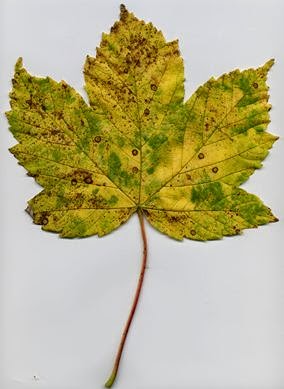
Autumn this year has been a little slow to arrive, but now the weather’s beginning to turn a bit cooler, I suppose the leaves will soon be falling thick and fast. And because it’s been a very dry September, quite a few in my garden had fallen already, when I went out to look the other day. Here’s one I came across in my backyard. It’s a sycamore, which is a member of the maple family of trees. The leaves of some of the maples are among the most attractive in autumn because of the bright colours, and many people cross the Atlantic at this time of the year to see the colours of fall in New England or Ontario. We were there last year but just a few weeks too early to get the full effect of the changing leaves.

So the nearest I generally get to the bright colours of fall is likely to be a bright autumn day in the Ironbridge Gorge or at Lake Vyrnwy. Here too though, the leaves can glow so brightly in the autumn sunshine that you might almost think the hills were on fire. And yet these colours are in fact the colours of decay, for all that they can seem for a short time to glow with life and fire. The autumn colours we see were in fact there in the leaves all along, but while each leaf is active and living, those background colours of red and yellow are hidden by the green of summer. That green pigment is chlorophyll, and chlorophyll is in a way the powerhouse of our living planet. This is the magic component that allows a plant to tap into the energy of the sun, and to use that energy to turn carbon dioxide into food, while at the same time issuing out oxygen as a waste product. This process, called photosynthesis, is what provides an atmosphere we can breathe in, as all kinds of plant life flourish in the sun, from little mosses and ferns to the wheat and potatoes in our fields, the dahlias and chrysanthemums in our gardens, up to the giant trees in our woods and forests.

Having trained as a plant scientist, I know how the system works, and yet it still feels like magic, in a way. Not all life depends on what green leaves are doing, but if those green leaves weren’t doing what they do, there’s be precious little life around above the level of bacteria. We certainly wouldn’t be alive.

So, sitting the other looking at this leaf, I found that quite a sobering thought, just for a moment. What if the leaves stopped doing what they do? What if they all died? What if the system stopped working? We’d all be gone in no time.

While our distant ancestors knew nothing about chlorophyll and photosynthesis, they were probably more worried than we are by the fall of the leaves in the autumn, and about the cooling temperatures and the shortening days. How could they be sure the sun would ever grow strong again? How could they be sure the leaves would reappear on the trees. Somewhere behind many of our autumn and winter ceremonies, whether it be bonfires or yule logs of holly and mistletoe, those primaeval fears lurk. The sun has faded but maybe our fires can bring him back. The leaves have fallen, but the evergreen branches that remain are a promise that they won’t be gone for ever.

We haven’t quite got to those darker days yet; but we’ve reached the first of our autumn ceremonies, harvest festival. The origin of this celebration is the harvest home: all is safely gathered in (as the hymn reminds us), so there’s a chance to put down our rakes and sickles and have a bit of a party. Behind the joy of the celebration there’d have been relief too in past times, if the harvest had been good - this year at least there’d be enough put by to see folk through the dark and testing weeks of winter, when nothing could grow and the land was gripped by snow and frost.

This year’s harvest has for most of us been a good one, I think. Some of my gardener friends have had record crops. For most of us though whether the harvest is good or not so good is more a matter of degree than of life and death. Prices may be higher if the harvest hasn’t been all that good, but most of what we need will still be there on the supermarket shelf, and we’ll not starve. Not so in the past. Mass starvation in Europe was a reality of life only a matter of a few centuries ago, and more recently in Ireland, if you think back to the potato famine of not that much more than a century ago.

The Bible includes many stories and incidences of famine. The one that brought Jacob and his sons to Egypt, for example, or the one that threatened to starve the widow and her son with whom Elijah took refuge. People back then knew how close to the edge they lived; nor has famine finished with the human world today - we may always have enough to eat in Europe, but that’s not so true in other places.

So the edge is perhaps closer than we’d like to think. Leaves may not fail us, but there’ve been some scare stories this year about bees. And other insects too, together the pollinators without which - well, without which the plant world would fall apart: no fruit, no seeds. Whatever the truth and the science behind the particular stories and scares that did the rounds this year, it remains true that we need the bees, and that all insects can be very vulnerable to environmental changes we may well make without even noticing.

Tonight our theme is thanksgiving, and you may think I’ve taken rather a long time to get to there. When the old harvest homes began to include singing hymns and prayers in church or chapel, they became harvest thanksgivings. So let’s think for a moment about what we’re being thankful for.
For me this is a time to give thanks to God for all the complexity and wonder of creation, with its possibilities and opportunities, and its beauty and fruitfulness and wealth. And to remind myself that our harvest doesn’t just depend on weather and soil, on leaves and photosynthesis, on bees and other pollinators, it depends on him. We plough the fields and scatter the good seed on the land, but it is fed and watered by God’s almighty hand. Or so the hymn tells us.

It doesn’t always feel like that, these days, when a field can be harvested, cleared, manured, ploughed, prepared and sown all in a matter of days. But even though we’ve so much power at our disposal, so much knowledge, so much technology, we’re still at the mercy of the forces of nature, as people in many parts of the country discovered only too well over last winter with its widespread flooding. But still there’s a need to give thanks that’s deeply ingrained within us; it’s good to pause at this season of gathering in, and to be reminded that for all our power, harvest begins not with what we’ve devised or done, but with what we’ve been given.

Thanksgiving, then. Thank-you’s come in different shapes and sizes, and some of them can be perfunctory and disinterested, just a nod in the right direction for form’s sake. I hope our thanksgiving at harvest isn’t that sort of thank-you. Some gifts are treated poorly - quickly broken, thrown away or sent off to car boot sales. How much of a thank-you did they ever get? To be truly thankful is to value the gift and to honour the giver. So in our harvest thanksgiving, firstly, we praise God just because the world is such a fantastic place and it’s good to be alive in it; secondly we pledge ourselves to look after the wonderful world that he’s given into our care, leaves and bees and all; and thirdly we recognise the responsibility of harvest, that it’s ours not just to keep but to use.

There’s a lot about harvests in the New Testament, Jesus told quite a few harvest stories, and they’re mostly stories about judgement. And underlying everything else in our harvest thanksgiving is the Gospel message that we ourselves are called to bear a good harvest - thinking back to the parable of the sower, we’re called to be seed set in good soil, that grows as it ought to grow, yielding some thirty fold, some sixty, and some a hundred fold.

This leaf has stopped working. That’s why it fell off the tree as it did. New leaves will replace it and go on working, even if not until next spring. But if all leaves stopped working and never grew back, the whole shebang would come to an end. Not that leaves have any choice in the matter: they’re just components that serve their purpose and are then ditched by the plant or tree when their work is done.

But we as leaves on the human tree of life do have a choice. We can be fruitful in God’s service, we can share what we harvest and care for the world, or we can just look after number one and contribute nothing to the tree. It occurs to me that when a sycamore leaf gets to that stage that’s when the tree gets rid of it - the leaf stops producing food for the tree, so the tree seals off the leaf stem, and a breath of wind soon brings the leaf down. Our best thanksgiving to God at harvest is to be leaves that go on contributing to the life of the whole tree, that have the vision, courage and love to be givers rather than takers, and workers ourselves rather than those who simply depend on the work of others. And as we do that we create an environment in which other leaves will also thrive, and in which our harvest thanksgiving won’t be a single event, a festival day, but something to generate an outward-looking state of mind and a generous and loving commitment of our hearts.

Thursday, 2 October 2014

Sunday Talk

Goodness, what a busy week!  I haven't had time to post anything, least of all the Sunday talk prepared for last weekend, based on the set Gospel reading. Here it is, though . . .

“There was a man who had two sons.” With these words Jesus begins a story that can be a bit dangerous for us to read, and here’s why. Because it compares and contrasts two sons, one of whom makes a promise and doesn’t keep it, while the other refuses the request but then does what was wanted after all, we can easily find ourselves reading the story with particular people in mind, and being tempted into doing something Jesus tells us we shouldn’t ever do – sitting in judgement on someone else: “Judge not, so you won’t be judged,” he says.

Of course, the clear message of the story is that it’s what we do that counts, not what we say. Elsewhere, Jesus tells his disciples, “By their works shall you know them” - works, not words. Here Jesus is talking to the religious leaders of his day, the chief priests and their allies. At the beginning of the reading we heard how they came up to ask Jesus what authority he’d got to preach on their patch – for there he was in the temple. He sidestepped that challenge by presenting them with a question they didn’t dare answer honestly.

To me they behaved rather like politicians on Newsnight or Question Time. They scratched about to work out the party line – what will happen if we say this, and what will happen if we say that? Jesus asked them what they thought about the ministry of John the Baptist: were his words from men or from God? And like modern politicians waiting for the text from party HQ or the whips’ office to tells them what they ought to say (our own MP I think being an honourable exception to the rule) there they were, searching for an answer based not on truth, not on what they really thought, but on expediency, on what would play with the crowd.

So Jesus follows up by saying, “Tell me what you think about this, instead,” and he gives them the parable of the two sons. Which of them did what his father wanted? Well, the answer to that was clear enough. A job done is worth a lot more than a job promised.

We’re not told why the first son went back on his promise. He could have had good reason. Things change, problems come up, sometimes you just can’t do what you’d hoped and intended to do. Often we tell the story as though the first son broke his promise out of idleness or because his mates called to take him out for a beer. But Jesus doesn’t say that – so take care: the times when we change our plans for what we claim as good and plausible reasons, they matter too.

In fact, any character defect on the part of either of the sons is completely incidental to the point of the story. The only point of the story is this – that the job gets done by those who do it, and not by those who merely talk about it. Which reminds me of the saying that when all is said and done, there’s usually a great deal more said.

And even those chief priests, they weren’t bad people, or at not for the most part, I shouldn’t think. They were just doing their best to keep the religious show on the road, and maybe to keep their jobs too, but who wouldn’t? And it wasn’t easy, under Roman occupation and with the people themselves often very fractious, and liable to follow any new teacher or possible messiah. Of course, they were very aware of their own status, their high position in society, and the protected and for the most part highly comfortable lives they were able to lead. So maybe they didn’t really have the common touch any more, if they ever did. But I feel sure they were doing their best, even so.

Since it’s these people who clearly are depicted by the first son, the one who promised but didn’t deliver, it’s worth asking just what it was the chief priests had promised, and in what way they hadn’t delivered on their promise. And my answer to that question, I think, has to do with honesty, and is connected very closely with the reason why they couldn’t and wouldn’t answer the question Jesus put to them about John the Baptist.

Fundamental to the role of the high priest or the temple servant is the promise they have made to God, to serve him first and foremost, to give him first place in their lives, to build everything around that prior claim he has, over all else. But it’s so easy for the institution and the way things are done to become more important than the God we’re called to serve and worship, and that’s what had happened here - and the status and security they so valued was also part of the problem. So Jesus had little chance of getting an honest answer, because all they could think of was “What will people think of us if we say this?”

As the religious establishment they had the insiders’ interest in rocking no boats and keeping things as much the same as they could. They were allowing the religion, the cult, to become a business in itself, in which God ends up with a bit part at best, tolerated so long as he keeps to his place within the process. We can see as we read the Gospels how Jesus has much more success with outsiders, with people whose only prayer, like that of the tax collector in the temple, was “Lord, have mercy on me, a sinner.” These guys had nothing to cling to but their honesty, for they were people who knew they’d gone wrong but longed to be right again, they were like the second son, coming to a change of heart and of mind.

But there’s a detail of what Jesus has to say to the temple elite that we mustn’t overlook. They won’t be happy to hear him say that tax collectors and prostitutes are entering the kingdom ahead of them, but those words ‘ahead of them’ are important. He doesn’t say ‘instead of them,’ he doesn’t say they no longer have a place. For his message is that no-one is excluded. Everyone can have that change of heart and mind that brings them back into the right place. Jesus tells them that unlike the tax collectors and the prostitutes, they did not change their minds and believe John.” But they still could. The door remains open.

Sadly I’s have to say that I have seen churches where God has to know his place, and it’s second place to the organisation and the ritual. Probably all churches have a tendency to be like that sometimes. And I don’t suppose any of us, hand on heart, can say there haven’t been times when we’ve promised, but not delivered; when we’ve promised God, but not delivered; and when that’s happened, we’ve probably had all sorts of good reasons why we couldn’t do it, or had postpone. Life is shades of grey, it isn’t always black and white and easy to decide. So it’s good from time to time to be reminded of our outsider status. We’re saved not by our works, and certainly not by our words, however well meant, but by grace alone; by our Lord Jesus Christ and through the cross on which he bore our sins.


Which takes me back to where we started, I suppose, the danger of this reading leading us into judging others, who perhaps don’t match up to our fine examples, when the truth is, we don’t even match up to them ourselves. This is a story to encourage me into judgement, but I can only judge myself. So I’ll spend a while being honest about the promises I’ve passed up on, and I’ll work at building more transparency and consistency into my life, and I’ll ask my God to help me.

Sunday, 21 September 2014

Matthew

A reflection prepared for today, the feast day of Matthew the Apostle :-

Today the Church honours the apostle Matthew, whose name is attached to the first of the four Gospels. In fact, the Gospel of Matthew we know was written by a later hand, but in part it probably depends on sayings and stories of Jesus that we’re told were assembled by Matthew, and then expounded by others.

There was no need for a written account of the life and teachings of Jesus when the Church was very new – not least because the first followers of our Lord expected the day of judgement would arrive at any moment. They were already in the last days. But as the Church grew, and time went on, and those who led the church in each place hadn’t necessarily known or heard Jesus themselves, that it became important to write things down.

Matthew should no doubt be honoured for his part in beginning the work of assembling the written Gospels, but today I’d like to concentrate on Matthew the disciple rather than Matthew the evangelist. Like Peter, Andrew, James and John, he wasn’t an obvious candidate. To be honest, he was a much less obvious candidate than the other four, now that I come to think of it. They were fishermen, an honourable enough occupation; he was a tax collector, and no-one likes them, do they?

Now I’ve known a few tax collectors fairly well, and all the ones I’ve known have been really nice people. And I have a fairly positive feeling about paying my taxes, because that’s part of how we ensure a society in which all members can find a level of provision and care and have the chance to live together in peace. Although that’s not to say I agree with everything the government chooses to do with the money it takes from me.

But at least it is my government, and if I don’t like what it does, then every five years or so I get the chance to cast my vote and maybe effect a change. Tax collectors at the time of Jesus were working for a government that was imposed on the people from outside, and which was hostile or at best dismissive of their faith and therefore their law. Israel had been a free kingdom with kings of the line of David; but now they were part of the Empire of Rome, and that’s where their taxes went, and that’s who the tax collectors who received their taxes worked for.

You could make a good living as a tax collector. You could in fact pretty much collect as much as you liked, provided you remitted to the Roman exchequer the amount the Romans had assessed. So really you had permission from the authorities to be extortionate; the downside of that was that anyone who took the job was going to be hated by his own people, and treated with suspicion and contempt. By definition a tax collector was likely to be a man who cared more for money and for the trappings of wealth than he cared for community or friends or even family. And since his hands were fatally tainted by being in league with the godless Romans, no man of religion, no priest or Pharisee, would have anything at all to do with a tax collector.

But Jesus did. In the Gospel stories we find Jesus quite deliberately meeting with tax collectors, eating at their tables, and treating them as though they hadn’t completely and utterly excluded themselves from God’s favour. You’ll remember the story of little Zaccheus, the tax collector who climbed up a tree to see Jesus over the heads of the crowd. Jesus called him down and invited himself to have tea at Zaccheus’ house. You’ll remember too the anger of the Pharisees when they saw this rabbi, teacher, sitting to eat with tax collectors.

I suppose Matthew – or Levi as he would have been then – must have been at such an event. Or maybe like Zaccheus he’d been jostled by the crowd as he strained to hear what Jesus had to say out on the streets. And then one day Jesus called him, there as he was sitting at his seat of custom, doing his books, collecting and counting the money. Why would Jesus call a tax collector, though? Why would Jesus want someone like that? What would Jesus expect to do with him?

Jesus called Matthew for the same reason that he called Peter and the others; because he could see that Matthew was ready to follow. That’s exactly what he did: he left his seat straight away, and didn’t hesitate for a moment. Then as now, for Jesus qualifications or status or suitability (in the way that society might assess it) – these things aren’t important in a disciple . . . the important thing is that they’re ready to follow, ready to listen, ready to learn.

The words of the traditional collect for St Matthew’s day speak of Jesus calling Matthew “from the selfish pursuit of gain”. So we’re talking about a life turned upside down, and a radical changing of priorities. Matthew’s good life as a tax collector had turned out not to be good after all. He might have thought money would compensate for the rejection and abuse and cold shoulders – but I think he’d found that however much money you got, and however much money you spent, there was an empty space in the middle of him that mere money could never fill. A God shaped space, if you like.

So Levi became a disciple, left his old life, left his money behind, I suppose, started afresh. And from being Levi, which means “attached” or “pledged”, he became Matthew, which means “gift of God”.

I think that at the point of Jesus’ call to him, Matthew had come to realise the truth of that simple but profound statement, attributed among others to William Ruskin, that “he who gives God second place in life gives him no place.” If our priorities are wrong, whoever and wherever we are, the God shaped slot remains empty and unfilled, and, however rich we may like to think we may be, we are in fact fatally poor.

But here for me is the crux of the matter, and here’s why the story of Matthew matters to me, and not only to the bankers of Canary Wharf or the City of London: let me put it as a question – what’s the difference between Matthew the tax collector and the Pharisees and priests who were so quick to condemn Jesus for spending time with Matthew and his like?

Here’s an immediate and obvious difference. Matthew had chosen money, and the Pharisees had chosen religion. But that’s a bit of red herring, not least because religion and faith are not necessarily the same thing. Religion can in fact become as much of a self-seeking thing as any pursuit of wealth or power. Just look at the amount of misery and conflict religion causes in our world today. Do you imagine God wants any of that? Do you imagine God is calling people into any of that?

The difference between Matthew and the Pharisees, the difference that matters, is this: Matthew knew he needed to be saved and repaired and healed by God. The Pharisees didn’t. And for us too, as for Matthew, we are here gathered today not because we’re good enough, not because we’re sorted out and are getting it all right, but because we know we need God to fix us, and that there is inside me and you a God-shaped hole that only the love of Jesus can fill. And he knows that, which is why he calls me and you as he called Matthew that day, to put him first, to leave the other stuff behind, and to follow.

Saturday, 13 September 2014

Mr Twistleton and the Football

A Sunday talk to tie in with this week's CL readings . . .

Mr Twistleton was in his favourite place: in his own back garden, on his sun lounger, good book, cold drink, lovely sunny afternoon. It would have been absolutely perfect had it not been for the thump, thump, thump from next door. Those blasted children were out there again, playing with a ball. Mr Twistleton tried to put the sound out of his head, but he didn’t find it easy.

And then it happened. Just as Mr T had managed to close his eyes, the ball sailed over the wall and landed straight on his stomach. Mr Twistleton got up and grabbed it. He was not best pleased. “Really sorry, Mr Twistleton,” came a young voice. “Can we have our ball . . .” “NO, you may not!” Mr Twistleton responded. “It’s on my property, so it IS my property!” And he stomped off into the house with it, opened the cupboard under the stairs, flung the ball inside and slammed the door on it.

Fine minutes later, he was back outside, lying once again on his sun lounger, and this time there were no noises from next door to stop him drifting off to sleep.  He’d had quite a snooze when, rat-a-tat, he was woken by a peremptory knock on his front door. He got up, went to the door, and there stood a postman. “You need to sign for this, sir. Important letter.” It did look important, too. Large, brown, well-stuffed, and marked ‘Department of Revenue and Customs’.

Mr Twistleton’s heart sank. He had been a little worried about his tax return. He opened the letter to find he was wrong to be a little worried; he should have been a whole LOT worried. There were sheets and sheets, all filled with figures in red ink. “How on earth did I come to owe this much?” Mr Twistleton wondered. “And how on earth am I going to pay it?”

He hadn’t been wondering that for very long when there came another knock on his door. The postman’s knock had been peremptory. This knock was merely brutal. He opened the door to find a smallish man there in a black jacket, pinstriped trousers, bowler hat, briefcase marked ‘DRC’. Perhaps the man wasn’t really that small - he just looked it, compared to the two immense guys stood either side of him. They didn’t look very friendly.

“Good afternoon, Mr Twistleton,” said the man in the middle. “My, er, friends and I felt we should call to discuss your account with Her Majesty’s Revenue and Customs, and to see if we can’t work out together some way of - er - settling your outstanding balance with us.”

“But it’s only just arrived,” said Mr Twistleton anxiously. “I’ve only just this minute seen the figures. Surely you can give me some time to get things organised?”

“Oh, I hardly think so,” said the man from the ministry. “After all, this is a debt built up over quite some time, and, well, frankly, sir, when we’re talking this sort of money, we do feel it’s best to come to an early and swift arrangement.” Mr Twistleton noticed that one of the bailiffs seemed somehow to have acquired a baseball bat, which he was smacking in a meaningful way into the huge palm of his other hand.

Mr Twistleton fell to his knees. “Oh, please, please, please, please just give me a bit of time, sirs. I’ll do anything, I’ll work every hour I can, I’ll scrub floors, just give me time, I’ll pay it all, I really will . . .” His voice tailed away. “If you scrubbed floors for fifty years you wouldn’t raise enough to pay off this amount,” said the revenue man. “But I hate to see a grown man cry . . .

“Tell you what. I’ll let you off. It’ll be as though this bill never existed. You tear up your copy. I’ll tear up mine. Clean slate; start again. How’s that?”

Mr Twistleton could hardly believe his ears. “Thank you” hardly seemed enough of a reply - but, before he could say anything, the door under the stairs edged open, and a ball tumbled out, bounced a couple of times, and rolled down the hallway to rest at the feet of the man from the ministry. He looked down, and picked it up. “Is this your ball, sir?” he asked.

“Yes,” said Mr Twistleton, “er - I mean no, er yes, er no, er.” “Doesn’t this ball actually belong to the children next door? Oh dear. That puts rather a different complexion on things. It’s difficult to see how we can let you off, after all.” The two minders stepped forward purposefully, both of them now with baseball bats in hand, and that’s when . . .

. . . a second ball sailed over the wall, landed like the first on Mr Twistleton’s stomach, this time knocking him off his sun lounger and waking him up. There was a sort of horrified silence from the other side of the wall.

Then a rather frightened voice said, “Sorry again, Mr Twistleton! But can we please have our ball back, if we promise to be really extra specially careful from now on?” “Of course you may, both of them, of course,” Mr T replied - much to their surprise, but then of course, they didn’t know about his dream.

There’s a simple message from that story, as there is in the story Jesus told in this morning’s Gospel. Christians should live generously and graciously.

We’ve been let off a mountain of debt, more than we could ever pay. We who deserve death have been promised life, we who deserve the pains of hell have been promised the joys of heaven. We are saved by grace and by the generosity of our Father God; as his people we should be generous to one another and we should live generously in his world. Day by day we pray “Forgive us our trespasses, as we forgive those who trespass against us.” We pray those words. Our task in mission and service is to make sure that we also live them. Amen.

Friday, 12 September 2014

Winter Visitors

My 'Nature Notes' piece for local community magazines . . .

Birds face a struggle to survive the rigours of a British winter. The darker days mean there is less daylight in which to find food, and frost and snow (and last winter, floods) can make vital feeding areas inaccessible. Our native species will spend the autumn building up their fat reserves to help cope, while many other birds, as I mentioned last month, will have headed south. But winters further north and east are much harder than ours, so many birds are also arriving at this time of the year.

Many water birds spend their winter here, including huge numbers of geese and arctic swans, mostly heading for coastal mudflats and marshlands. The wild geese we’re likely to see overhead are not migrating - they are the Canada geese that are here all year round, though in their native North America they do migrate. But numbers of winter ducks may be found in suitable places like Llyn Coed y Dinas, with the wigeon, with its distinctive whistling call, a particular favourite of mine. I’ll write more about ducks and other water birds next time.

Many winter garden birds are extras to our resident species: blackbirds and song thrushes, robins and starlings in our gardens are all augmented by visitors from abroad, from Scandinavia and as far east as Siberia. With them come birds that are special to winter, like the two winter thrushes: redwings, slightly smaller than a song thrush and with an orange flash on its flanks, and the larger fieldfare, elegant in grey and brown, and often in large noisy flocks. Redwings will come to gardens, taking yew berries but happy also to sample chopped up apples - why not leave a few on your lawn? Fieldfares are more typical of open fields, especially where a field has been newly manured, with plenty of worms and insects to find.

A colourful and unusual visitor is the waxwing, more likely to be found on the eastern side of the country, but occurring anywhere in harder weather. They love berries, and can often be found in such places as supermarket car parks, where berry-bearing bushes have often been planted. Finches flock together in the winter, the flock giving a better chance to find food and some protection for each individual bird from predators. Winter visitors like bramblings will join our native finches; this is a finch closely related to the chaffinch, but more robust-looking and with a distinctive white rump visible as it flies. Siskins and redpolls move down from wilder areas into our gardens, where they often flock with goldfinches. The male siskin, about the size of a blue tit, is an attractive bird in yellow and green with a black cap. 

One summer warbler, the blackcap, has started to be seen in Britain through the winter, visiting bird tables. These may well not be the birds that were here in the summer, but continental birds coming in. The male is easy to identify with its black cap,  while the female has a brown cap.  Our smallest British bird, the goldcrest, will also move into gardens in winter, from the conifer plantations that are its preferred habitat, to join tits in feeding from suet balls. Its close relative the firecrest is a winter visitor, but not I think to be found this far north.

Wednesday, 10 September 2014

I just hope his name is Gordon . . .

I turned up at the church at the right time for the meeting. Well, to be honest, a minute or two late, but I like a stylishly late entrance - it helps maintain the illusion of a busy man just managing to fit everything in. I could see Gordon outside, back to me, scanning the noticeboards, so, although it did seem awfully quiet, I presumed his wife was inside along with everyone else. "Evening, Gordon!" I said cheerily, and in I went, only to find an empty room. There were, however, noises coming from the smaller meeting room off, and as I walked towards the door a head popped round it. Sadly, not one I recognised. "Are you looking for us?"

Inside the room there indeed was Gordon's wife, but with a completely different set of people from the ones I'd expected, and obviously a completely different meeting. I had the right day, and (almost) the right time, but I was a week early, not having properly read the instructions sent to me. I made some comment about having seen Gordon outside. "I hope not," came the reply, "I left him at home, doing the dishes." There was much hilarity at my confusion, and I retreated to lick my wounds, and reflect that at least my foolishness had brightened up what might have been a boring meeting.

Back outside, I could see "Gordon" further down the street, looking now into an estate agent's window. I headed towards him, he turned round, and from the front, proved to be a complete stranger who looked a bit like Gordon from behind. Oh well. I can only hope his name was Gordon, too.

Monday, 8 September 2014

Making Up

An address given yesterday at Middleton and Trelystan (Chirbury Group) :-

How many people here have got brothers? Sisters? I have the fortune or the misfortune (I’ve used both words at different times) to be part of quite a large family, the eldest in fact of five brothers, plus one little sister who is the youngest of any of us. Fortune? Well, we don’t live in each others’ pockets, but we do know where we belong, and we’re all of us there for each other when help is needed. I can think of a couple of times in my life when I’d have been sunk without my brothers and sister, and I’m pretty sure each and every one of them could say the same.

Misfortune? Oh well, you know what they say – you can choose your friends but you get what you’re given as regards family. We’re all very different. We don’t vote the same way, we don’t go out to the same places, we don’t necessarily agree on a whole range of stuff. And sometimes, just sometimes, a couple of us might have a real falling-out.

To be honest, I can’t remember too many of those – or at least, not since we were very young children. But it isn’t so much how often they happen, these arguments and spats, it’s what you do with them. And what happens when it doesn’t get sorted out.  There’s someone I know quite well who hasn’t spoken to her sister in twenty years. I can’t comment on that, because I don’t know what caused the split and therefore I can’t begin to guess at why it’s never been resolved – except that I can say, with a fair degree of confidence, that I can’t imagine that happening within my own immediate family. To be frank, I just don’t think that any of us could keep it up.

The Gospel reading this morning is quite a tough one, about relationships and what we should do when they get thorny and difficult. Jesus speaks about what to do “if your brother sins against you”. Of course, we’re not just talking about blood brothers (or sisters) here: when I pray I call God “Our Father”, and to do that instantly turns everyone else who prays the same prayer into my brother and my sister. And every argument or disagreement between us into a family matter. And arguments will happen - so what should we do about them when they do?

This is important I think, because our faith is proved and witnessed to not in how we behave when things are going well and the world is bright and cheerful, but in how we behave when things are going wrong. Jesus knew that as well as anyone. Don’t you get the impression that that band of men he called to be his disciples could be a pretty argumentative bunch from time to time?

Anyway, here, based on this morning’s Gospel, are some clues as to how we, as disciples in our turn of the Lord Jesus Christ, can deal effectively with the problems and issues and slights that happen from time to time. Say you do something to me that miffs me and annoys me, or maybe gets me into trouble, and I think it’s wrong. What should I be doing about it?

Well, first of all I do need to do something, and not just let it lie. When you let things lie they fester. I could end up brooding about things in such a way that something that on its own probably shouldn’t be all that important starts to take over my life. And not only mine: unresolved issues lead to a toxic environment in which constructive working together becomes impossible.
And I need I think quite deliberately to put my complaint into words; sometimes that in itself can expose a grievance for what it often is, not so big and bad that it can’t be resolved. Otherwise I could get things out of balance, so that someone’s clumsy action or thoughtless word gets to feel like a personal attack.

But if I do feel wronged by someone, I guess it would be good to be able to talk things over, face to face. That might not be easy of course, so someone else may need to perform the service of preparing the way beforehand. I remember on one occasion inviting two people round who I knew needed to sort something out between them, preparing the way a bit with each of them, but then on the day just leaving them there together while I went to make a cup of coffee. I confess that I did wonder whether world war three might break out – but it didn’t.

I’m a great writer of letters of complaint (I do also write letters of praise and thanks, by the way, I’m not quite in the Victor Meldrew camp). But while letters of complaint can be very effective when written to companies and corporations, I don’t think they’re a good idea between individuals - not if what you want to do is to make friends again, anyway. I think positions can become entrenched and attitudes hardened when set down on paper – though sometimes a generous and apologetic card can work wonders.

Perhaps though nothing at this stage is working wonders, and the problem isn’t sorted. Jesus in this morning’s reading says that then we should take two or three witnesses along with us. If that sounds like escalating things, Jesus I think is reminding his disciples of the Jewish Law in Deuteronomy chapter 19, verse 15.

We read there that a charge of misdemeanour can’t be sustained on the evidence of one person; two or three further witnesses are required. Having said that, the witnesses aren’t there as a sort of legal heavy mob to make sure the charges are proved – I don’t think so, anyway. Extra people can defuse tension and enable reconciliation. So I’d not want to be taking along two or three barrack-room lawyers (or real ones for that matter) – not if I really want to set things right. Better to have with me two or three wise and kind and clear sighted people who maybe just by being there can help two people at odds really to listen to each other and find some common ground. Like ACAS when the management and the unions are at odds, or like the hard but honest friend who can say, “Do you really see what you’re doing here, not just to yourselves, but to the rest of us as well?”

For make no mistake, if left untreated and unresolved an issue between two people may very well end up poisoning the whole well. I can think of churches I’ve known that were turned into toxic places by things left unresolved, in one case by an event that happened more than thirty years before. A stranger coming into that church would quickly have felt uneasy there, and that there was something in the air. Not surprisingly, that church was in a very poor way.

So Jesus goes on to tell his disciples that if the matter can’t be sorted out face to face or with the help of others, then it becomes a matter for the whole fellowship. Some fallings-out end up with lawyers and in the courts, but what does that ever achieve? Legal proceedings may settle an issue, but they don’t restore unity; whereas a caring and prayerful Church, with Christian prayer, fellowship and love just might be able to bring people back together.

There’s a lot more I could be saying, but I’ll make just two more points before I close. The first is a scriptural comment. To properly understand this quite hard passage of scripture we need to see it in context. It immediately follows the story of the lost sheep. Remember? The ninety-nine are left, and the Good Shepherd goes to find the one that’s lost. This passage isn’t about dealing with trouble-makers but finding and restoring the lost, and keeping the whole flock together. It’s about staying family in difficult times. This is such an important point: Jesus isn’t instructing us in how to deal with a situation, but how to save a soul; and unless that’s what we want to do when we engage with a situation of hurt or breakdown in the church, we’re likely to fail, for we’re not seeing or acting with the mind of Christ.

And the last thing is very much from my own experience: none of us is perfect, and where I have an issue with someone else I need to look hard at myself as well as at the other chap. If I go in believing that all the fault’s on the other side and none rests with me I’m going to get things wrong. I can think of times when an unkind word or action directed against me was actually sparked by something I’d done or said without realising or understanding the hurt I’d caused. I can’t often stand easily on the moral high ground! I think that’s the saving grace in my own family, that stops our arguments becoming feuds and keeps us talking: we’re all pretty self-aware. And so we need to be as Christians – if we’re self-aware and Christ-aware, and seriously in the business of wanting souls to be saved, then God will be able to use us graciously, and we’ll be good at being his family. Amen.

Saturday, 6 September 2014

Cricket

Lots of insects around at present, following our really rather good summer (even if the past few weeks have been a little less so). These turned up on our back porch this morning, and I think they are oak bush crickets. They are quite slimly built, and are a uniform bright green colour, with a distinctive brown mark on the thorax. We have plenty of oak trees nearby, of course, and these are insects that fly readily and are attracted to lights at night.


I think they are rather attractive little beasts, and I particularly love their long antennae, which are in fact more than the length of the body.