Monday, 19 October 2015
Kite Attack
Driving back from Castle Caereinion to Welshpool this afternoon, I spotted a red kite as I crested Golfa Bank: long, thin wings as seen from the side - even from a distance, quite distinctive. As I drew closer, it crossed the road , coming over a field in which a flock of jackdaws was feeding. To my surprise, the kite did a typical piece of kite aerobatics, a spiralling tumble, straight down onto the jackdaws, scattering them in all directions, then actively pursuing a group of them. I've often seen corvids mobbing and harrying birds of prey - amusing to see the tables turned. I can't think the kite had any interest in actually taking a jackdaw, so can only assume it was just enjoying itself.

Sunday, 18 October 2015
A sermon for today if it hadn't been St Luke's Day . . .
Jesus is “a priest for ever, after the order of Melchizedek” - so we read in today’s reading from the Letter to the Hebrews. Who was Melchizedek then, and why was he so special? Melchizedek is a shadowy and mysterious figure from the Old Testament, who we first find in the Book of Genesis, chapter 14. There he meets with Abraham - who at this stage is still called Abram; he gives him food and wine and a special blessing. My own view of Melchizedek is somewhat coloured by the fact that he was a central figure in the east window of the chapel at Lincoln Theological College, where I trained for ordination - and seemed in that window to be wearing red and white striped football socks. As featured in our window, he became a sort of college icon or mascot, but we found it a little hard to take him seriously as a Bible character.
And that’s a shame, I thought; I decided to do some research. What was so special about Melchizedek, that Jesus should be a priest after his order? Well, he is in fact the first person in the Old Testament to be given the title of priest. And he was also a king, the King of Salem, or Jerusalem - king then of the place where after many more journeys and adventures, the people of Israel would eventually settle. Melchizedek’s kingship and priesthood somehow confirms Salem as holy and blessed by God, even before the Israelites have been formed into a nation, something that will happen in the next book of the Bible, the Book of Exodus.
So the priesthood of Melchizedek precedes the priesthood of the Jerusalem Temple, and that was very important to the writer of the Letter to the Hebrews. The temple priests had to purify themselves before they could offer sacrifice, by prayers and ritual washing and other rites of preparation. But Jesus is not like them. He is already and always worthy; last Sunday’s reading from Hebrews tells us that he was “tested as we are, yet without sin.”
And he is both king and priest, in a way that no temple priest could ever be. In chapter eight of Hebrews we read, “This is the kind of high priest we have: he has taken his seat at the right hand of the Throne of Majesty in heaven.”
Two other things to say briefly about Melchizedek: first, that he gives Abram food and wine, something some Christian writers interpret as an Old Testament precursor to the Eucharist; and second, that he both blesses Abram and receives a tribute from him, one tenth of all he’d taken from the King of Elam and his allies. Briefly, a force led by King Kedorlaomer of Elam had defeated the King of Sodom and his allies, and had carried off all their flocks and herds, along with Abram’s nephew Lot. When he heard the news, Abram mustered his men and pursued the victorious kings, winning back everything they’d taken.
By receiving a blessing and offering a tithe, Abram places himself under the lordship of Melchizedek; and this happens before the Law is given, the Law of Moses. The temple priests stood firmly under the Law, which directed and dictated their every action. But the priesthood of Melchizedek can be seen as being before and above the Law. His name itself, translated as “King of Righteousness” led Jewish thinkers, even before the time of Christ, to link Melchizedek with the expected Messiah.
“So what?” you may be saying at this point. Certainly the mysteriousness of Melchizedek has led some rather odd people to make some fairly crazy claims about him. But the writer of the Letter to the Hebrews simply wants to say that Jesus our high priest is very different from the priests of the temple. This ‘priesthood of the order of Melchizedek’ is liked to the humility, perseverance and submission of the one who offers not some creature or gift brought from elsewhere, but his own self: he is perfect priest and perfect sacrifice.
So true kingship, and true priestliness, is revealed in service, and in the man Jesus who is set free to live not outside the rules but above them. This man offers his own self that we might live, and as he does this he redefines both kingliness and priestliness.
But his disciples were slow to realise this of him. In our Gospel reading they’re still thinking about earthly thrones and temples, with James and John in particular asking, as a special favour, if they could have the best seats. I’m sure they felt they’d every chance of the top jobs, once Jesus came into the glory they expected of him. James and John, with Peter, were a sort of inner circle among the disciples, and Jesus shared things with them he didn’t share with the others. But they’ve a lot to learn still about his sort of kingdom, and his sort of king; and maybe everything still to learn about Jesus the priest. Jesus is different from other kings, different from other priests.
And Jesus is himself the message he preaches. And so he says to James and John and the others, “Look at me, and learn from me what it means to be a king: the Son of Man came not to be served but to serve, and to give his life a ransom for many.” He challenges them to be ready to give, ready to serve, and so to discover what true greatness means.
Like them, we’re disciples of the man who walks a different path, the man who turns the wisdom of the world upside down. The king who is servant and slave; the priest who offers himself as sacrifice. He presents a challenge to James and John: “Can you drink the cup that I drink? Can you be baptized with the baptism that I am baptized with?” And he presents us with the same challenge.
The Church is a very human organisation; we’ve books to balance and rules to govern us, we’ve hierarchies and pay scales and all sorts of other stuff that means we can look much the same as any other organisation. But our Lord is of the order of Melchizedek - he doesn’t copy the way of kings or governors like Herod or Pontius Pilate, or the way of high priests like Annas and Caiaphas. He is his own man, and God’s, and his is the way of total abandonment of self. He is love incarnate - love made flesh among us - and love is never bound by the rules. He’s called and chosen each of us - to be his, and like him to be great in service. “Let the greatest among you become like one who serves.”
So while churches have to have order and organisation, and rules and canons, and some kind of system of leadership - while therefore churches must in some ways to mirror the world, and seem to operate in the same way, in fact the way we do and decide things must be always challenged by the Lord we follow and serve. We must never let the rules take over; we must never let systems become more important than people; we must never let our buildings, beautiful and special though they be, be the reason why we’re here when what we need them to be is servants of our worship and witness and mission.
Jesus is “a priest for ever, after the order of Melchizedek.” For me the most important thing about what the writer of Hebrews tells us is that our Lord never conforms to the status quo; and nor should we, not if we truly believe that this king of righteousness, this one true high priest, is our Saviour and our Lord, and the example and director of our lives.
And that’s a shame, I thought; I decided to do some research. What was so special about Melchizedek, that Jesus should be a priest after his order? Well, he is in fact the first person in the Old Testament to be given the title of priest. And he was also a king, the King of Salem, or Jerusalem - king then of the place where after many more journeys and adventures, the people of Israel would eventually settle. Melchizedek’s kingship and priesthood somehow confirms Salem as holy and blessed by God, even before the Israelites have been formed into a nation, something that will happen in the next book of the Bible, the Book of Exodus.
So the priesthood of Melchizedek precedes the priesthood of the Jerusalem Temple, and that was very important to the writer of the Letter to the Hebrews. The temple priests had to purify themselves before they could offer sacrifice, by prayers and ritual washing and other rites of preparation. But Jesus is not like them. He is already and always worthy; last Sunday’s reading from Hebrews tells us that he was “tested as we are, yet without sin.”
And he is both king and priest, in a way that no temple priest could ever be. In chapter eight of Hebrews we read, “This is the kind of high priest we have: he has taken his seat at the right hand of the Throne of Majesty in heaven.”
Two other things to say briefly about Melchizedek: first, that he gives Abram food and wine, something some Christian writers interpret as an Old Testament precursor to the Eucharist; and second, that he both blesses Abram and receives a tribute from him, one tenth of all he’d taken from the King of Elam and his allies. Briefly, a force led by King Kedorlaomer of Elam had defeated the King of Sodom and his allies, and had carried off all their flocks and herds, along with Abram’s nephew Lot. When he heard the news, Abram mustered his men and pursued the victorious kings, winning back everything they’d taken.
By receiving a blessing and offering a tithe, Abram places himself under the lordship of Melchizedek; and this happens before the Law is given, the Law of Moses. The temple priests stood firmly under the Law, which directed and dictated their every action. But the priesthood of Melchizedek can be seen as being before and above the Law. His name itself, translated as “King of Righteousness” led Jewish thinkers, even before the time of Christ, to link Melchizedek with the expected Messiah.
“So what?” you may be saying at this point. Certainly the mysteriousness of Melchizedek has led some rather odd people to make some fairly crazy claims about him. But the writer of the Letter to the Hebrews simply wants to say that Jesus our high priest is very different from the priests of the temple. This ‘priesthood of the order of Melchizedek’ is liked to the humility, perseverance and submission of the one who offers not some creature or gift brought from elsewhere, but his own self: he is perfect priest and perfect sacrifice.
So true kingship, and true priestliness, is revealed in service, and in the man Jesus who is set free to live not outside the rules but above them. This man offers his own self that we might live, and as he does this he redefines both kingliness and priestliness.
But his disciples were slow to realise this of him. In our Gospel reading they’re still thinking about earthly thrones and temples, with James and John in particular asking, as a special favour, if they could have the best seats. I’m sure they felt they’d every chance of the top jobs, once Jesus came into the glory they expected of him. James and John, with Peter, were a sort of inner circle among the disciples, and Jesus shared things with them he didn’t share with the others. But they’ve a lot to learn still about his sort of kingdom, and his sort of king; and maybe everything still to learn about Jesus the priest. Jesus is different from other kings, different from other priests.
And Jesus is himself the message he preaches. And so he says to James and John and the others, “Look at me, and learn from me what it means to be a king: the Son of Man came not to be served but to serve, and to give his life a ransom for many.” He challenges them to be ready to give, ready to serve, and so to discover what true greatness means.
Like them, we’re disciples of the man who walks a different path, the man who turns the wisdom of the world upside down. The king who is servant and slave; the priest who offers himself as sacrifice. He presents a challenge to James and John: “Can you drink the cup that I drink? Can you be baptized with the baptism that I am baptized with?” And he presents us with the same challenge.
The Church is a very human organisation; we’ve books to balance and rules to govern us, we’ve hierarchies and pay scales and all sorts of other stuff that means we can look much the same as any other organisation. But our Lord is of the order of Melchizedek - he doesn’t copy the way of kings or governors like Herod or Pontius Pilate, or the way of high priests like Annas and Caiaphas. He is his own man, and God’s, and his is the way of total abandonment of self. He is love incarnate - love made flesh among us - and love is never bound by the rules. He’s called and chosen each of us - to be his, and like him to be great in service. “Let the greatest among you become like one who serves.”
So while churches have to have order and organisation, and rules and canons, and some kind of system of leadership - while therefore churches must in some ways to mirror the world, and seem to operate in the same way, in fact the way we do and decide things must be always challenged by the Lord we follow and serve. We must never let the rules take over; we must never let systems become more important than people; we must never let our buildings, beautiful and special though they be, be the reason why we’re here when what we need them to be is servants of our worship and witness and mission.
Jesus is “a priest for ever, after the order of Melchizedek.” For me the most important thing about what the writer of Hebrews tells us is that our Lord never conforms to the status quo; and nor should we, not if we truly believe that this king of righteousness, this one true high priest, is our Saviour and our Lord, and the example and director of our lives.
Saturday, 17 October 2015
A sermon for tomorrow, which is St Luke's Day
Today is the feast day of St Luke.
Luke at once interests me, inspires me and challenges me. He wrote what is I
think my favourite Gospel and I love his poetic touch; he’s a prime source for
my faith in Jesus Christ. Luke’s Gospel lays great stress on the prayerfulness
of Jesus, the social care and concern of Jesus, and the work of the Holy
Spirit. And Luke is also, of course, the author of the Acts of the Apostles; Acts
and his Gospel really belong together as one, even though in our Bibles we bind
St John’s Gospel between them.
Both Luke’s books are well written
and finely structured. Luke was an educated man: he might have been a non-Jew
who’d accepted the Gospel message in the very early days of the Church, or a
Jew from the Greek diaspora or dispersion, in other words one of those who
lived away from the Holy Land and had been immersed in Greek culture and
learning. Luke presents his Gospel as a journey, from Bethlehem to Nazareth and
on to Jerusalem; and in Acts he continues that journey from Jerusalem to Rome.
And he made some of that journey
himself; most of the Acts of the Apostles is written in the third person about
things happening to, or done by, other people; but there comes a point, in
Troas I think, at which Luke ceases to write ‘they’ and begins instead to write
‘we’. These verses are first-hand experience, Luke was there. As we heard Paul
write to Timothy in our first reading, Luke was Paul’s constant and faithful
companion through much of his mission.
Mary the mother of Jesus has a
higher profile in Luke’s writing than anywhere else. Her song, the Magnificat,
is found in Luke’s Gospel, as is the Benedictus (Zechariah’s song) and the Nunc
Dimmitis (words from Simeon in the Temple). Luke is a very poetic writer; he
also explicitly tells us that Mary was present when the Holy Spirit fell upon
the disciples of Jesus at the first Christian Pentecost.
It’s perhaps because Mary has the place
she has in his Gospel that Luke was popularly believed to painted Mary’s
portrait. The idea that Luke was an artist has no historical foundation, but
the belief, that Luke was a physician, a doctor of medicine, is much more
credible, so he’s become a patron saint for doctors and all who work in the
healing professions. His feast day today is often used as an opportunity to
celebrate and pray for their work.
And also to reflect on the healing
ministry of the Church. The Church has always had a strong presence within the
world of medicine, of course. Many of our great hospitals had a Christian
foundation, as does the modern hospice movement. Although in many places their
jobs are under financial pressure, chaplains are still seen as important within
hospitals, and chapels are well-used. When I worked for a mission agency, a
very substantial part of our fund-raising and expenditure had a medical theme;
and I found it very moving a few years ago to be able to visit one of the
hospitals, Milo in Tanzania, that I’d been supporting and reading about for
many years.
But here is also where I’m
challenged: to take seriously the healing ministry of the Church, not as a sort
of optional bolt-on to what else we do, or as a fund-raising exercise to
support those bits of our health service that are not fully funded by statutory
means, but as something that is or should be an essential part of our mission.
The New Testament record as a whole would seem to suggest that if the Church
isn’t doing healing, the Church isn’t really doing mission.
When Jesus sent his disciples out
to prepare the way, as we heard in this morning’s Gospel reading, his
instructions to them included, “Heal the sick.” When Jesus himself preached to
the crowds, there were always miracles of healing. And when, in the Acts of the
Apostles, the Gospel is taken out into the world, message and healing are
intertwined.
This challenges me partly because I
do believe the Church at every level should be taking the call to heal more
seriously than it often seems to; but also because a lot of the healing
ministry I come across causes me some disquiet. I confess I find myself pulled
in two directions.
I’ve attended some events where
healing ministry has been conducted in what seemed to me to be an exercise in
whipping up hysteria. And that felt a million miles away from how I see Jesus
operating in the Gospels. There’s a type of faith healing ministry that seems
to require a high profile and high emotion environment before healing can happen;
and to me that seems a world away from healing as the essential life blood of
the Church in mission, which is what I believe.
We have to be in the healing
business, because God is in the healing business; God desires wholeness and not
brokenness, so his Church must be a place where broken people are healed and
restored and made whole. We shouldn’t be afraid to offer healing when we invite
people in; we shouldn’t be afraid to campaign for healing when we go out into
the world; and we shouldn’t be afraid to believe that healing might be true and
possible within ourselves. Our living and our praying should reflect this and
express it.
But our understanding of what
healing is may be too narrow, while God’s response to our praying may not be
what we expect or require of him. My father attended healing services in his
local church when he was terminally ill; at one I was among the ministers who
laid hands on him. It didn’t work; he still got more ill and died. Or maybe it
did work; my father was very much reconciled in spirit by the time of his
death, and it was a good death, and many of our memories of that sad time are, perhaps
surprisingly, good ones. It wasn’t the answer we wanted, but I think my father
did receive a healing touch. Healing isn’t only physical healing, and we all
remain mortal, and will experience physical death.
If healing isn’t only physical
healing, nor is it only personal healing. There’s the healing of families, of conflict
situations, of relationships, perhaps also the healing of histories and
memories that are the cause of separation and suspicion. The healing of
communities and societies, the bridging of gaps, the need to learn or
rediscover what it means to belong together - I am sure that all of this too is
part of the healing ministry we’re called to as Church.
Personal physical healing is
certainly part of what we should be doing, but only part. Through most of my
ministry I’ve arranged and led healing services, seminars, prayer groups and
other activities. But we need to be engaged with the need for healing on every
front, and with a real breadth of vision. Too much of the world’s religion, and
certainly too much of the religion that shouts loudest and makes the biggest
headlines, maims rather than heals (maiming spiritually, ethically, mentally,
societally as well as physically), excludes rather than includes, bullies rather
than invites, frightens rather than consoles. Many people, when they see that
sort of religion in action, say, “If that’s what religion does, I want none of
it!” But nor do I; such religion, though powerful and, sadly, often persuasive,
is false, and it denies the God whose healing touch we see in Jesus, especially
in the Gospel picture of Jesus painted for us by Luke.
True religion is about healing,
because God is about healing; for me the challenge of Luke is this: that it’s only
when we’re passionately involved ourselves in working to make ourselves, our
families, our friends, our communities, our nations, our world better that we can
really even begin to preach the Gospel. But there’s also a promise in Luke:
when we’re sure ourselves that the love of God can change things, that it can heal,
restore, set right and enliven our world, then the way is open for marvels and
miracles to happen among us.
Wednesday, 14 October 2015
Yew Trees
My nature notes piece for the month . . .
I happened to be in the churchyard at Castle Caereinion not long ago, and was mystified by a sharp tapping noise coming from a large yew tree near the south-east gate. I walked quietly up to the tree; several birds flew off as I approached, but the tapping continued. I had thought woodpecker at first, but this tapping, though very definite and distinct, was I think not loud enough; this was a smaller bird.
In fact, the number of birds in this large and spreading and quite ancient tree was huge, as many as I’ve ever seen in a tree this size. On top were a dozen jackdaws, part of a flock that had flown in and settled in various places round about. A pair of collared doves appeared, invisible until they flew off. The village house sparrows were coming and going, with lots of blue tits, great tits and miscellaneous finches.
The yew is probably the most long-lived of our native trees. Unusually for a conifer, its seeds are borne not in cones but in red berries (or, more precisely, in fleshy berry-like structures called arils). These berries are popular with birds like thrushes and blackbirds. The seeds are excreted, an effective dispersal mechanism much needed as yew seeds will not germinate well, if at all, beneath the parent tree.
Yew berries are also taken by squirrels and dormice, and the fleshy part (the aril) is quite good eating. The seed itself, however, or more precisely its coating, contains toxic alkaloids, as do the leaves, which growers may harvest and sell as the taxane alkaloid is the active ingredient of an effective cancer drug. Not all yew trees have berries - yews are dioecious, bearing male and female flowers on separate trees.
One possible source of the tapping I heard could have been a nuthatch, particularly since I spotted at least one among the birds flying from the tree. Nuthatches do take yew berries; more to the point, they often place nuts and seeds in crevices in order to hammer them open with their sharp beaks, and the trunk and branches of an old yew will supply many such cracks and openings. The soft bark also attracts tree creepers, who probe for insects as they creep, mouselike, up and around the trunk and branches. The yew’s thick canopy is good shelter, which helps explain the sheer number of birds there were in the one in Castle churchyard that day. Yews are noted as giving shelter and nest sites for our two smallest birds, the goldcrest and firecrest.
No-one seems very sure why yew trees are planted in churchyards, but being very long-lived they have been seen as symbols of immortality. They may also have been planted over the graves of plague victims to purify the soil. But there are many church-yards that contain yews older than the church, and this is a tree that was regarded as sacred before Christianity reached our shores.
I happened to be in the churchyard at Castle Caereinion not long ago, and was mystified by a sharp tapping noise coming from a large yew tree near the south-east gate. I walked quietly up to the tree; several birds flew off as I approached, but the tapping continued. I had thought woodpecker at first, but this tapping, though very definite and distinct, was I think not loud enough; this was a smaller bird.
In fact, the number of birds in this large and spreading and quite ancient tree was huge, as many as I’ve ever seen in a tree this size. On top were a dozen jackdaws, part of a flock that had flown in and settled in various places round about. A pair of collared doves appeared, invisible until they flew off. The village house sparrows were coming and going, with lots of blue tits, great tits and miscellaneous finches.
The yew is probably the most long-lived of our native trees. Unusually for a conifer, its seeds are borne not in cones but in red berries (or, more precisely, in fleshy berry-like structures called arils). These berries are popular with birds like thrushes and blackbirds. The seeds are excreted, an effective dispersal mechanism much needed as yew seeds will not germinate well, if at all, beneath the parent tree.
Yew berries are also taken by squirrels and dormice, and the fleshy part (the aril) is quite good eating. The seed itself, however, or more precisely its coating, contains toxic alkaloids, as do the leaves, which growers may harvest and sell as the taxane alkaloid is the active ingredient of an effective cancer drug. Not all yew trees have berries - yews are dioecious, bearing male and female flowers on separate trees.
One possible source of the tapping I heard could have been a nuthatch, particularly since I spotted at least one among the birds flying from the tree. Nuthatches do take yew berries; more to the point, they often place nuts and seeds in crevices in order to hammer them open with their sharp beaks, and the trunk and branches of an old yew will supply many such cracks and openings. The soft bark also attracts tree creepers, who probe for insects as they creep, mouselike, up and around the trunk and branches. The yew’s thick canopy is good shelter, which helps explain the sheer number of birds there were in the one in Castle churchyard that day. Yews are noted as giving shelter and nest sites for our two smallest birds, the goldcrest and firecrest.
No-one seems very sure why yew trees are planted in churchyards, but being very long-lived they have been seen as symbols of immortality. They may also have been planted over the graves of plague victims to purify the soil. But there are many church-yards that contain yews older than the church, and this is a tree that was regarded as sacred before Christianity reached our shores.
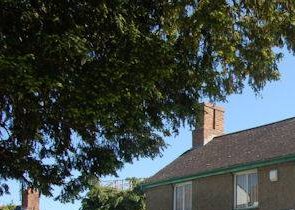
Part of the yew canopy, and the roof of Mike Rogers' shop
Saturday, 10 October 2015
Sunday Sermon
These are my words for this Sunday, based on Mark 10.17-31 :-
One way to catch a thieving monkey, so they say, is to put a tempting tit-bit like a bit of fruit inside a narrow-necked jar that’s just wide enough for the monkey to get his hand inside. You need to firmly secure the jar itself, maybe tie it to a tree. And what happens is the monkey puts his hand inside the jar to grab the goodies inside, but of course he can’t get his hand out unless he lets go of it. And he won’t let go, so you can sneak up on him and catch him, caught by his own greed.
Jesus said to his disciples, "It is easier for a camel to pass through the eye of a needle than for a rich man to enter the kingdom of God." Like the monkey, we find it very hard to let go of the goodies; we become trapped by our possessions. Things we possess begin instead to possess us, and things we think of as helping us control our own lives start instead to bring us under their control.
And yet what Jesus said would have seemed quite shocking to his disciples. It ran counter to what they'd probably heard before. Many Jews would have reckoned a man who was well off and doing all right to be finding favour with God; his wealth and success were proof that they way he lived must be pleasing to God. That, I think, is why the disciples said in amazement, 'Then who can be saved?'
Though there were some religious teachers among the Jews who encouraged their followers to renounce worldly wealth. John the Baptist for example, or the community that produced the Dead Sea Scrolls, the Essenes, who lived an austere monastic life in caves. Through the years of Christian history there’ve been teachers and preachers who’ve encouraged poverty, such as Francis of Assisi, whose feast day was a week or so ago. He recalled how Jesus had sent out his own disciples, telling them to take no possessions, no food, nothing for the road, and he set himself to do the same.
Francis of Assisi had in fact been born into serious wealth. He’d have expected to inherit all his father’s possessions, and his father was been a very wealthy merchant. But Francis took a dramatically different course in life. He took very seriously the words Jesus spoke to the rich young man about selling possessions, and giving to the poor; he threw away his affluent possessions, even the clothes he stood up in, and set himself to serve, as he said ‘Sister Poverty’, taking the open road to be a little brother to anyone in need. We call followers of Francis ‘Friars Minor’, which just means ‘Little Brothers’. In old age Francis received the stigmata, the marks of crucifixion in his hands and feet, as a tangible symbol of his deep devotion to his Lord. And yet he knew that none of it was ever enough; he was still a sinner in need of grace; in his poverty still at risk of being distracted by lesser loves from the one great love, the love of Christ.
If someone as saintly as Francis knew himself to be fatally flawed, what chance is there for the rest of us? Well, that was the point of what Jesus said to his disciples that day. The rich young man who’d come to him still thought he had to earn his own way into heaven. So Jesus told it to him straight - the only way to do that is to remove from your life anything that can possibly distract from complete and wholehearted service of God, to give away all the stuff that gets in the way.
One of the lessons I’ve had to learn as a minister is how to cope with the burden and pressure of failure. At the end of every week there’s still a load of stuff not finished, some of it not even started, lots of stuff I wanted to do, needed to do, but never quite found the energy or the time. There’s a temptation just to give up, and there’s a temptation to work myself into the ground. I need to know how to deal with that, and where to look for resourcing and support.
I know I’m not the only person to have an impossible job. I’ve known plenty of teachers and head-teachers at risk of going under. Farmers, too; even when you’re absolutely on top of all the routine tasks that have to be done, there’s probably some repair you never quite get round to, or some new development that never quite gets off the ground. And in fact just being a Christian discipleship is also impossible I find, if I’m taking discipleship as seriously as I should. I’m supposed to be Christ-like - so how am I really matching up?
Jesus said, “For mortals it is impossible, but all things are possible for God.” What makes the impossible possible is the thing Christians call grace, which is the forgiving, saving, healing and undeserved love of God. That’s the message Jesus wanted to get across to his disciples, and indeed to that rich young man. We don’t have to worry, or to be weighed down by a sense of our own failure. “All things are possible for God.” God in his love meets our weakness and makes it strong; he accepts our faltering attempts at service and makes out of them a worthy offering.
God forgives us when we fail, but he loves the fact that we try. For me it’s like when I try to speak the language when I’m on holiday abroad. I don't speak any other languages, but I’ll have a go at using the bits I can of French or German or Spanish; and I might make a mess of it, but people are often delighted that I’ve tried and not just stuck to English. They have respected my attempts at speaking their language and have met me in my incompleteness.
That’s what God does too, I think. When we’re doing our best to serve him he delights in that, even when we don’t always get it right. He’s glad to see us having a go. And when we do go wrong and mess up, when we turn to him and say sorry he is always gracious and forgiving. We may sometimes forget to love him, but he never stops loving us.
The rich young man was limited in his vision, and people still are today, and some of them are religious people. There’s the kind of religious zealot who is so sure of himself, so sure of his own perfection, keeping all the commandments and rituals and rules, that they can’t help but look down on the rest of us who don’t match up to that. There’s not much room for love and sharing in that sort of religion, and one of the great curses of our modern world is the sort of harsh, unloving and fundamentalist faith that divides and oppresses and does damage, when faith should surely be including and welcoming and healing.
And others who also lack vision give up on faith to put their trust in a different sort of success and status - in worldly wealth and power and status, maybe also in technology and science. Conspicuous over-consumption is another curse of our modern world, as the divide grows ever wider between rich and poor. Those who put their faith in worldly goods are as trapped and tied to the earth as that monkey who wouldn't let go of the titbit in the bottle, and with just such fatal results.
To all whose vision is limited we preach the God who loves failures, the God who loves us when we try even though we often fall short. Our own efforts can never win us a place in heaven, and we know it; and knowing that opens the way to a tolerant, welcoming and loving faith whose members will always want to include and encourage one another. It frees us also to take a healthy and wholesome attitude to the wealth we have. Riches and possessions can be a danger if we get fixated on them, hanging on like that monkey with its hand in the jar. But the things we own are ours to offer to God, and to use in his service. When we do as he desires with what he gives us, it’s then that his heart is pleased.
One way to catch a thieving monkey, so they say, is to put a tempting tit-bit like a bit of fruit inside a narrow-necked jar that’s just wide enough for the monkey to get his hand inside. You need to firmly secure the jar itself, maybe tie it to a tree. And what happens is the monkey puts his hand inside the jar to grab the goodies inside, but of course he can’t get his hand out unless he lets go of it. And he won’t let go, so you can sneak up on him and catch him, caught by his own greed.
Jesus said to his disciples, "It is easier for a camel to pass through the eye of a needle than for a rich man to enter the kingdom of God." Like the monkey, we find it very hard to let go of the goodies; we become trapped by our possessions. Things we possess begin instead to possess us, and things we think of as helping us control our own lives start instead to bring us under their control.
And yet what Jesus said would have seemed quite shocking to his disciples. It ran counter to what they'd probably heard before. Many Jews would have reckoned a man who was well off and doing all right to be finding favour with God; his wealth and success were proof that they way he lived must be pleasing to God. That, I think, is why the disciples said in amazement, 'Then who can be saved?'
Though there were some religious teachers among the Jews who encouraged their followers to renounce worldly wealth. John the Baptist for example, or the community that produced the Dead Sea Scrolls, the Essenes, who lived an austere monastic life in caves. Through the years of Christian history there’ve been teachers and preachers who’ve encouraged poverty, such as Francis of Assisi, whose feast day was a week or so ago. He recalled how Jesus had sent out his own disciples, telling them to take no possessions, no food, nothing for the road, and he set himself to do the same.
Francis of Assisi had in fact been born into serious wealth. He’d have expected to inherit all his father’s possessions, and his father was been a very wealthy merchant. But Francis took a dramatically different course in life. He took very seriously the words Jesus spoke to the rich young man about selling possessions, and giving to the poor; he threw away his affluent possessions, even the clothes he stood up in, and set himself to serve, as he said ‘Sister Poverty’, taking the open road to be a little brother to anyone in need. We call followers of Francis ‘Friars Minor’, which just means ‘Little Brothers’. In old age Francis received the stigmata, the marks of crucifixion in his hands and feet, as a tangible symbol of his deep devotion to his Lord. And yet he knew that none of it was ever enough; he was still a sinner in need of grace; in his poverty still at risk of being distracted by lesser loves from the one great love, the love of Christ.
If someone as saintly as Francis knew himself to be fatally flawed, what chance is there for the rest of us? Well, that was the point of what Jesus said to his disciples that day. The rich young man who’d come to him still thought he had to earn his own way into heaven. So Jesus told it to him straight - the only way to do that is to remove from your life anything that can possibly distract from complete and wholehearted service of God, to give away all the stuff that gets in the way.
One of the lessons I’ve had to learn as a minister is how to cope with the burden and pressure of failure. At the end of every week there’s still a load of stuff not finished, some of it not even started, lots of stuff I wanted to do, needed to do, but never quite found the energy or the time. There’s a temptation just to give up, and there’s a temptation to work myself into the ground. I need to know how to deal with that, and where to look for resourcing and support.
I know I’m not the only person to have an impossible job. I’ve known plenty of teachers and head-teachers at risk of going under. Farmers, too; even when you’re absolutely on top of all the routine tasks that have to be done, there’s probably some repair you never quite get round to, or some new development that never quite gets off the ground. And in fact just being a Christian discipleship is also impossible I find, if I’m taking discipleship as seriously as I should. I’m supposed to be Christ-like - so how am I really matching up?
Jesus said, “For mortals it is impossible, but all things are possible for God.” What makes the impossible possible is the thing Christians call grace, which is the forgiving, saving, healing and undeserved love of God. That’s the message Jesus wanted to get across to his disciples, and indeed to that rich young man. We don’t have to worry, or to be weighed down by a sense of our own failure. “All things are possible for God.” God in his love meets our weakness and makes it strong; he accepts our faltering attempts at service and makes out of them a worthy offering.
God forgives us when we fail, but he loves the fact that we try. For me it’s like when I try to speak the language when I’m on holiday abroad. I don't speak any other languages, but I’ll have a go at using the bits I can of French or German or Spanish; and I might make a mess of it, but people are often delighted that I’ve tried and not just stuck to English. They have respected my attempts at speaking their language and have met me in my incompleteness.
That’s what God does too, I think. When we’re doing our best to serve him he delights in that, even when we don’t always get it right. He’s glad to see us having a go. And when we do go wrong and mess up, when we turn to him and say sorry he is always gracious and forgiving. We may sometimes forget to love him, but he never stops loving us.
The rich young man was limited in his vision, and people still are today, and some of them are religious people. There’s the kind of religious zealot who is so sure of himself, so sure of his own perfection, keeping all the commandments and rituals and rules, that they can’t help but look down on the rest of us who don’t match up to that. There’s not much room for love and sharing in that sort of religion, and one of the great curses of our modern world is the sort of harsh, unloving and fundamentalist faith that divides and oppresses and does damage, when faith should surely be including and welcoming and healing.
And others who also lack vision give up on faith to put their trust in a different sort of success and status - in worldly wealth and power and status, maybe also in technology and science. Conspicuous over-consumption is another curse of our modern world, as the divide grows ever wider between rich and poor. Those who put their faith in worldly goods are as trapped and tied to the earth as that monkey who wouldn't let go of the titbit in the bottle, and with just such fatal results.
To all whose vision is limited we preach the God who loves failures, the God who loves us when we try even though we often fall short. Our own efforts can never win us a place in heaven, and we know it; and knowing that opens the way to a tolerant, welcoming and loving faith whose members will always want to include and encourage one another. It frees us also to take a healthy and wholesome attitude to the wealth we have. Riches and possessions can be a danger if we get fixated on them, hanging on like that monkey with its hand in the jar. But the things we own are ours to offer to God, and to use in his service. When we do as he desires with what he gives us, it’s then that his heart is pleased.
Friday, 9 October 2015
Light Beyond Shadow
A first draft of a poem:
We sang our Taize, and the small candles around us
flickered into the mist-dark of the medieval nave.
Where we sang, great pillars soared upwards
to disappear into arches of black velvet. And I felt
how the uncertain light of our candles
had made the great church both smaller and larger;
our little patch of light became a room,
a simple choral cell in which to sit,
we holy few, come together to sing
only for ourselves and for our God;
while beyond our candles the dark
had become a vast and cavernous chamber,
our few lit pillars just the small beginning
of an endless colonnade; and the starless roof above us
had been raised as high as any stars could fly.
We are afraid in the dark, and
perhaps we are afraid of the dark, for
only our small pool of light is safe and known,
this little space that we call life,
in which the old shapeless primeval dark
is pushed back a little way, and for a little while,
for a moment in time before the great tide of
darkness
rolls back in. Our little light is itself defined
by shadow, threatened by shadow too.
But I shall continue to believe
and to sing of the light without shadow,
light beyond shadow, love beyond fear,
light that is there in those dark places, and
has already conquered them. And if
as yet we do not see it, the fault is
in our own sight, not in the light.
Sometimes, perhaps, our singing may touch it,
or open the way for that light to touch us,
to flame in our hearts. And this I believed
that night: the one and true light
is unquenchable and is all-conquering,
and in him there can be no darkness at all.
Monday, 5 October 2015
Tired
After a few very busy days, this is a very tired me writing this! But it's a good sort of tiredness, I've been doing things I enjoy with people I enjoy being with. Harvest services, singing events, and some more sombre tasks . . . and a good portion of the autumn garden clear-up. Tomorrow I head for London and a day out with my son, which will be great I know, despite the forecast rain. Tonight I shall sleep well, and feel happy to have done well these last few days.
Amongst everything else, I have put together a collection of one hundred poems, which will be published as soon as I've got it all set up. Time to write some new ones, too, perhaps? But not tonight, I'm far too tired!
Amongst everything else, I have put together a collection of one hundred poems, which will be published as soon as I've got it all set up. Time to write some new ones, too, perhaps? But not tonight, I'm far too tired!
Saturday, 3 October 2015
Writing
I've bought quite a few books of poetry over recent weeks, from good and sometimes challenging writers. Overall the standard has been high; I hope what I write can match up to that. Often getting the first two or three words down is the most important thing. I may not know at that point what I want to say, but once you force yourself to start, something flows. Some of my poems are almost the finished article when first written - stream of consciousness stuff, I suppose; others will take years of work before I'm happy. None of them are ever finished; there just comes a time when I have to set down my pen, or these days more usually lift my fingers from the keyboard - the discipline to leave it at that. In any case, no poem is completed until read, what I write is never just mine, I have to take the risk of sharing.
Our sunny bit of Michaelmas summer continues, but not for much longer I fear. I've stained and prepared most of our exterior woodwork (of which we have a great deal) before the rigours of winter. We have a few tomatoes left, but the plum tomatoes have all rotted on the vine for some reason. Things are winding down, and there'll be some cutting back and clearing to be done later on today. We've had a wonderful display of Japanese anemones, though - I'm pleased, because when I previously tried them they wouldn't grow for me (annoying, since two gardens away they were as rampant as weeds!).
This week my Permission to Officiate (PTO) in Hereford Diocese arrived. I've been officiating, with the Bishop's blessing, for several months, but it feels good to have the right piece of paper at last.
Our sunny bit of Michaelmas summer continues, but not for much longer I fear. I've stained and prepared most of our exterior woodwork (of which we have a great deal) before the rigours of winter. We have a few tomatoes left, but the plum tomatoes have all rotted on the vine for some reason. Things are winding down, and there'll be some cutting back and clearing to be done later on today. We've had a wonderful display of Japanese anemones, though - I'm pleased, because when I previously tried them they wouldn't grow for me (annoying, since two gardens away they were as rampant as weeds!).
This week my Permission to Officiate (PTO) in Hereford Diocese arrived. I've been officiating, with the Bishop's blessing, for several months, but it feels good to have the right piece of paper at last.
Thursday, 1 October 2015
-
Today has been a good day - sunny weather, a very interesting spirituality study day with Adrian Scott, a poet from Sheffield, whose own poems (and works by Dylan Thomas) were thought provoking and stimulating . . . plus too much chocolate brownie (but then again, can you have too much chocolate brownie). An enjoyable drive home, then harvest festival at New Street United Church, Welshpool, with musical contributions from the marvellous Bordermen. And a pleasant interlude afterwards at the King's Head, Guilsfield. A day for decisions, too - the right ones, I think.
Wednesday, 9 September 2015
Dust
Another poem in progress . . .
Everywhere is dust coloured,
everywhere is dust; swirls and eddies of wind
whirl it about, while shoes, for those who have them,
are outside quickly covered, and half filled inside.
Even the fabric of the rough tents
is more dust than cotton.
There is nothing green here. No tree grows,
no blade of grass, even. This was supposed to be
a transit camp, a pause along the way,
time to take stock, to plan the next step.
It does not feel like that now,
after so many days, so many dusty days.
There are no facilitators,
no manufacturers of passports and promises and hope.
They have gone. It is a common enough mistake:
having been paid up front, they are no doubt
repeating the exercise with a new crop
of wide-eyed and desperate pilgrims.
There is food, at least; not a lot, but enough.
It comes as a bargaining counter, or maybe a subtle threat:
we will feed you so long as you stay here,
and do not cross any further oceans,
or beg at our doors, or sleep in our streets.
This is as far as you get.
If you want to eat, this is as far as you get;
if you want your children to eat.
So the food comes dusted with condescending compassion,
carefully measured out, a ration of grudging kindness.
But we do not want compassion, but just to live,
free from fear, and not left to turn into dust.
Everywhere is dust coloured,
everywhere is dust; swirls and eddies of wind
whirl it about, while shoes, for those who have them,
are outside quickly covered, and half filled inside.
Even the fabric of the rough tents
is more dust than cotton.
There is nothing green here. No tree grows,
no blade of grass, even. This was supposed to be
a transit camp, a pause along the way,
time to take stock, to plan the next step.
It does not feel like that now,
after so many days, so many dusty days.
There are no facilitators,
no manufacturers of passports and promises and hope.
They have gone. It is a common enough mistake:
having been paid up front, they are no doubt
repeating the exercise with a new crop
of wide-eyed and desperate pilgrims.
There is food, at least; not a lot, but enough.
It comes as a bargaining counter, or maybe a subtle threat:
we will feed you so long as you stay here,
and do not cross any further oceans,
or beg at our doors, or sleep in our streets.
This is as far as you get.
If you want to eat, this is as far as you get;
if you want your children to eat.
So the food comes dusted with condescending compassion,
carefully measured out, a ration of grudging kindness.
But we do not want compassion, but just to live,
free from fear, and not left to turn into dust.
Together
(Poem now nearing completion, I think)
This road we’ve walked together,
winding westward to the sea, gulls calling from the cliffs,
and a sky streaked with red and gold,
sign and promise of a fine day to come. We see
this evening's first lights appear in distant windows,
as moths ghost their way along the hedgebanks,
meadowsweet and honeysuckle scent the air,
and bats flitter between the trees. This has been a good day,
a good walk and time together,
for all there’s been a wrong turning or two along the way.
And now we can see the lamps along the harbour wall,
and riding lights flicker on the night boats
as they rise on a new tide. And so it is:
day's end, walk's end, a rest to come,
still together, and there are new things yet to see, new songs to sing,
while the promise nestles safe within our hearts
of a new day's alleluia at our next awakening.
This road we’ve walked together,
winding westward to the sea, gulls calling from the cliffs,
and a sky streaked with red and gold,
sign and promise of a fine day to come. We see
this evening's first lights appear in distant windows,
as moths ghost their way along the hedgebanks,
meadowsweet and honeysuckle scent the air,
and bats flitter between the trees. This has been a good day,
a good walk and time together,
for all there’s been a wrong turning or two along the way.
And now we can see the lamps along the harbour wall,
and riding lights flicker on the night boats
as they rise on a new tide. And so it is:
day's end, walk's end, a rest to come,
still together, and there are new things yet to see, new songs to sing,
while the promise nestles safe within our hearts
of a new day's alleluia at our next awakening.
Sunday, 6 September 2015
Together
A road walked together,
westward to the sea, the gulls calling from the cliffs,
sky streaked with red and gold, sign of a good day to come.
This evening's first lights appear,
moths ghost their way along the hedgebanks,
bats fly between the trees. It has been a good day,
a good walk, despite a wrong turning or two.
We can see now the lights along the harbour wall,
the riding lights on the boats, rising on the new tide.
Day's end, walk's end, a rest to come:
still together, still with new things to see, new songs to sing,
a new day's alleluia at our awakening.
(First draft, 6th September)
westward to the sea, the gulls calling from the cliffs,
sky streaked with red and gold, sign of a good day to come.
This evening's first lights appear,
moths ghost their way along the hedgebanks,
bats fly between the trees. It has been a good day,
a good walk, despite a wrong turning or two.
We can see now the lights along the harbour wall,
the riding lights on the boats, rising on the new tide.
Day's end, walk's end, a rest to come:
still together, still with new things to see, new songs to sing,
a new day's alleluia at our awakening.
(First draft, 6th September)
Wednesday, 2 September 2015
Sticklebacks
I remember: jam jars on strings,
holiday fishing nets, days when time stood still.
Wading through the dusty field of tussock grass
to the splashy brook that meandered through.
And that pool on a bend in the stream,
where the flow of the water slowed: it was ours,
made by us from clods and stones
collected for a dam - and how it crawled
with shrimps and water-fleas,
beetles and boatmen and little snails,
froglets sometimes, and the minnows
and sticklebacks that were our chosen quest.
We were not far from the town: familiar noises linger in my mind:
a rumble of traffic from the main road,
steam whistles from the shunting yards, the steady hum
of the English Electric works.
But this was our bit of country - I remember
the time we saw a kestrel drop down to catch a vole,
the shrew that dashed out in front of my scooter
(I crashed it and lost a wheel);
and always the fine golden sun ruling the sky,
and always the hours and hours we had till tea.
But the sticklebacks were our delight -
we caught them and brought them home
to stay a night with us, silver fish in silver jars,
protected from cats behind a cardboard screen
in a corner of our back yard. And I’m sure that next day
we must have taken them back to the brook,
or maybe it was Dad who did it.
For by then we children had a new quest:
hunting for fat hairy caterpillars. In the same jars,
emptied of water and stuffed with miscellaneous leaves,
with kitchen-scissored holes in the black lids,
they would pupate, to emerge as bright tiger moths
before the long days ended of our childhood holidays
under that bright and glorious and forever sun.
holiday fishing nets, days when time stood still.
Wading through the dusty field of tussock grass
to the splashy brook that meandered through.
And that pool on a bend in the stream,
where the flow of the water slowed: it was ours,
made by us from clods and stones
collected for a dam - and how it crawled
with shrimps and water-fleas,
beetles and boatmen and little snails,
froglets sometimes, and the minnows
and sticklebacks that were our chosen quest.
We were not far from the town: familiar noises linger in my mind:
a rumble of traffic from the main road,
steam whistles from the shunting yards, the steady hum
of the English Electric works.
But this was our bit of country - I remember
the time we saw a kestrel drop down to catch a vole,
the shrew that dashed out in front of my scooter
(I crashed it and lost a wheel);
and always the fine golden sun ruling the sky,
and always the hours and hours we had till tea.
But the sticklebacks were our delight -
we caught them and brought them home
to stay a night with us, silver fish in silver jars,
protected from cats behind a cardboard screen
in a corner of our back yard. And I’m sure that next day
we must have taken them back to the brook,
or maybe it was Dad who did it.
For by then we children had a new quest:
hunting for fat hairy caterpillars. In the same jars,
emptied of water and stuffed with miscellaneous leaves,
with kitchen-scissored holes in the black lids,
they would pupate, to emerge as bright tiger moths
before the long days ended of our childhood holidays
under that bright and glorious and forever sun.
Wednesday, 26 August 2015
Insects that bite and sting . . .
. . . my "Nature Notes" article for the month ahead :-
We were sitting outside in the sunshine with a glass or two the other day when a particularly persistent wasp decided to spoil the party. We are surrounded by millions of insects, and some of them can be a bit of a pain.
Wasps and hornets are probably the more feared than most British insects, and some people can have extreme allergic reactions to their stings. Hornets, though larger than wasps and with a nastier sting, are much less aggressive than smaller wasps and are really no trouble provided you keep your distance. Other insects can be confused with hornets, such as queen wasps and some quite harmless insects like the giant wood wasp (stingless) or the hornet clearwing moth. At this time of the year wasps have less work to do and lots of sweet stuff to binge on - hence they start to be more troublesome. Our instinctive reaction is to try to bat them away; I do it, but it’s never a good idea - it only makes them cross and all the more more likely to sting. If you do get stung and start to feel faint, out of breath or your skin begins to swell up, seek immediate medical attention.
Like wasps, bees will sting when they feel threatened, and we can be allergic to their stings too. Bee and wasp venoms are quite different from each other. Ants can also be venomous; ant poison is administered via a bite, but most British ants don’t have high toxin levels, and won’t cause much damage. Ant and bee stings are acid, and I recall we used to treat them with washing blue; wasp stings are alkaline, and can be eased with a bit of vinegar. The little black garden ants don’t bite.
Horseflies are my number one hate. Bees, wasps and ants bite or sting if threatened, but horseflies really are out to get you, and some can be very persistent. In my experience, there are those that sneak up on you, and you don’t know they are there until they have bitten you, but even nastier are the big black horseflies that have a loud and very annoying buzz and just seem to want to terrify you into submission (maybe that makes the blood flow more freely). Horseflies are in fact placid vegetarians most of the time, but the female, as with mosquitoes, needs mammalian blood before she can lay her eggs. They cause damage by ripping the skin so that blood flows freely, which they then lap up. The wound is very painful, can easily become infected, and horseflies can also carry a number of diseases. It’s important to treat wounds with antiseptic wipes, and keep them free from dirt.
Midges and mosquitoes are a nuisance rather than a danger in the UK, though of course mosquitoes spread malaria and other dangerous diseases elsewhere in the world. Mozzies are more active in the early morning and the evening than at other times - cover up, and use over-the-counter repellants. Then there are ticks - but they’re not actually insects, so I’ll leave them for another time!
We were sitting outside in the sunshine with a glass or two the other day when a particularly persistent wasp decided to spoil the party. We are surrounded by millions of insects, and some of them can be a bit of a pain.
Wasps and hornets are probably the more feared than most British insects, and some people can have extreme allergic reactions to their stings. Hornets, though larger than wasps and with a nastier sting, are much less aggressive than smaller wasps and are really no trouble provided you keep your distance. Other insects can be confused with hornets, such as queen wasps and some quite harmless insects like the giant wood wasp (stingless) or the hornet clearwing moth. At this time of the year wasps have less work to do and lots of sweet stuff to binge on - hence they start to be more troublesome. Our instinctive reaction is to try to bat them away; I do it, but it’s never a good idea - it only makes them cross and all the more more likely to sting. If you do get stung and start to feel faint, out of breath or your skin begins to swell up, seek immediate medical attention.
Like wasps, bees will sting when they feel threatened, and we can be allergic to their stings too. Bee and wasp venoms are quite different from each other. Ants can also be venomous; ant poison is administered via a bite, but most British ants don’t have high toxin levels, and won’t cause much damage. Ant and bee stings are acid, and I recall we used to treat them with washing blue; wasp stings are alkaline, and can be eased with a bit of vinegar. The little black garden ants don’t bite.
Horseflies are my number one hate. Bees, wasps and ants bite or sting if threatened, but horseflies really are out to get you, and some can be very persistent. In my experience, there are those that sneak up on you, and you don’t know they are there until they have bitten you, but even nastier are the big black horseflies that have a loud and very annoying buzz and just seem to want to terrify you into submission (maybe that makes the blood flow more freely). Horseflies are in fact placid vegetarians most of the time, but the female, as with mosquitoes, needs mammalian blood before she can lay her eggs. They cause damage by ripping the skin so that blood flows freely, which they then lap up. The wound is very painful, can easily become infected, and horseflies can also carry a number of diseases. It’s important to treat wounds with antiseptic wipes, and keep them free from dirt.
Midges and mosquitoes are a nuisance rather than a danger in the UK, though of course mosquitoes spread malaria and other dangerous diseases elsewhere in the world. Mozzies are more active in the early morning and the evening than at other times - cover up, and use over-the-counter repellants. Then there are ticks - but they’re not actually insects, so I’ll leave them for another time!
Saturday, 22 August 2015

Sermon for tomorrow
. . . to be preached at Marton, Llanymynech and Corndon Marsh. Text (RCL) Ephesians 6.10-20 and John 6.56-69.
A sentence struck me as I was reading through the scriptures for today, and it was this: “From that moment many of his disciples drew back and no longer went about with him.” I wonder what provoked that? What was going through the minds of those people who had followed Jesus but now fell away?
I didn’t register for the Labour party leadership election. I was slightly tempted. I’m very much a floating voter, but now and again I have voted Labour. Mr Jeremy Corbyn, though not as far as I know a religious man, is in a way the most messianic of the candidates. I can see why he’s become the front runner, and why he seems to be gathering support from young and idealistic party members and supporters, however damaging it all might be to Labour’s electoral chances.
I reckon Jesus attracted people like that: idealists, who liked the sound of this new world, this Kingdom he talked about. But how do you get there? Some of his folowers were realising that this man was making some powerful enemies. What he said sounded good, but the road was looking less like a triumphal procession than a collision course. It’s all very well to say that the meek shall inherit the earth, but what if the other guys don’t agree?
Jesus even offered his closest companions a chance to take the exit door. “Do you also want to leave?” he asks them - and I think what he was meaning was something like “You can leave too if that’s what you want. I shan’t hold it against you.” It’s Peter who speaks up of course, but he speaks for them all: “Where else can we go? To whom else can we turn? You speak the words of life.”
People were beginning to walk out on Jesus because he was saying things that sounded a bit weird, and they were beginning to think that this might not be such an easy ride. You have to aim pretty high to keep up with this man: people prefer to be comfortable, and this was starting to look as if it might not be. The Twelve must have been as shocked as everyone else at some of the things Jesus said - what did he mean by it? But they stayed with him because, as Peter sort of said, “We may not understand everything you’re saying to us, but we know what you are, we know you’re God’s man.”
By the time Paul wrote his Letter to the Ephesians he knew very well that to follow Jesus wasn’t an easy road. He’d had his own share of beatings and imprisonment, and he speaks of himself as “an ambassador in chains.” He begins the last chapter of his letter to the Ephesians by telling them to find their strength in the Lord, and follows that with those amazing words that compare what they’ll need for the fight with the armour worn by a Roman soldier. And that’s a good comparison: there were no soldiers in the ancient world better prepared and protected than the army of Rome.
I’ll say a bit more about that armour in a moment, but first a question I ask myself on a regular basis: how committed am I, really? How far would I go, how much would I face, to follow my Lord? How good am I at dealing with the stuff that tempts me away from where I should be and what I should be doing? Don’t I drift from the path and lose my way all too easily, again and again? And does Jesus even want me, after all this time, and after all this failure?
It seems to me that the devil’s very good at persuading people they’re not good enough, they can never be good enough, so they may as well give up trying. Even so-called saints have feet of clay really, he tells us. So give up, and enjoy yourselves instead.
Paul came across plenty of human opposition in his ministry, but that isn’t what he’s writing about in the words we’ve heard to the Ephesians. He speaks to them about the wiles, the stratagems of the devil, saying “Our struggle is not against human foes, but against the elemental forces of the universe.” Just as mine is today, and yours.
One of the reasons why the Roman army was so effective was that they had excellent defensive armour. The great shield especially, when raised up and employed properly left pretty much no way through for the enemy. Use the armour God gives you, says Paul to the Ephesians, and he says it to us too.
What does this armour consist of? Paul talks about truth, integrity, peace: in other words, not just looking good on the outside, but being true at heart; and then he speaks of the great shield, which is the shield of faith, along with the helmet of salvation. Those disciples who faded away when it looked as though the going might get tough lacked faith; unlike the Twelve, they couldn’t bring themselves to be sure of Jesus. And we have the helmet of salvation. The conflict may continue, but the decisive battle has already been won. And though we may sometimes fail, and stray, and let our Lord down - as did every one of the Twelve at some point - we’re not excluded by that, that doesn’t mean we’re not good enough. Jesus has made us good enough, he has given us a share in his victory. Through him we have access to the Father, despite ourselves. In him we find a love that will never let us down; the journey we make with him, though sometimes the road may be hard, is our journey home. As Jesus says in John chapter 14: “In my Father’s house there are many rooms. I am going to prepare a place for you.”
With this promise in mind, I can resist the temptation to give up and to stop believing. Or I should be able to. In fact I’m not always good at keeping my armour up to scratch, and sometimes that armour doesn’t work as well as it should. We keep our armour in good trim by coming regularly to our Lord’s table, and between those times by being disciplined in our praying, our reading of the Bible, and the way we seek Jesus out and choose to spend time with him. We need to do this, just as the Roman soldier needed to work hard on his armour to keep it up to scratch. If he didn’t, he’d be a weak link in the wall of shields that presented such an impregnable defence against any opposing force.
“Seven days without prayer make one weak (w-e-A-k).” I recall seeing that on a church notice board, and it’s right. Paul tells the Ephesians to “constantly ask God’s help in prayer, and pray always in the power of the Spirit.” And to be watchful, and attentive, for what we face is rarely a full-on attack, it’s more subtle than that, more persuasive, cleverer. So we need to be on our guard.
Finally, Paul adds to all this defensive armour the one weapon he talks about, which is the sword: the sword the Spirit gives you, he says, which is the word of God. So is this a soldier taking cover and cowering behind his shield? No it’s not: Paul reminds us that we’ve a job to do and a word to speak, and that God has sent his Spirit to help us do it. The Roman soldier knew when to take cover and when to break out of cover, and take the initiative. And though sometimes all I can do is to hold on, faith requires me to do more: to live for Jesus, to work for Jesus, to strive for Jesus. So I pray: Grant me shelter and refuge when I need it, Lord, but then show me how I can be an active witness to your love - and may your Church be a bright light in every dark place, shining your love into needy and broken lives. Amen.
A sentence struck me as I was reading through the scriptures for today, and it was this: “From that moment many of his disciples drew back and no longer went about with him.” I wonder what provoked that? What was going through the minds of those people who had followed Jesus but now fell away?
I didn’t register for the Labour party leadership election. I was slightly tempted. I’m very much a floating voter, but now and again I have voted Labour. Mr Jeremy Corbyn, though not as far as I know a religious man, is in a way the most messianic of the candidates. I can see why he’s become the front runner, and why he seems to be gathering support from young and idealistic party members and supporters, however damaging it all might be to Labour’s electoral chances.
I reckon Jesus attracted people like that: idealists, who liked the sound of this new world, this Kingdom he talked about. But how do you get there? Some of his folowers were realising that this man was making some powerful enemies. What he said sounded good, but the road was looking less like a triumphal procession than a collision course. It’s all very well to say that the meek shall inherit the earth, but what if the other guys don’t agree?
Jesus even offered his closest companions a chance to take the exit door. “Do you also want to leave?” he asks them - and I think what he was meaning was something like “You can leave too if that’s what you want. I shan’t hold it against you.” It’s Peter who speaks up of course, but he speaks for them all: “Where else can we go? To whom else can we turn? You speak the words of life.”
People were beginning to walk out on Jesus because he was saying things that sounded a bit weird, and they were beginning to think that this might not be such an easy ride. You have to aim pretty high to keep up with this man: people prefer to be comfortable, and this was starting to look as if it might not be. The Twelve must have been as shocked as everyone else at some of the things Jesus said - what did he mean by it? But they stayed with him because, as Peter sort of said, “We may not understand everything you’re saying to us, but we know what you are, we know you’re God’s man.”
By the time Paul wrote his Letter to the Ephesians he knew very well that to follow Jesus wasn’t an easy road. He’d had his own share of beatings and imprisonment, and he speaks of himself as “an ambassador in chains.” He begins the last chapter of his letter to the Ephesians by telling them to find their strength in the Lord, and follows that with those amazing words that compare what they’ll need for the fight with the armour worn by a Roman soldier. And that’s a good comparison: there were no soldiers in the ancient world better prepared and protected than the army of Rome.
I’ll say a bit more about that armour in a moment, but first a question I ask myself on a regular basis: how committed am I, really? How far would I go, how much would I face, to follow my Lord? How good am I at dealing with the stuff that tempts me away from where I should be and what I should be doing? Don’t I drift from the path and lose my way all too easily, again and again? And does Jesus even want me, after all this time, and after all this failure?
It seems to me that the devil’s very good at persuading people they’re not good enough, they can never be good enough, so they may as well give up trying. Even so-called saints have feet of clay really, he tells us. So give up, and enjoy yourselves instead.
Paul came across plenty of human opposition in his ministry, but that isn’t what he’s writing about in the words we’ve heard to the Ephesians. He speaks to them about the wiles, the stratagems of the devil, saying “Our struggle is not against human foes, but against the elemental forces of the universe.” Just as mine is today, and yours.
One of the reasons why the Roman army was so effective was that they had excellent defensive armour. The great shield especially, when raised up and employed properly left pretty much no way through for the enemy. Use the armour God gives you, says Paul to the Ephesians, and he says it to us too.
What does this armour consist of? Paul talks about truth, integrity, peace: in other words, not just looking good on the outside, but being true at heart; and then he speaks of the great shield, which is the shield of faith, along with the helmet of salvation. Those disciples who faded away when it looked as though the going might get tough lacked faith; unlike the Twelve, they couldn’t bring themselves to be sure of Jesus. And we have the helmet of salvation. The conflict may continue, but the decisive battle has already been won. And though we may sometimes fail, and stray, and let our Lord down - as did every one of the Twelve at some point - we’re not excluded by that, that doesn’t mean we’re not good enough. Jesus has made us good enough, he has given us a share in his victory. Through him we have access to the Father, despite ourselves. In him we find a love that will never let us down; the journey we make with him, though sometimes the road may be hard, is our journey home. As Jesus says in John chapter 14: “In my Father’s house there are many rooms. I am going to prepare a place for you.”
With this promise in mind, I can resist the temptation to give up and to stop believing. Or I should be able to. In fact I’m not always good at keeping my armour up to scratch, and sometimes that armour doesn’t work as well as it should. We keep our armour in good trim by coming regularly to our Lord’s table, and between those times by being disciplined in our praying, our reading of the Bible, and the way we seek Jesus out and choose to spend time with him. We need to do this, just as the Roman soldier needed to work hard on his armour to keep it up to scratch. If he didn’t, he’d be a weak link in the wall of shields that presented such an impregnable defence against any opposing force.
“Seven days without prayer make one weak (w-e-A-k).” I recall seeing that on a church notice board, and it’s right. Paul tells the Ephesians to “constantly ask God’s help in prayer, and pray always in the power of the Spirit.” And to be watchful, and attentive, for what we face is rarely a full-on attack, it’s more subtle than that, more persuasive, cleverer. So we need to be on our guard.
Finally, Paul adds to all this defensive armour the one weapon he talks about, which is the sword: the sword the Spirit gives you, he says, which is the word of God. So is this a soldier taking cover and cowering behind his shield? No it’s not: Paul reminds us that we’ve a job to do and a word to speak, and that God has sent his Spirit to help us do it. The Roman soldier knew when to take cover and when to break out of cover, and take the initiative. And though sometimes all I can do is to hold on, faith requires me to do more: to live for Jesus, to work for Jesus, to strive for Jesus. So I pray: Grant me shelter and refuge when I need it, Lord, but then show me how I can be an active witness to your love - and may your Church be a bright light in every dark place, shining your love into needy and broken lives. Amen.
Monday, 3 August 2015
Retreat: first morning
Another first draft . . .
As I look out through the leaded panes
of the seaward window of my room or, maybe, cell,
a pale sun filters through the leafless branches
of the clifftop trees; early morning, low tide,
with oystercatchers and turnstones prospecting the shoreline,
the sudden black and white of their flurried wings.
Sheltered by gothic walls, I am where I need to be,
though not entirely from choice. I am here
because I will have things to do, and need to be prepared,
or maybe because God has things to do with me,
in the interplay of trying and being tried
to which we give the title ‘retreat’.
This is my week’s shelter from the world, yet not a place to hide
nor any admission of defeat. I am here
to confront in me what needs to change
and to confirm what needs to grow;
I am here because it is right to be here,
where the tide runs softly over the pebbled sand,
while the sun lifts over the winter trees
to lose itself as a smear of brightness in the soft clouding
of this new day. I am here because of the love
that has claimed me and will not leave me, here
to slow things down to the tempo of my own heart,
and to align myself to the peaceful rhythm
of the praise and prayer of this house.
And I am here because of where I shall be next,
to know here the close-breathing presence of my Lord
that I may know him too where he will be, there.
The chapel bell rings softly, half-hidden behind the calls
of curlew and gull; on this silvered morning
my healing time begins.
As I look out through the leaded panes
of the seaward window of my room or, maybe, cell,
a pale sun filters through the leafless branches
of the clifftop trees; early morning, low tide,
with oystercatchers and turnstones prospecting the shoreline,
the sudden black and white of their flurried wings.
Sheltered by gothic walls, I am where I need to be,
though not entirely from choice. I am here
because I will have things to do, and need to be prepared,
or maybe because God has things to do with me,
in the interplay of trying and being tried
to which we give the title ‘retreat’.
This is my week’s shelter from the world, yet not a place to hide
nor any admission of defeat. I am here
to confront in me what needs to change
and to confirm what needs to grow;
I am here because it is right to be here,
where the tide runs softly over the pebbled sand,
while the sun lifts over the winter trees
to lose itself as a smear of brightness in the soft clouding
of this new day. I am here because of the love
that has claimed me and will not leave me, here
to slow things down to the tempo of my own heart,
and to align myself to the peaceful rhythm
of the praise and prayer of this house.
And I am here because of where I shall be next,
to know here the close-breathing presence of my Lord
that I may know him too where he will be, there.
The chapel bell rings softly, half-hidden behind the calls
of curlew and gull; on this silvered morning
my healing time begins.
Saturday, 1 August 2015
A Sermon for Tomorrow
Preached on the set readings, viz Exodus 16.2-4, 9-26; Ephesians 4.1-16, John 6.24-35
“Are we nearly there yet?” Yes, it’s the summer holidays, and dads and mums up and down the country will be listening to variations on that question from the back seat as they head off on holiday or out for a day trip. I remember it well from when my kids were young; we used to try and head it off with I-spy games, spotting interesting pub signs, or things like first to see three mums pushing push chairs. These days kids can listen to their ipods, watch Peppa Pig on video, or play computer games on their tablets or smart phones. Not that it seems to make much difference - it’s still boring in the back of the car, and it still takes just as long.
At least we usually made sure we brought enough to eat with us. Not always - once we left a fully packed cool box with sandwiches and sausage rolls and cakes back at home. It wasn’t very cool or fresh inside that box two weeks later when we got back. But mostly we could shut the kids up for a bit with a bun or a packet of crisps, even if it did sometimes leave us with a major job clearing out the car once we’d got to where we were going. In our Old Testament reading the people of Israel had run out of food. They were miserable and hungry, and the promised land was still only a promise - and they were having to walk there. Moses and Aaron were beginning to get a little worried at the rebellious mood of the people.
But the Lord was on the case, to send quails and also manna, and at the same time to test the people and make sure they recognised who was giving them this food, food to be accepted as a gift and therefore harvested and used daily as the Lord commanded, not hoarded or treated as though it were the fruit of their own labours. This is true, isn’t it, of any present, that the giver is honoured in the way we use the gift. And that’s certainly true of God’s gifts to us - and he has greater gifts to bestow than the manna that saved his people in the wilderness.
Manna was a temporary fix, no more. It was given for as long as the people needed it. But it got them through, and it was long remembered. “Our forefathers were given manna in the wilderness,” said the people to Jesus. “That’s what Moses did for them. What are you going to give us? What can you give us, that’s as good as that?” “You’re mistaken if you think the manna came from Moses,” Jesus tells them. “It came from God, and now God has new bread to give you, bread that will last forever, the true bread of life.” “Give us this bread,” the people plead, “give it to us now and always!”
That sounds like a great prayer to make, but in John’s Gospel people are often found thinking in purely physical terms when Jesus is speaking of the spirit. People have just been fed in the wilderness, five thousand men plus whoever else was with them, women and children: enough for all and twelve baskets left over. Now the crowd want more of the same. But what Jesus is really offering is a different kind of bread altogether. He offers himself, a spiritual bread for the life and health of the world. A gift to be received and used in a way that truly honours the giver.
Before I think a little more about that, let me spend a moment or two reflecting on the verses we heard from Paul’s letter to the Ephesians - Paul’s writing there about receiving and using God’s gifts in a way that truly honours the giver. He says, “Each of us has been given some special gift, some special share in the bounty of Christ.” Our gifts are different and complementary; they enable us to build one another up; the gifts we’re given are facets of the nature of Christ, so when we use them as we should we ourselves become in some way Christ-like, and the whole body becomes all the more fully what we are called to be - the body of Christ - as we exercise these gifts in supporting one another and serving the community around us.
Paul speaks about “attaining the unity inherent in our faith” and “being measured by nothing less than the full stature of Christ.” If we use well the gifts we’re given our fellowship will be enhanced and enriched, and made (in the modern jargon) fit for purpose. That’s promise and challenge for the Church, just as the manna in the wilderness was both promise and challenge to the Israelites under Moses. Promise and gift given freely, the outworking of God’s love, not earned or merited - given because God claims us as his own. Challenge, because to use well what God gives us requires discipline and obedience; his gifts must be used according to the mind of the giver. As the body of Christ is built (quote) “the whole frame grows through the proper functioning of each part, and builds itself up in love.”
The people had asked Jesus “What must we do to merit God’s gifts and favour?” Jesus replied that the work God requires is simply this: that they believe in the one God has sent. That doesn’t sound too hard; to believe in something shouldn’t take too much effort, surely? Well, believing in something might not, but to believe in someone does, if we’re serious about it. Believing in something is an academic exercise. Believing in someone brings you into relationship with them.
Many people today speak negatively about the impact of religion on the world, and I’m not surprised. Far too often religion - even some versions of the Christian faith - present themselves in ways that are closed and rigid and at least potentially harmful, at times openly destructive. Such religion is more about believing things than it is about believing in the God who calls us into relationship with him. A comment I read this week about the sad shooting of Cecil the lion in Zimbabwe made the point that huge harm is done when we start thinking that one life is worth less than another one. The way is open to exploitation and abuse.
If that applies to the way in which we treat wild creatures (or some of us do), it’s also about the way we dehumanise those among our brothers and sisters who are in our way or not like us in looks or wealth or politics. Or religion. Religion can be a powerful dehumanising force, and we’ve only to look at the appalling violence in Iraq or Syria to realise that. This is not true religion. It’s false and even godless, I’d dare to say. To borrow some words written by the late Terry Pratchett, so-called religious wars are caused by “mad, manipulative and power-hungry men who cloak their ambition in God.” But not the true God; a god they’ve manufactured and distorted so as to give credence to their ambitions.
Genuinely godly faith will seek always to include, not exclude; to encourage, not oppose; to share and to feed, not grab and hoard or neglect. It’s a risky way to live, but it’s the life Jesus shows us. Jesus says, “Love one another, as I have loved you.” It’s not hard to love the crowd you’re with, people who think the way you think. The risky thing is that there are no limits to the love Jesus loves us with; his is the love of the father watching for his prodigal son who has walked out on him; his is the love which prays “Forgive them” from the agony of the cross. This is costly love, but who can deny that our world needs it so very much?
All that’s needed of us is that we believe in the one whom God has sent; but what does it mean? We need to receive and use the gifts God brings us, knowing where they’re from; and we need to honour the giver. We love because we are ourselves most wonderfully loved. And we need to understand that the skills and talents with which we’re gifted come with a duty, a responsibility - to play our full part in building up the whole fellowship, the whole body of Christ where we are.
Remember the question with which I began this address? “Are we nearly there yet?” Thinking back to when I was the child in the back seat of the car, I remember how frustrating it was that it took so long to get from A (boring old home) to B (exciting holiday place with sea and sand); stuck in the back seat there was nothing I could do to make the journey happen more quickly. Not much could be done from the front, either, since we were probably stuck in a queue of traffic.
Let’s apply that same question to our Christian journey. Are we nearly there yet? To a degree the answer’s yes, for every Sunday we celebrate God’s love triumphant over sin and death; our Lord is risen from the dead and in him we are already citizens of heaven. But of course our own individual journeys continue, and sometimes it’s boring, sometimes the road ahead is dark or tough going, and sometimes we’re stuck in a traffic jam. But our God resources us for the journey and travels with us; we know we’re loved by him, and that in love we’re gifted by him. The love in which we’re known and treasured is a love that’s cross-shaped, that’s borne our sins into that great conflict with death and has triumphed. So as our own life journeys continue our task is to travel with hope and joy and thanksgiving - proving our faith in our use of God’s gifts and in the risks we take with love.
“Are we nearly there yet?” Yes, it’s the summer holidays, and dads and mums up and down the country will be listening to variations on that question from the back seat as they head off on holiday or out for a day trip. I remember it well from when my kids were young; we used to try and head it off with I-spy games, spotting interesting pub signs, or things like first to see three mums pushing push chairs. These days kids can listen to their ipods, watch Peppa Pig on video, or play computer games on their tablets or smart phones. Not that it seems to make much difference - it’s still boring in the back of the car, and it still takes just as long.
At least we usually made sure we brought enough to eat with us. Not always - once we left a fully packed cool box with sandwiches and sausage rolls and cakes back at home. It wasn’t very cool or fresh inside that box two weeks later when we got back. But mostly we could shut the kids up for a bit with a bun or a packet of crisps, even if it did sometimes leave us with a major job clearing out the car once we’d got to where we were going. In our Old Testament reading the people of Israel had run out of food. They were miserable and hungry, and the promised land was still only a promise - and they were having to walk there. Moses and Aaron were beginning to get a little worried at the rebellious mood of the people.
But the Lord was on the case, to send quails and also manna, and at the same time to test the people and make sure they recognised who was giving them this food, food to be accepted as a gift and therefore harvested and used daily as the Lord commanded, not hoarded or treated as though it were the fruit of their own labours. This is true, isn’t it, of any present, that the giver is honoured in the way we use the gift. And that’s certainly true of God’s gifts to us - and he has greater gifts to bestow than the manna that saved his people in the wilderness.
Manna was a temporary fix, no more. It was given for as long as the people needed it. But it got them through, and it was long remembered. “Our forefathers were given manna in the wilderness,” said the people to Jesus. “That’s what Moses did for them. What are you going to give us? What can you give us, that’s as good as that?” “You’re mistaken if you think the manna came from Moses,” Jesus tells them. “It came from God, and now God has new bread to give you, bread that will last forever, the true bread of life.” “Give us this bread,” the people plead, “give it to us now and always!”
That sounds like a great prayer to make, but in John’s Gospel people are often found thinking in purely physical terms when Jesus is speaking of the spirit. People have just been fed in the wilderness, five thousand men plus whoever else was with them, women and children: enough for all and twelve baskets left over. Now the crowd want more of the same. But what Jesus is really offering is a different kind of bread altogether. He offers himself, a spiritual bread for the life and health of the world. A gift to be received and used in a way that truly honours the giver.
Before I think a little more about that, let me spend a moment or two reflecting on the verses we heard from Paul’s letter to the Ephesians - Paul’s writing there about receiving and using God’s gifts in a way that truly honours the giver. He says, “Each of us has been given some special gift, some special share in the bounty of Christ.” Our gifts are different and complementary; they enable us to build one another up; the gifts we’re given are facets of the nature of Christ, so when we use them as we should we ourselves become in some way Christ-like, and the whole body becomes all the more fully what we are called to be - the body of Christ - as we exercise these gifts in supporting one another and serving the community around us.
Paul speaks about “attaining the unity inherent in our faith” and “being measured by nothing less than the full stature of Christ.” If we use well the gifts we’re given our fellowship will be enhanced and enriched, and made (in the modern jargon) fit for purpose. That’s promise and challenge for the Church, just as the manna in the wilderness was both promise and challenge to the Israelites under Moses. Promise and gift given freely, the outworking of God’s love, not earned or merited - given because God claims us as his own. Challenge, because to use well what God gives us requires discipline and obedience; his gifts must be used according to the mind of the giver. As the body of Christ is built (quote) “the whole frame grows through the proper functioning of each part, and builds itself up in love.”
The people had asked Jesus “What must we do to merit God’s gifts and favour?” Jesus replied that the work God requires is simply this: that they believe in the one God has sent. That doesn’t sound too hard; to believe in something shouldn’t take too much effort, surely? Well, believing in something might not, but to believe in someone does, if we’re serious about it. Believing in something is an academic exercise. Believing in someone brings you into relationship with them.
Many people today speak negatively about the impact of religion on the world, and I’m not surprised. Far too often religion - even some versions of the Christian faith - present themselves in ways that are closed and rigid and at least potentially harmful, at times openly destructive. Such religion is more about believing things than it is about believing in the God who calls us into relationship with him. A comment I read this week about the sad shooting of Cecil the lion in Zimbabwe made the point that huge harm is done when we start thinking that one life is worth less than another one. The way is open to exploitation and abuse.
If that applies to the way in which we treat wild creatures (or some of us do), it’s also about the way we dehumanise those among our brothers and sisters who are in our way or not like us in looks or wealth or politics. Or religion. Religion can be a powerful dehumanising force, and we’ve only to look at the appalling violence in Iraq or Syria to realise that. This is not true religion. It’s false and even godless, I’d dare to say. To borrow some words written by the late Terry Pratchett, so-called religious wars are caused by “mad, manipulative and power-hungry men who cloak their ambition in God.” But not the true God; a god they’ve manufactured and distorted so as to give credence to their ambitions.
Genuinely godly faith will seek always to include, not exclude; to encourage, not oppose; to share and to feed, not grab and hoard or neglect. It’s a risky way to live, but it’s the life Jesus shows us. Jesus says, “Love one another, as I have loved you.” It’s not hard to love the crowd you’re with, people who think the way you think. The risky thing is that there are no limits to the love Jesus loves us with; his is the love of the father watching for his prodigal son who has walked out on him; his is the love which prays “Forgive them” from the agony of the cross. This is costly love, but who can deny that our world needs it so very much?
All that’s needed of us is that we believe in the one whom God has sent; but what does it mean? We need to receive and use the gifts God brings us, knowing where they’re from; and we need to honour the giver. We love because we are ourselves most wonderfully loved. And we need to understand that the skills and talents with which we’re gifted come with a duty, a responsibility - to play our full part in building up the whole fellowship, the whole body of Christ where we are.
Remember the question with which I began this address? “Are we nearly there yet?” Thinking back to when I was the child in the back seat of the car, I remember how frustrating it was that it took so long to get from A (boring old home) to B (exciting holiday place with sea and sand); stuck in the back seat there was nothing I could do to make the journey happen more quickly. Not much could be done from the front, either, since we were probably stuck in a queue of traffic.
Let’s apply that same question to our Christian journey. Are we nearly there yet? To a degree the answer’s yes, for every Sunday we celebrate God’s love triumphant over sin and death; our Lord is risen from the dead and in him we are already citizens of heaven. But of course our own individual journeys continue, and sometimes it’s boring, sometimes the road ahead is dark or tough going, and sometimes we’re stuck in a traffic jam. But our God resources us for the journey and travels with us; we know we’re loved by him, and that in love we’re gifted by him. The love in which we’re known and treasured is a love that’s cross-shaped, that’s borne our sins into that great conflict with death and has triumphed. So as our own life journeys continue our task is to travel with hope and joy and thanksgiving - proving our faith in our use of God’s gifts and in the risks we take with love.
Friday, 31 July 2015
Payback
Another attempt at an original poem . . .
He supposed it must be payback,
for too much time spent enjoying
the fruits for which others had laboured.
For years, he knew, he had been living on borrowed
time.
Shortening days: he began to be aware of the
silence
behind those forced and formulaic smiles.
Kind words and expressions of sympathy, but
meanwhile
doors were being closed that used to be open.
This had been more than a little disturbing:
the sudden silences when he entered each room,
the stealthy undermining of security and status,
his removal from the loop, the world having moved
on.
He had been for so long the point of reference,
the one always consulted, courted for his opinion;
these colder days he found himself excluded, even,
from the briefest glance at the plan,
while, outside, leaves had begun to fall from the
trees
and the first frost of autumn was forecast,
along with a blue moon and its accompanying madness
to go with him into exile.
Thursday, 30 July 2015
Sometimes there's just nothing to say . . .
. . . so here's a picture instead. This is where I'd like to be, but for the present Ann and I have to be homebirds. We took this picture a few years ago while watching bee-eaters and woodchats on the island of Lesbos.


Wednesday, 29 July 2015
Natural Atheist
The first draft of a poem written today . . .
I am, I think, a natural atheist;
I can find both sense and a sort of strange
comfort
in the irrationality of my accidental life,
sprung as I am from blackness into a sharp and
brief
splash of light, my self alive, before the
darkness claims me
once again. That’s how it is
and how it must be, that’s all that can be proved;
and surely it’s enough, enough to contend with.
So leave me like this I say, I can do it. How is
it then
that I keep coming across God,
not the one who hides in the pages of holy books
or the doctrines formulated by holy conclaves; no,
God just there, round odd corners of my life? And
why is it
that I sense this God is wanting something from
me?
Not just an image or idea - I could cope with
that,
just airbrush God out of the picture,
just keep the stuff I can make sense of, or else
feel there is no need to - no, this is God
bumping into me, knocking me off balance,
changing my direction of travel,
challenging me into belief, into faith. I don’t
need you,
I tell God, I can do this on my own; trouble is,
God insists on loving me, that’s the sense I have,
and so I find myself thinking
that maybe love itself makes too much sense,
and the light I live in is worth too much,
for the black to be all that’s next (or all that
was before).
It seems wrong that nothing should have the last
word.
Of course, I recognise that one of my major
failings
is that I could never be a fundamentalist
anything.
For all that,
I am, I think, a natural atheist,
or I would be, perhaps,
if only God would let me.
Tuesday, 28 July 2015
Horsebridge
My second poem, written over the past couple of days, addresses a memory from this time of the year but some fifteen or more years ago :-
It’s a busy day down there
as I peer over the bridge wall.
Along the lane I’ve enjoyed the blue sky,
the sun in my face as I walked, screwing my eyes,
the swoop of the swallows, chant of yellowhammers.
Now I’m leaning on these old stones
to gaze down into another world.
Fringed by ferns and loosestrife and hemp agrimony
the surface of the idling stream,
deep pooled and slow-moving here, is
pulsating with gold and silver whirligigs,
each one a splinter of sunlight unexpectedly
mobile,
a dot of raw energy spinning around.
Above them bright damselflies float and whisper,
meeting and mating, delighting in the mix of sun
and shade.
Now and again they settle, straight-winged,
just for a moment on some leaf or frond,
till perhaps a shadow crosses
to make them lift away. Today’s bright sun
has inspired all this busy motion. None of it was
here
when yesterday I made the same walk under cloud, but
now
it’s a busy day down there,
and everything seems to be dancing.
Meanwhile, down below where the dark water drifts,
it is business as usual at a deeper level.
There are other creatures moving, unseen by me,
nor, I suppose, by those sun-struck whirligigs and
damsels:
the stream’s hunters continue to ply their
stealthy trade
today as yesterday, and as every day.
Their community of violence does not reference the
sun;
they do not seek or need the light.
Sonnet
I seem to have been doing quite a few poetic things recently, so today I'm posting two poems. Here is the first of them; someone said to me not long ago, "You can't really call yourself a poet unless you can write a half-decent sonnet." Well, I don't know whether this passes muster poetically, but it's my attempt, and it's from the heart - poetically, in Miltonian style and using a classic Italian rhyme structure, theologically reflecting, as so much I write, the thinking of Mother Julian of Norwich.
When,
looking back, I trace the steps I made,
my
wilfulness, my sin, my empty pride,
it shames
me, Lord: if only I could hide
in
some shade place until those memories fade,
or thou
forget the false prayers I have prayed,
the
dark distortion of the self inside;
my
hopeful dreams, long left untended, died,
so
cold the stone which on my heart is laid.
And
yet I hear my Lord say, “Child, I know
how
chill your heart, how far and lost you feel,
how
mired you are in guilt and fearfulness;
come
close, and see where living waters flow,
come,
touch the cross, which is my true love’s seal:
I
love you now, and never loved you less.”
Monday, 13 July 2015
Pests
Our garden fruit cage is delivering well, and I brought in a decent bowlful of raspberries last evening. Sadly, though, while we've got a few gooseberries to bring in, the bush itself has been almost completely denuded of leaves. We've been attacked by sawfly larvae, which can pretty well strip a bush in no time, leaving only a few of the outer leaves. I tend to have a quietist approach to garden pests, choosing to share some of what I grow with them, rather than blast them with sprays and stuff, but of course the pests themselves don't necessarily play ball!
Sawflies can have several generations in one year, so it's a problem that doesn't quickly go away if not sorted. They also take redcurrant leaves, but for some reason don't seem to like blackcurrant much, so our blackcurrant bush is still all right. It may be the strong smell of blackcurrants that puts them off.
So, what to do? I'm not inclined to use much in the way of chemicals, so I need to find a natural remedy or else just sit it out and hope for the best. One suggestion I came across involved making an infusion of foxglove leaves and spraying; trouble is, that needed to be done as soon as the caterpillars appeared. Far too late now! Apparently growing garlic nearby can be enough, so there's something to try next year; putting in some wild garlic might be enough, and it could look quite attractive when the flowers are out. Blue and great tits will readily take sawfly larvae, and we've plenty of them - maybe a feeder close to the gooseberries will make sure they're in the right place at the right time. Pyrethrum dust is also effective.

Sawflies can have several generations in one year, so it's a problem that doesn't quickly go away if not sorted. They also take redcurrant leaves, but for some reason don't seem to like blackcurrant much, so our blackcurrant bush is still all right. It may be the strong smell of blackcurrants that puts them off.
So, what to do? I'm not inclined to use much in the way of chemicals, so I need to find a natural remedy or else just sit it out and hope for the best. One suggestion I came across involved making an infusion of foxglove leaves and spraying; trouble is, that needed to be done as soon as the caterpillars appeared. Far too late now! Apparently growing garlic nearby can be enough, so there's something to try next year; putting in some wild garlic might be enough, and it could look quite attractive when the flowers are out. Blue and great tits will readily take sawfly larvae, and we've plenty of them - maybe a feeder close to the gooseberries will make sure they're in the right place at the right time. Pyrethrum dust is also effective.

Tuesday, 7 July 2015
Kite
Our garden birds list gained a new tick today when a red kite came drifting directly over us this morning, dipping down quite low over our front garden. We were able to get some great views - no time to grab my camera though . . . we were just about to set off for the Osprey Project, and everything was packed and inside the car already. Red kites are no longer an unfamiliar sight in the Welshpool area, but I hadn't seen one from our garden before. We get buzzards regularly - always very high up, though - and once spotted a peregrine, again very high overhead.
Red kites were very much part of the urban scene centuries ago. They are predominantly carrion feeders, and towns then were I suppose scruffier places, with plenty of good meals available for kites. In the south-east of England kites are settling well into the suburbs, I understand, as they regularly come to gardens when people offer suitable food. I have no intention to add minced steak to our bird table, though the kite is welcome to come and take the odd pigeon, if he wishes.
Meanwhile, we have very large numbers of goldfinches, alternating between bursts of bubbling song and what sound rather like harsh strings of swear words when they argue, as they do frequently. Many of the goldfinches are juveniles, a fairly plain sandy brown but with the distinctive gold in the wing. The juveniles are often still pestering adults for food, but generally just get a string of goldfinch swear words and an aggressive thrust-forward beak in response.
Our Japanese cherry, which blossomed prolifically this year, is now forming masses of small red fruits, which are popular with blackbirds. Again, there are arguments, and often parents fending off aggressively begging offspring. They have to learn that it doesn't grow on trees - er - well, it does grow on trees, but you still have to get it yourself!

Red kites were very much part of the urban scene centuries ago. They are predominantly carrion feeders, and towns then were I suppose scruffier places, with plenty of good meals available for kites. In the south-east of England kites are settling well into the suburbs, I understand, as they regularly come to gardens when people offer suitable food. I have no intention to add minced steak to our bird table, though the kite is welcome to come and take the odd pigeon, if he wishes.
Meanwhile, we have very large numbers of goldfinches, alternating between bursts of bubbling song and what sound rather like harsh strings of swear words when they argue, as they do frequently. Many of the goldfinches are juveniles, a fairly plain sandy brown but with the distinctive gold in the wing. The juveniles are often still pestering adults for food, but generally just get a string of goldfinch swear words and an aggressive thrust-forward beak in response.
Our Japanese cherry, which blossomed prolifically this year, is now forming masses of small red fruits, which are popular with blackbirds. Again, there are arguments, and often parents fending off aggressively begging offspring. They have to learn that it doesn't grow on trees - er - well, it does grow on trees, but you still have to get it yourself!

Monday, 6 July 2015
Rubbish - my latest "Nature Notes" article
Yes!
This month I’m talking rubbish; and I think I’m fairly well qualified to do
this, as I volunteer as a “litter champion” and go out several times each month
to pick litter and other rubbish off my local streets and footpaths. Sadly,
there’s often an awful lot to collect. The reason for mentioning it here is
that rubbish is not only unsightly, it can often cause harm to wildlife (and
also to pets, farm stock and unwary people, too). Much of the litter we
carelessly discard fails to rot away or biodegrade, and therefore hangs about
for a very long time. And it doesn’t just sit there; drinks cans can disappear
into long grass, only to be mangled up when the roadside verges are mowed, or
when a farmer mows down thistles or nettles in a grazed meadow, leaving sharp
shards of metal to cause injury. Broken glass is an even more obvious hazard,
and there’s a lot of it about, I find, as I do my litter-picking rounds.
Cigarette smokers, sadly, are in my experience major contributors to urban and rural litter. Cigarette stubs are biodegradable, it’s true, but they still look very ugly. A friend of mine who can’t break the habit always carries a tin to put his stubs into. We know tobacco is a potential health risk, and we use nicotine as a pesticide, so it surely can’t be good to be scattering it about the place!
A number of TV documentaries recently have focused on the growing problem of plastic debris in the oceans; even thousands of miles from inhabited land, plastic bags and bottles sail our seas. They just don’t degrade! What’s worse is that floating plastic bags, whether in the sea or in a local pond or river, can look enough like appetising food to tempt creatures into swallowing them. Even though they may not cause direct harm, they remain inside and severely limit the ability of the animal to digest enough real food to sustain itself. Discarded fishing-lines, hooks and weights pose a danger to water birds, and can kill. Fly-tipped rubbish, and from time to time run-offs from official landfill sites, can cause pollution of water-courses. Please, wherever you go, take your litter home with you or use a bin (there are plenty about, for example 108 just in Welshpool, I’m told). And in general, the less we dump, even legally, the better: re-use or recycle as much as you can.
Sunday, 5 July 2015
Skylarks
I led a service high on the border hills this evening, at the stone circle known as Mitchell's Fold, above the village of Priestweston. The song of skylarks was a constant throughout, and a poignant reminder of a sound absent from much lowland farmland these days, which would have been always present in my childhood days. Skylarks have not coped well with increasingly intensive agriculture; while they are by no means the only bird of agricultural land to have declined markedly, they are among the most missed, for their wonderful song from the ascending wing, hailed in poetry and prose.
Why have they declined? They are ground-nesting birds, and at a guess one problem could be that pairs will be attracted to exactly the sort of level green field that will in fact be disturbed by machinery and cut as a growing crop. So their nesting attempts fail. I did still hear skylarks singing when we lived at Llandrinio, perhaps because there was quite a lot of permanent pasture within the farmland there, but even then rarely more than one singing bird at a time. Up above Priestweston there were at least two birds singing; on a recent walk on the Stiperstones there were more than that. It was almost like being a child again.
One of my favourite flowers was liberally scattered over the site at Mitchell's Fold, and that's the little acid-tolerant potentilla known as tormentil. While it has the typical five-fold (cinquefoil) leaf of many potentillas, it is unusual in that the flowers have not five petals, but four.

Why have they declined? They are ground-nesting birds, and at a guess one problem could be that pairs will be attracted to exactly the sort of level green field that will in fact be disturbed by machinery and cut as a growing crop. So their nesting attempts fail. I did still hear skylarks singing when we lived at Llandrinio, perhaps because there was quite a lot of permanent pasture within the farmland there, but even then rarely more than one singing bird at a time. Up above Priestweston there were at least two birds singing; on a recent walk on the Stiperstones there were more than that. It was almost like being a child again.
One of my favourite flowers was liberally scattered over the site at Mitchell's Fold, and that's the little acid-tolerant potentilla known as tormentil. While it has the typical five-fold (cinquefoil) leaf of many potentillas, it is unusual in that the flowers have not five petals, but four.

Saturday, 4 July 2015
More on Sparrowhawks
I was told this morning of a kingfisher kill locally, almost certainly by a sparrowhawk, which is to my mind remarkable and can't happen often, both birds being such able and agile fliers. I've also had a number of conversations with people who are very negative towards sparrowhawks, which I am tempted towards when I think of the kingfisher, but am not in general.
Are there more sparrowhawks? Yes, they've certainly increased over recent years. Do they kill garden birds? Yes, of course, and feeding stations provide a better opportunity than the hawk will find in most other locations. Birds are gathering there in good numbers and very regularly, and sometimes the placing of feeders allows plenty of cover and opportunity for surprise. We've tried to ensure that's not the case in our garden, but it's quite a small patch. But, third question - is that a problem? No, I feel.
We are maintaining an artificially high population of many garden species due to regular feeding, and therefore we're bound to boost the population of sparrowhawks. However, this is a classic case where predator and prey species are kept pretty much in balance, with the numbers of sparrowhawks fluctuating in a way that matches the charts for prey species, with the curve on the predator graph a little behind that of the prey species. If sparrowhawks kill too many prey species, then prey becomes rarer, and there is a consequent decline in sparrowhawk numbers.
The same principle of balance does not apply, though, to certain other species, with magpies being one I'd particularly note. I like magpies, and they regularly visit our garden without doing too much harm. They do, however, predate on small birds, and in particular they take eggs and nestlings. If the garden population of small birds is artificially high (which it is), many nests may be built in not very suitable locations (that will also be the case if gardens are too tidy and bushes and hedges too well-trimmed). If the gardener can see the nest, so can the magpie, or, for that matter, next door's cat.
I think that a major factor in maintaining a higher-than-it-should-be population of magpies is roadkill. Crows in general cash in on roadkill, but I rarely see a dead creature on the road without magpies around. This must have a seriously beneficial impact on magpie numbers, and means that those numbers are not closely correlated with those of small garden birds in the way that sparrowhawk statistics are.
Are there more sparrowhawks? Yes, they've certainly increased over recent years. Do they kill garden birds? Yes, of course, and feeding stations provide a better opportunity than the hawk will find in most other locations. Birds are gathering there in good numbers and very regularly, and sometimes the placing of feeders allows plenty of cover and opportunity for surprise. We've tried to ensure that's not the case in our garden, but it's quite a small patch. But, third question - is that a problem? No, I feel.
We are maintaining an artificially high population of many garden species due to regular feeding, and therefore we're bound to boost the population of sparrowhawks. However, this is a classic case where predator and prey species are kept pretty much in balance, with the numbers of sparrowhawks fluctuating in a way that matches the charts for prey species, with the curve on the predator graph a little behind that of the prey species. If sparrowhawks kill too many prey species, then prey becomes rarer, and there is a consequent decline in sparrowhawk numbers.
The same principle of balance does not apply, though, to certain other species, with magpies being one I'd particularly note. I like magpies, and they regularly visit our garden without doing too much harm. They do, however, predate on small birds, and in particular they take eggs and nestlings. If the garden population of small birds is artificially high (which it is), many nests may be built in not very suitable locations (that will also be the case if gardens are too tidy and bushes and hedges too well-trimmed). If the gardener can see the nest, so can the magpie, or, for that matter, next door's cat.
I think that a major factor in maintaining a higher-than-it-should-be population of magpies is roadkill. Crows in general cash in on roadkill, but I rarely see a dead creature on the road without magpies around. This must have a seriously beneficial impact on magpie numbers, and means that those numbers are not closely correlated with those of small garden birds in the way that sparrowhawk statistics are.
Friday, 3 July 2015
Sparrowhawk
We had a visit the other day from a sparrowhawk, the first I've seen on our patch since much earlier in the year. Our visitor then was a rather grey male, this was a tawny and much larger female. The first intimation that something was up was a blackbird alarm call, then birds scattered in all directions as the sparrowhawk came through. As the hawk hit the feeders - which didn't seem to be at high speed - there was a great flapping of wings, then she continued through. I presume she did strike, but I can't be sure. I was sitting on our patio only a short distance away, so I'm sorry not to have seen more than I did - blame the "Independent" crossword!
This stock picture gives a good impression of the bird we saw:


This stock picture gives a good impression of the bird we saw:

We had a siskin at the feeder this morning, the first I've seen in nearly two weeks, so it's good to know they're still around. We have plenty of greenfinches, despite concerns nationally about disease. We share that concern, though, and greenfinch numbers have been severely hit by Trichomonosis, a disease that affects many garden birds but seems to have hit greenfinches in particular since about 2006. "Springwatch" was encouraging better hygiene of garden feeders this spring, and we make sure all ours are cleaned every week.

This shot of male and female siskins is from our previous garden (same feeder as this morning, though!).
Thursday, 2 July 2015
New Start: Humming-Bird Hawk Moth et al
Well, here we are in the second half of the year, so time for a new start, and a fresh attempt to make daily, or near-daily, reports on this blog. There's no shortage of stuff to write about, after all. I've wanted to mention what seems to me a distinct shortage of swallows and house martins this summer. To be honest, we never see many here, but we do usually get a few passing over. Not this year, not so far. But yesterday there were plenty of house martins busy where I was in Four Crosses, so perhaps it does just depend where you are; and at the old cemetery chapel in Longden Road, Shrewsbury the swallows were busy at their nests in the cloisters, as always. Even so, numbers of hirundines as of other migrants have been decreasing, there's no doubt about that.
Our bird feeders have been very busy of late, with large numbers of greenfinches, goldfinches and tits, among others. Here, though, is a rare view of one of our feeding stations empty!


Our bird feeders have been very busy of late, with large numbers of greenfinches, goldfinches and tits, among others. Here, though, is a rare view of one of our feeding stations empty!

We had had them out of use for a day or so while we cleaned everything, and it's taken a little while for the birds to find their way back to us. Not very long, though - last time I looked out of the window, there was plenty going on! We have three feeding stations, one of which is out of use through the summer. We feed fat pieces and sunflower hearts, plus other bits and pieces as needed. I tried niger seed but it just left a mess everywhere, and the goldfinches preferred the sunflowers anyway; and I don't put peanuts out except in small quantities, as they tend to be consumed very slowly and therefore, to my mind, pose more of a disease risk. Scraps, including bits of apple, get put out as and when. We are very conscious of the need to keep everything clean - where birds are coming back again and again to feed in the same place, infections can easily be passed on, and good hygiene is essential.
Speaking of migrants, which I was a bit back, one turned up at a committee meeting I attended last night, which with the weather as it was, took place out of doors, in a garden with some lavender in full bloom. Those sitting near the lavender were startled by what turned out to be a humming-bird hawk moth. There are such wonderful creatures, and it's a couple of years since I had a good sight of one. The meeting paused for several minutes while we observed the moth, which fed on the lavender for a while before eventually leaving us. I didn't have my camera with me, so this is a picture borrowed from elsewhere :-

A strange sound in our garden this morning somewhat startled me. It was quite a loud tapping sound, almost like hammer blows. I could see nothing happening, just the usual birds, so I descended the steps from our patio to see a blackbird fly away leaving a snail on the garden path where it had obviously been trying to break it open. Song thrushes famously smash snails on anvil stones, and I remember a pebble in my childhood garden being used for this purpose, to my delight, but I hadn't previously come across a blackbird trying to smash snail shells. I may have saved a snail, or perhaps the blackbird returned to finish the job. I'll go out and look in a moment!
Bees are very busy in our garden in this good weather. Here are photos of a bumble bee on hypericum, and a mason bee getting stuck in in one of our insect homes :-


Subscribe to:
Posts (Atom)