Yesterday I spent some time putting up a new feeding station for our garden birds. The ones we had were I think too close to the trees that our garden backs onto, and therefore birds using them were potentially at risk from predators, cats mostly, that can use the cover to sneak up on them. The feeders themselves were also quite vulnerable to thieving squirrels . . . I don't really mind feeding the odd squirrel, but they are greedy little beggars: they consume far more than I can afford, and hang around for ages keeping the birds away.
So a swish new feeding station (complete with squirrel-proof baffle) has now been placed on an area of flagstones which I can easily keep clean (that's the theory, anyway), and stocked with sunflower kernels, peanuts, fat balls and nyger seed. And almost straight away, our garden is full of birds; it's quite remarkable. So far, I have to say, they've not spent much time on the feeders. They are still too new, I suspect. The birds know what they are, and that there's good food there, but they don't yet know how safe it will be to use them. So birds are flying by, across the garden from right to left, then back from left to right. Numbers of them have perched in our little row of blossom trees, pretending to prospect the branches for insects. Occasionally one of them will fly across very close to the new feeders, perhaps veering away at the last minute, and perhaps then perching where the old feeders used to be and looking wistfully (or so I expect) across at the new ones.
In other words, birds are just like us. We too hang around waiting for someone else to take a lead, hoping that someone else will take the risk of trying it first, whatever "it" may be. I don't want it to be me that looks the fool, I don't want it to be me that gets caught. Mind you, once someone does take the lead, the rest of us soon enough follow - and I'm sure it will be just like that in our garden too. I'm not one of life's trailblazers, much as I might like to be; but I do thank God very sincerely that such people exist, for so much in human progress has depended on the one person who dared to take the risk, while ninety-nine others were just hanging around and dithering.
Tuesday, 8 October 2013

Monday, 7 October 2013
Bat
An unusual event today: I decided to put away the sunshade we'd been using over our table on the veranda. Though it was a lovely day today and we all sat out for a while, the sunshade weather is past and over for this year! So I took it apart and opened up the shade so that I could fold it round more neatly, only to find a little furry ball inside. Closer inspection revealed it to be a bat, too large I think for a pipistrelle, but I'm not well up on other species. After a while, the bat decided it was perhaps time to move on; it crawled up the fabric to a point at which it could take off, extended its wings, paused for a moment, and then flew across our garden and along the woodland edge, eventually disappearing into the trees. I was sorry to have disturbed it; maybe it would have been happy in our shed, but I don't know. Was it intending to spend the winter in our sunshade, or had it just been hiding up there till evening? Well, I hope it found somewhere comfortable and safe in the wood!
Saturday, 5 October 2013
Coffee
It was suggested to me this morning that Welshpool is, perhaps, the coffee capital of mid-Wales, if not the entire UK. Our small town seems to have at least one coffee morning each day of the week, and sometimes as many as three, and a hardy band of supporters will trek from one to the next. Needless to say, I was helping to run a coffee morning at the time of this conversation; there is a coffee morning every Saturday morning at Church House, with a different charity running it each week (today it was the turn of Welshpool Rotary Club), and a very faithful band of folk who come and support it. We took just over £100 this morning, I think, which we shall be quite happy with.
I think the punters get a good deal at our coffee mornings - for £1 entrance, plus a quid or two on raffle tickets, they get the chance to catch up on the latest news and gossip, fuelled by pretty much all the coffee they can drink and a plate of cheap biccies thrown in. Having said that, please don't imagine that this means commercial coffee outlets don't get a look-in. There are plenty of them too. At least three new tea shops or coffee bars have opened in the town this year, and they (together with the many we already have) all look attractive and inviting. I wonder whether the economy of Welshpool can support so many caffs? I sort of hope so - after all, it's nice to have a good choice of places where you can sit about and have a good chinwag over a latte or two, and if there are decent sticky cakes on offer too, so much the better.
I think the punters get a good deal at our coffee mornings - for £1 entrance, plus a quid or two on raffle tickets, they get the chance to catch up on the latest news and gossip, fuelled by pretty much all the coffee they can drink and a plate of cheap biccies thrown in. Having said that, please don't imagine that this means commercial coffee outlets don't get a look-in. There are plenty of them too. At least three new tea shops or coffee bars have opened in the town this year, and they (together with the many we already have) all look attractive and inviting. I wonder whether the economy of Welshpool can support so many caffs? I sort of hope so - after all, it's nice to have a good choice of places where you can sit about and have a good chinwag over a latte or two, and if there are decent sticky cakes on offer too, so much the better.
Friday, 4 October 2013
Harvest Thoughts
The first Friday in October is clearly big in the Harvest Festival world, and a large proportion of our local churches and chapels seem each to have their harvest services and suppers tonight. I suspect that not quite so many people attend Harvest Festival as used to, but it is even so one of the success stories of the church year, and I hope all of these local Harvests will have had a good attendance.
The present situation of political deadlock in the USA, and the deaths of many economic migrants off the coast of Italy - two of today's headline news stories - are both a reminder that Harvest these days is more global then ever, even if at the level of the local church and chapel we may pretend to old-fashioned self-sufficiency with our local apples and potatoes and sheaves of corn and all those traditional harvest hymns. In reality the economies of the world mesh together to such an extent that today, three days or so into the American shut-down and with the dollar at its lowest for many a year, worried noises from all across the world are beginning to be heard in the news media. We live in a world where jobs are being exported, or outsourced to low-wage economies, while increasing numbers of people are travelling in the opposite direction, some at immense risk, hoping that our streets may be paved with gold. Our economies are increasingly dependant on the cheap labour both of workforces in Chinese economic zones or Bangladeshi sweatshops, and also (however hard a line may we talk up on immigration) of those who come voyaging to our shores hoping for a better life and a share of our wealth, whether they arrive legally or illegally.
Hmm - thinking about it, maybe that's why the old traditional Harvest Festival still attracts - it takes us away from the messy mixed up realities of today and allows us to bury ourselves in a sepia tinted simpler past that even then probably never really quite existed.
The present situation of political deadlock in the USA, and the deaths of many economic migrants off the coast of Italy - two of today's headline news stories - are both a reminder that Harvest these days is more global then ever, even if at the level of the local church and chapel we may pretend to old-fashioned self-sufficiency with our local apples and potatoes and sheaves of corn and all those traditional harvest hymns. In reality the economies of the world mesh together to such an extent that today, three days or so into the American shut-down and with the dollar at its lowest for many a year, worried noises from all across the world are beginning to be heard in the news media. We live in a world where jobs are being exported, or outsourced to low-wage economies, while increasing numbers of people are travelling in the opposite direction, some at immense risk, hoping that our streets may be paved with gold. Our economies are increasingly dependant on the cheap labour both of workforces in Chinese economic zones or Bangladeshi sweatshops, and also (however hard a line may we talk up on immigration) of those who come voyaging to our shores hoping for a better life and a share of our wealth, whether they arrive legally or illegally.
Hmm - thinking about it, maybe that's why the old traditional Harvest Festival still attracts - it takes us away from the messy mixed up realities of today and allows us to bury ourselves in a sepia tinted simpler past that even then probably never really quite existed.
Thursday, 3 October 2013
Mobbed
I was out a little earlier than usual this morning, as I wanted to spend an hour or so at one of our local nature reserves, Llyn Coed y Dinas. I had the hide to myself on arrival, and in my hour there was plenty to see - snipe, gadwall, lapwings; a little grebe and a common sandpiper - and all the regulars, ducks, geese, swans, coots, cormorants, that frequent this bustling reserve, formed by flooding pits that were the result of nearby road-building a few years ago.
What I was really there for was the chance to see a great white heron (or egret; I prefer heron) that has been at the reserve for a few weeks now; in fact at one time there were two. I'd seen quite a few of these birds while on holiday, and I have seen them before in the UK, but for Welshpool this was a rarity, and worth the effort. It took a while to emerge from behind the bushes at the far end of the lake (until then I'd had very brief and tantalising glimpses of something white moving behind the leaves - I knew what it was but couldn't really say I'd seen it, as such). Once out in the open, though, I had some very good views.
It was left to itself while at the far end of the lake, but once it decided to fly up to "my end" so to speak - where the hide is, in other words - it didn't have such an easy time. There were four or five greay herons also on the reserve, and they were obviously rattled by this interloper. Again and again it was driven off, and forced back into the air. The grey herons, or one or two among them at least, were prepared to chase the great white half the length of the lake.
Perhaps that's why the other great white heron decided to move on. This one certainly seemed to have more "stickability" - but it was interesting to see an example of something a little different getting a reaction, and a hostile one at that, within the natural world. To be fair, the grey herons do get quite fractious and territorial even among themselves, as they carve out their own hunting patches around the lake (I was fascinated, by the way, to get a good sight through my scope of a grey heron just in front of the hide catching and eating a fish. The fish was caught and swallowed almost in one movement). But I couldn't help but be reminded of the way in which in human societies the different person or the minority community so easily becomes seen as a threat and identified as a target, when often in reality there would be room for all to live in peace - it just requires a bit of give and take.
What I was really there for was the chance to see a great white heron (or egret; I prefer heron) that has been at the reserve for a few weeks now; in fact at one time there were two. I'd seen quite a few of these birds while on holiday, and I have seen them before in the UK, but for Welshpool this was a rarity, and worth the effort. It took a while to emerge from behind the bushes at the far end of the lake (until then I'd had very brief and tantalising glimpses of something white moving behind the leaves - I knew what it was but couldn't really say I'd seen it, as such). Once out in the open, though, I had some very good views.
It was left to itself while at the far end of the lake, but once it decided to fly up to "my end" so to speak - where the hide is, in other words - it didn't have such an easy time. There were four or five greay herons also on the reserve, and they were obviously rattled by this interloper. Again and again it was driven off, and forced back into the air. The grey herons, or one or two among them at least, were prepared to chase the great white half the length of the lake.
Perhaps that's why the other great white heron decided to move on. This one certainly seemed to have more "stickability" - but it was interesting to see an example of something a little different getting a reaction, and a hostile one at that, within the natural world. To be fair, the grey herons do get quite fractious and territorial even among themselves, as they carve out their own hunting patches around the lake (I was fascinated, by the way, to get a good sight through my scope of a grey heron just in front of the hide catching and eating a fish. The fish was caught and swallowed almost in one movement). But I couldn't help but be reminded of the way in which in human societies the different person or the minority community so easily becomes seen as a threat and identified as a target, when often in reality there would be room for all to live in peace - it just requires a bit of give and take.
Wednesday, 2 October 2013
An Autumn Walk
(The first draft of a new poem)
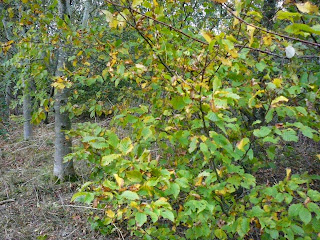

Late afternoon into early evening; the sound of bells from some way behind me
seems set to follow me all through my walk. Leaves are turning by now,
red and gold showing amongst the green, while
from somewhere the slow smell pervades of a
stinkhorn fungus.
This morning has been wet, that mizzling wet that
soaks everything through,
so that now the bracken and the rangy nettles are
strewn with pearls.
There is a feeble sort of sun that seems itself to
be made mostly of water.
A robin is singing, another responds, and still
the sound of the bells
is there, chasing me from a steepled tower half a
mile away and more.
Years ago, too many to think about, I used to walk
this path;
nothing much has changed, or so it seems -
certainly
the bells sound just the same, just
a new generation learning the methods, plain bob
minor,
grandsire triples, all of that. The names mean little to me,
but the sound tugs at my heart, where somehow I am
still that boy,
kicking at the leaves and hoping for fallen
conkers.
And now I have reached the high bridge over the
canal, where close by
busy squirrels are laying quarrelsome claim to the
last few hazel nuts.
Here is where I shall pause, and reflect on which
of three or four possible ways back I might take:
perhaps the high path through the wood, and then
the towpath.
That’s the way I would always use back then, but
there is a steep descent
and my knees are not quite what they were.
A nearby sycamore has already lost nearly all its
leaves -
yellow and brown, they crowd against my feet
as I look down to check my boot-treads and laces.
Ways back I might take; how about
a way back into boyhood, into the innocence of
those far off days,
with my aims and hopes and dreams as yet unblunted
by time,
and everything still to happen?
The only way I can take is via those bells
and the memories they stir, and even they are
partial now and fading.
“Forty years on, when afar and asunder . . .”
There is only the onward journey, from autumn
towards winter,
framed in the frosting air and falling leaves, but
with, still,
the hope of a spring to follow.

Some Harvest Thoughts
Just to keep my hand in, a Harvest address, based on Psalm 104 and Luke 12.13-34 :-
This is a favourite time of the year for me, and this year we’ve had the sort of summer that produces a good harvest, so there is much to give thanks for. We live in a beautiful place here, and indeed we live in a world that is full of marvellous things. I’ve chosen as a first reading one of my favourite psalms, a hymn of praise that speaks very vividly of the variety of forms of life with which we share our planet, and the way in which the Lord provides and cares for all of them. I’m a keen naturalist, plant collector and bird watcher, and within the natural world I find our creator God glorified and glorified again. Christians, and indeed members of the other great faiths of our world, more and more today are coming to understand that we are given the responsibility of stewards within this world of living wonder and variety. Just as God placed Adam and Eve in a garden to tend it, so we too have the task under God of looking after all that he has made.
So for me that’s a significant dimension of my thinking at harvest festival. We use the earth to provide for ourselves as gardeners and farmers, and also as miners, manufacturers, fishermen and hunters. But we’re also stewards of creation - so who are we as stewards protecting the earth from? Just ourselves, I suppose - after all, we’re the ones (at our greedy worst) who are the damagers and the exploiters and the despoilers of creation.
And it may even be that the Bible gives us encouragement to do this, to see the earth entirely in terms of resource for us to use. For right at the beginning of our Bibles, in the first chapter of Genesis, God tells his people that they must “fill the earth and subdue it, and have dominion” - dominion over everything: fish in the sea, birds of the air and all the rest of it.
So where does that leave us? Well, there is surely a huge difference between using the earth’s resources and using up the earth’s resources. We’re given dominion over all other forms of life, but the model for that dominion is provided by our Lord himself, and we see that his dominion is a dominion of love and care. In Jesus, who says to his friends “I am among you as one who serves” he shows us the way of sacrifice and service. For the disciples of Jesus the measure of greatness is never how high and grand a throne we sit on, but how ready we are to serve one another.
I’ve been privileged over the years to travel quite widely in the world, to places where people seem to have very little, and to places where arguably people have far too much; to places where development is urgently needed, and to places that suffer from over-development; and certainly to some places where the harvest is poor and sparse.
So I’ve been made very aware of the challenge of sharing, of making space for one another within our human economy. I’ve been in Palestine, seeing how political tensions intervene, so that some of the harvest can’t be gathered because of the borders that can no longer be crossed. In Tanzania I’ve seen lakeside communities where potentially there could be a rich fishery, only the resources to develop it aren’t there, so instead people just scrape a living, with goats and bony cattle on the shore and dug out canoes on the lake. In Peru I’ve been in shanty towns where people have migrated to the city hoping for streets paved with gold, and finding instead mostly dust. Many have been driven from their family lands by poverty and by terror gangs. I visited smallholdings established by the Rural Landless movement in Brazil, to hear stories of violence and murder done by agents of the big landowners against those who were trying to settle the land in a peaceful way.
And in all of these places I found church communities working hard and courageously to make things better for people in need, and taking seriously that call of our Lord to serve. They were empowering people who had been helpless, and speaking out for people whose voices had till then gone unheard. All these communities would I’m sure take to heart the verse from my second reading, in which Jesus says, “Lay up for yourselves treasures in heaven, for where your treasure is, there will your heart be also.”
I don’t know who it was who said “tread as lightly as we can upon this world, for it’s the only one we have,” but those are wise words. Someone else has said: “Live simply, that others may simply live.” In his story, Jesus quite brutally exposes the shallow desires of the man who hoarded all his crops in his brand new storehouses and barns. “What good is all the wealth to you?” the man is told - it’ll all be left behind when you go.
My wife and I have not long got back from New York, where perhaps more than anywhere else on this planet you are brought face to face with human power and conspicuous consumption, in the immense buildings that rise up so high. We ascended one of them - not the Empire State but the Rockefeller Tower, not quite so tall but 67 floors up as we looked out over the city.
As we surveyed the city skyline, wealth and power was laid out in front of us, expressed many times over in steel and glass and stone. But looking north from the Top of the Rock, as the viewing floors of the Rockefeller Tower are known, you see not only skyscrapers but also the vast expanse of green at the heart of Manhattan that is Central Park. We fell a bit in love with New York, for all its demonstration of the power of mammon, but we fell very much in love with Central Park, and for me that green oasis was a timely reminder of the truth that “Man cannot live by bread alone, but by every word that proceeds from the mouth of God.”
In Central Park birds flit through the trees, squirrels forage about on the grass, turtles sun themselves on rocks around the lake, and people eat ice creams and go jogging, sometimes both at the same time. And here space is made and kept for the natural world and for the wild things, as well as for the refreshment and re-formation that we humans need if we’re to be healthy and strong in body and in spirit. And this should surely be true of the way in which we use the earth wherever we are within it. Sometimes that means creating nature reserves and game parks and the like, not just as a resource for us or for the tourist trade, but also because the creatures with which we share this planet deserve their own space in which to survive and thrive.
But we also need simply to recognise that as human beings we’re a part of, rather than apart from, the natural order of our planet. And as such we are diminished ourselves if we abuse or destroy the beauty of the wild places, whether that’s the hedgerows and woodlands that make our own countryside so lovely, or the rain forests and savannahs and wetlands and coral reefs of other lands.
What makes Psalm 104 so inspirational to me is the way in which it tells me that our lives are linked in to the lives of other living things, of wild donkeys and rock badgers and storks, and shows me how God provides for us all. The other day I was listening on the radio to Bishop James Jones, the former Bishop of Liverpool; one thing he said that I felt struck home was this: for Christians, to abuse God’s creation should be understood not only as something foolish and wrong, but also as an act of blasphemy. When we do as we like with the planet we deny God’s sovereignty, we say to him “You don’t really matter, we can do as we please.”
Another Psalm begins with these words: “The fool says in his heart ‘There is no God’". God gives us the freedom to act as though he were not there, but we're fools if we take that route. Jesus made it very clear that the rich man with his storehouses and barns was going nowhere. Why have faith in stuff that will rust and rot and moulder away? Instead, lay up for yourselves treasure in heaven.
So for me, harvest thanksgiving must always be a time of commitment and recommitment, when we think of blessings received and also of our call to be blessing for others. Anything less isn’t a real thanksgiving - thanksgiving for harvest isn’t expressed in what we do this evening, in our hymns and our prayers and our gifts on this one day, but in the generous and faithful living of our whole life and in the way we use all that God gives us.
That’s why at their Harvest Thanksgiving, the people of Israel brought the first fruits of harvest to lay before the Lord. It was their sign and acknowledgement that the whole of the crop was rightfully his, that the whole harvest should and would be used in ways that were faithful and just. May that be true for us too, and, indeed, may we ourselves be a good harvest to the Lord - through lives that will bear fruit, through lives that will reflect the love and care and compassion that the God we praise has for all he has made, and for all that by its being brings glory to his name.
Amen.
This is a favourite time of the year for me, and this year we’ve had the sort of summer that produces a good harvest, so there is much to give thanks for. We live in a beautiful place here, and indeed we live in a world that is full of marvellous things. I’ve chosen as a first reading one of my favourite psalms, a hymn of praise that speaks very vividly of the variety of forms of life with which we share our planet, and the way in which the Lord provides and cares for all of them. I’m a keen naturalist, plant collector and bird watcher, and within the natural world I find our creator God glorified and glorified again. Christians, and indeed members of the other great faiths of our world, more and more today are coming to understand that we are given the responsibility of stewards within this world of living wonder and variety. Just as God placed Adam and Eve in a garden to tend it, so we too have the task under God of looking after all that he has made.
So for me that’s a significant dimension of my thinking at harvest festival. We use the earth to provide for ourselves as gardeners and farmers, and also as miners, manufacturers, fishermen and hunters. But we’re also stewards of creation - so who are we as stewards protecting the earth from? Just ourselves, I suppose - after all, we’re the ones (at our greedy worst) who are the damagers and the exploiters and the despoilers of creation.
And it may even be that the Bible gives us encouragement to do this, to see the earth entirely in terms of resource for us to use. For right at the beginning of our Bibles, in the first chapter of Genesis, God tells his people that they must “fill the earth and subdue it, and have dominion” - dominion over everything: fish in the sea, birds of the air and all the rest of it.
So where does that leave us? Well, there is surely a huge difference between using the earth’s resources and using up the earth’s resources. We’re given dominion over all other forms of life, but the model for that dominion is provided by our Lord himself, and we see that his dominion is a dominion of love and care. In Jesus, who says to his friends “I am among you as one who serves” he shows us the way of sacrifice and service. For the disciples of Jesus the measure of greatness is never how high and grand a throne we sit on, but how ready we are to serve one another.
I’ve been privileged over the years to travel quite widely in the world, to places where people seem to have very little, and to places where arguably people have far too much; to places where development is urgently needed, and to places that suffer from over-development; and certainly to some places where the harvest is poor and sparse.
So I’ve been made very aware of the challenge of sharing, of making space for one another within our human economy. I’ve been in Palestine, seeing how political tensions intervene, so that some of the harvest can’t be gathered because of the borders that can no longer be crossed. In Tanzania I’ve seen lakeside communities where potentially there could be a rich fishery, only the resources to develop it aren’t there, so instead people just scrape a living, with goats and bony cattle on the shore and dug out canoes on the lake. In Peru I’ve been in shanty towns where people have migrated to the city hoping for streets paved with gold, and finding instead mostly dust. Many have been driven from their family lands by poverty and by terror gangs. I visited smallholdings established by the Rural Landless movement in Brazil, to hear stories of violence and murder done by agents of the big landowners against those who were trying to settle the land in a peaceful way.
And in all of these places I found church communities working hard and courageously to make things better for people in need, and taking seriously that call of our Lord to serve. They were empowering people who had been helpless, and speaking out for people whose voices had till then gone unheard. All these communities would I’m sure take to heart the verse from my second reading, in which Jesus says, “Lay up for yourselves treasures in heaven, for where your treasure is, there will your heart be also.”
I don’t know who it was who said “tread as lightly as we can upon this world, for it’s the only one we have,” but those are wise words. Someone else has said: “Live simply, that others may simply live.” In his story, Jesus quite brutally exposes the shallow desires of the man who hoarded all his crops in his brand new storehouses and barns. “What good is all the wealth to you?” the man is told - it’ll all be left behind when you go.
My wife and I have not long got back from New York, where perhaps more than anywhere else on this planet you are brought face to face with human power and conspicuous consumption, in the immense buildings that rise up so high. We ascended one of them - not the Empire State but the Rockefeller Tower, not quite so tall but 67 floors up as we looked out over the city.
As we surveyed the city skyline, wealth and power was laid out in front of us, expressed many times over in steel and glass and stone. But looking north from the Top of the Rock, as the viewing floors of the Rockefeller Tower are known, you see not only skyscrapers but also the vast expanse of green at the heart of Manhattan that is Central Park. We fell a bit in love with New York, for all its demonstration of the power of mammon, but we fell very much in love with Central Park, and for me that green oasis was a timely reminder of the truth that “Man cannot live by bread alone, but by every word that proceeds from the mouth of God.”
In Central Park birds flit through the trees, squirrels forage about on the grass, turtles sun themselves on rocks around the lake, and people eat ice creams and go jogging, sometimes both at the same time. And here space is made and kept for the natural world and for the wild things, as well as for the refreshment and re-formation that we humans need if we’re to be healthy and strong in body and in spirit. And this should surely be true of the way in which we use the earth wherever we are within it. Sometimes that means creating nature reserves and game parks and the like, not just as a resource for us or for the tourist trade, but also because the creatures with which we share this planet deserve their own space in which to survive and thrive.
But we also need simply to recognise that as human beings we’re a part of, rather than apart from, the natural order of our planet. And as such we are diminished ourselves if we abuse or destroy the beauty of the wild places, whether that’s the hedgerows and woodlands that make our own countryside so lovely, or the rain forests and savannahs and wetlands and coral reefs of other lands.
What makes Psalm 104 so inspirational to me is the way in which it tells me that our lives are linked in to the lives of other living things, of wild donkeys and rock badgers and storks, and shows me how God provides for us all. The other day I was listening on the radio to Bishop James Jones, the former Bishop of Liverpool; one thing he said that I felt struck home was this: for Christians, to abuse God’s creation should be understood not only as something foolish and wrong, but also as an act of blasphemy. When we do as we like with the planet we deny God’s sovereignty, we say to him “You don’t really matter, we can do as we please.”
Another Psalm begins with these words: “The fool says in his heart ‘There is no God’". God gives us the freedom to act as though he were not there, but we're fools if we take that route. Jesus made it very clear that the rich man with his storehouses and barns was going nowhere. Why have faith in stuff that will rust and rot and moulder away? Instead, lay up for yourselves treasure in heaven.
So for me, harvest thanksgiving must always be a time of commitment and recommitment, when we think of blessings received and also of our call to be blessing for others. Anything less isn’t a real thanksgiving - thanksgiving for harvest isn’t expressed in what we do this evening, in our hymns and our prayers and our gifts on this one day, but in the generous and faithful living of our whole life and in the way we use all that God gives us.
That’s why at their Harvest Thanksgiving, the people of Israel brought the first fruits of harvest to lay before the Lord. It was their sign and acknowledgement that the whole of the crop was rightfully his, that the whole harvest should and would be used in ways that were faithful and just. May that be true for us too, and, indeed, may we ourselves be a good harvest to the Lord - through lives that will bear fruit, through lives that will reflect the love and care and compassion that the God we praise has for all he has made, and for all that by its being brings glory to his name.
Amen.
Tuesday, 1 October 2013
Birding in the Park
So here we are, back in business, after our trip to New York, of which more later. Here, first of all, is the latest of my 'Nature Notes' columns, which derives from that visit :-
Parks are often good places to watch birds; they are leafy oases in urban areas, and often there’s a good range of plant species and therefore food supplies, kind human beings who deliberately or accidentally feed the birds, and who of course also persuade the birds to be a little less timid than they might be in other places.
But Central Park, New York is an urban park on a different scale. It’s vast! And although it’s very full of people (in the early morning it’s like a sort of M25 for joggers), it’s also full of interesting habitats and varied wildlife. Some of New York’s birds are very familiar, partly because we introduced them - Central Park has more than its share of house sparrows and starlings - while other birds like ravens and herring gulls just happen to be American as well as British.
But of course when you’re a new British arrival armed with field glasses everything is interesting! A local birdwatcher identified a Wilson’s Warbler for us - a migrant species not all that common in New York, being a western American species; but we were just as interested in birds like Grackles, Robins (the American Robin is actually much more closely related to our Blackbird) and Blue Jays, which he probably never even noticed any more, since they’re so common. There were a number of quite interesting warblers, and they seemed to be what the local birders were concentrating on most.
I’m sure that most of the birds we saw were common enough - Mockingbirds, Black-and-White Warblers, House Wrens, Mourning Doves, Chickadees - but they were all pretty special to us. We saw other creatures too - some splendid butterflies, including that master migrant of the butterfly world, the Monarch, dragonflies, grasshoppers; both grey and black squirrels, terrapins (there are several large pools) and, a couple of times, rats (well, they are everywhere, aren’t they?).
Two rather good sightings I had in the park were of a Red-Tailed Hawk (actually a close relative of our Buzzard and therefore a pretty big bird), which sailed across a clearing in front of me to escape a mobbing party of Blue Jays, to perch hardly more than twelve feet away from where I was standing; and a splendid woodpecker which again crossed close in front of me to land on the trunk of a nearby mature tree. I’m pretty sure this was a bird called the Northern Flicker. I watched several flycatchers without being sure of the species, but I must mention the lovely bright red Cardinal that Ann and I both saw . . . “a common back-yard species” my book says - well, I wish we had them here.
Elsewhere we saw egrets, cormorants, a variety of hawks, vultures, various small sparrows and finches; but two other delightful sightings to mention before closing were three Mockingbirds playing on the illuminated letters above the main doors of our hotel in Alexandria, Virginia; and, best of all, the pair of Bald Eagles we glimpsed from our coach between Baltimore and Washington. “Not many people see them,” commented Larry, our guide, who knew about them, when we told him later - and we felt pretty good.
Parks are often good places to watch birds; they are leafy oases in urban areas, and often there’s a good range of plant species and therefore food supplies, kind human beings who deliberately or accidentally feed the birds, and who of course also persuade the birds to be a little less timid than they might be in other places.
But Central Park, New York is an urban park on a different scale. It’s vast! And although it’s very full of people (in the early morning it’s like a sort of M25 for joggers), it’s also full of interesting habitats and varied wildlife. Some of New York’s birds are very familiar, partly because we introduced them - Central Park has more than its share of house sparrows and starlings - while other birds like ravens and herring gulls just happen to be American as well as British.
But of course when you’re a new British arrival armed with field glasses everything is interesting! A local birdwatcher identified a Wilson’s Warbler for us - a migrant species not all that common in New York, being a western American species; but we were just as interested in birds like Grackles, Robins (the American Robin is actually much more closely related to our Blackbird) and Blue Jays, which he probably never even noticed any more, since they’re so common. There were a number of quite interesting warblers, and they seemed to be what the local birders were concentrating on most.
I’m sure that most of the birds we saw were common enough - Mockingbirds, Black-and-White Warblers, House Wrens, Mourning Doves, Chickadees - but they were all pretty special to us. We saw other creatures too - some splendid butterflies, including that master migrant of the butterfly world, the Monarch, dragonflies, grasshoppers; both grey and black squirrels, terrapins (there are several large pools) and, a couple of times, rats (well, they are everywhere, aren’t they?).
Two rather good sightings I had in the park were of a Red-Tailed Hawk (actually a close relative of our Buzzard and therefore a pretty big bird), which sailed across a clearing in front of me to escape a mobbing party of Blue Jays, to perch hardly more than twelve feet away from where I was standing; and a splendid woodpecker which again crossed close in front of me to land on the trunk of a nearby mature tree. I’m pretty sure this was a bird called the Northern Flicker. I watched several flycatchers without being sure of the species, but I must mention the lovely bright red Cardinal that Ann and I both saw . . . “a common back-yard species” my book says - well, I wish we had them here.
Elsewhere we saw egrets, cormorants, a variety of hawks, vultures, various small sparrows and finches; but two other delightful sightings to mention before closing were three Mockingbirds playing on the illuminated letters above the main doors of our hotel in Alexandria, Virginia; and, best of all, the pair of Bald Eagles we glimpsed from our coach between Baltimore and Washington. “Not many people see them,” commented Larry, our guide, who knew about them, when we told him later - and we felt pretty good.
Monday, 23 September 2013
Please note . . .
. . . that postings on this blog will resume at the beginning of October 2013. Thank you.
Sunday, 8 September 2013
Perspective
It occurs to me that religion is so often a force for division, hostility and even violence in our world chiefly because it becomes an end in itself rather than a means toward a better understand of oneself, one's world and its Maker. An old colleague I came across last week - the first time I'd seen him for maybe twenty years or more - expressed the perspective by which he lives in what I thought was a succinct and relevant way :-
"Under God, and by his grace, I shall put Church before self, and Kingdom before Church."
It is that last section (and its equivalent, which there surely must be, in other faiths) which gets ignored. The faithful allegiance given to church is praiseworthy of course, but it can be the cause of great harm unless it is informed and moderated by an awareness of a higher aim and a greater purpose under God, which is that his love for all he has made should be proclaimed and lived.
"Under God, and by his grace, I shall put Church before self, and Kingdom before Church."
It is that last section (and its equivalent, which there surely must be, in other faiths) which gets ignored. The faithful allegiance given to church is praiseworthy of course, but it can be the cause of great harm unless it is informed and moderated by an awareness of a higher aim and a greater purpose under God, which is that his love for all he has made should be proclaimed and lived.
Wednesday, 4 September 2013
Fight!
Today has been another lovely late summer day - sadly I think the last for a while. One delight it served up for me was the sight of two speckled wood butterflies engaging in combat. These are very territorial insects, or the males are at least - they will fiercely defend a patch of sunlit space within, or on the edge of, a wood or overgrown hedgerow. Such a warm spot will provide the best chance of mating.
When an interloper arrives, a fight ensues, and that's what I witnessed today. The two butterflies circle rapidly around each other; and, looking closely, I could see that every so often one would dart towards the other and be repulsed. I supposed the duel I witnessed went on for ten or fifteen minutes, though I'm told that they have been known to last for an hour or more. The two butterflies covered a fair amount of ground even in that time, though! In the end one flew disconsolately away.
One tends not to think of insects as territorial but in fact quite a number of butterflies seem to be. Where we used to live we tended to find our drive claimed each year by a red admiral butterfly - obviously a different one each year, though as the behaviour was identical you might easily imagine it to be the same individual as last year. Any invasion of the space, for example by me parking my car, would result in a sort of dive bombing enterprise by the butterfly. Possibly it was responding to its own reflection in the windows or mirror, rather as some birds will.
Related butterflies, such as peacocks and small tortoiseshells, also behave in this way. A male will select a perch and simply sit there and bask a bit; but they are very watchful, and will quickly act to chase away any (male) intruders, their strategy being to sit in a good and obvious place and wait for the female to find them.
When an interloper arrives, a fight ensues, and that's what I witnessed today. The two butterflies circle rapidly around each other; and, looking closely, I could see that every so often one would dart towards the other and be repulsed. I supposed the duel I witnessed went on for ten or fifteen minutes, though I'm told that they have been known to last for an hour or more. The two butterflies covered a fair amount of ground even in that time, though! In the end one flew disconsolately away.
One tends not to think of insects as territorial but in fact quite a number of butterflies seem to be. Where we used to live we tended to find our drive claimed each year by a red admiral butterfly - obviously a different one each year, though as the behaviour was identical you might easily imagine it to be the same individual as last year. Any invasion of the space, for example by me parking my car, would result in a sort of dive bombing enterprise by the butterfly. Possibly it was responding to its own reflection in the windows or mirror, rather as some birds will.
Related butterflies, such as peacocks and small tortoiseshells, also behave in this way. A male will select a perch and simply sit there and bask a bit; but they are very watchful, and will quickly act to chase away any (male) intruders, their strategy being to sit in a good and obvious place and wait for the female to find them.
Wednesday, 28 August 2013
Nuthatch
I was gardening the other day on a bright sunny morning, when my thoughts were disturbed by a sharp insistent tapping sound. I looked up, and there ahead of me was a nuthatch performing the activity that gives it its name. It had carefully placed a hazelnut into the fissure where the trunk of a small tree divided, and was trying to break into it with repeated taps of its long sharp bill. Apparently, this bird was originally called a ‘nut-hack’.
Eventually, it gave up and flew off. I think it had misplaced the nut, so that its bill was striking the hardest and most intractable part of the shell. On investigation, I found a sign of previous activity further up the crack: another hazelnut, this time successfully dealt with - the kernel had been removed through a large hole in the shell.
Nuthatches are found throughout Wales and the southern half generally of the UK, and are here all the year round. They are impressive little birds, with their long thin beaks, blue-grey upper parts and buff-orange underside. For me, though, the best bit about the nuthatch’s plumage is the black bandit eye stripe that follows the line of its bill right across the side of the head. Male and female look alike.
It is a bird of woodlands and large gardens, where it feeds on insects and other small invertebrates as well as on nuts and seeds. It comes readily to bird tables, where it often lives up to its bandit eye stripe by being a bit of a bully. Having said that, the ones I’ve seen in my present garden seem fairly shy. In winter it flocks with tits and other small birds, tending to move around together - in flocks birds help each other find food, and have better protection against predators. The nuthatch likes large mature trees, and can move up and down the trunk with equal facility (the tree creeper, in contrast, can only move up). It has a loud and strident call.

Nuthatches nest in holes in trees, the entrance to which they make smaller (and therefore safer) by adding mud to partly close it up. They will also use nest boxes. A pair will raise maybe six or more young, lining the bottom of the nest hole with bark and dry leaves. For a short time this summer, our garden was thrillingly filled with nuthatches, as a local brood somewhere in the wood behind us fledged.
There is only one species of nuthatch in this country, but others are found elsewhere in the northern hemisphere, especially in Asia, but also the USA and Canada, and some parts of north Africa as well as across Europe. All have a similar style of plumage, including in most cases the eye stripe, and all share the same habit of nesting in holes and crevices, though one or two species will excavate their own nest holes. Some nuthatches are not woodland birds, for example the rock nuthatches which I enjoyed watching a few years ago on a visit to the Greek island of Lesbos. They are lovely birds, and for me it’s always a thrill to see them.
Eventually, it gave up and flew off. I think it had misplaced the nut, so that its bill was striking the hardest and most intractable part of the shell. On investigation, I found a sign of previous activity further up the crack: another hazelnut, this time successfully dealt with - the kernel had been removed through a large hole in the shell.
Nuthatches are found throughout Wales and the southern half generally of the UK, and are here all the year round. They are impressive little birds, with their long thin beaks, blue-grey upper parts and buff-orange underside. For me, though, the best bit about the nuthatch’s plumage is the black bandit eye stripe that follows the line of its bill right across the side of the head. Male and female look alike.
It is a bird of woodlands and large gardens, where it feeds on insects and other small invertebrates as well as on nuts and seeds. It comes readily to bird tables, where it often lives up to its bandit eye stripe by being a bit of a bully. Having said that, the ones I’ve seen in my present garden seem fairly shy. In winter it flocks with tits and other small birds, tending to move around together - in flocks birds help each other find food, and have better protection against predators. The nuthatch likes large mature trees, and can move up and down the trunk with equal facility (the tree creeper, in contrast, can only move up). It has a loud and strident call.
Nuthatches nest in holes in trees, the entrance to which they make smaller (and therefore safer) by adding mud to partly close it up. They will also use nest boxes. A pair will raise maybe six or more young, lining the bottom of the nest hole with bark and dry leaves. For a short time this summer, our garden was thrillingly filled with nuthatches, as a local brood somewhere in the wood behind us fledged.
There is only one species of nuthatch in this country, but others are found elsewhere in the northern hemisphere, especially in Asia, but also the USA and Canada, and some parts of north Africa as well as across Europe. All have a similar style of plumage, including in most cases the eye stripe, and all share the same habit of nesting in holes and crevices, though one or two species will excavate their own nest holes. Some nuthatches are not woodland birds, for example the rock nuthatches which I enjoyed watching a few years ago on a visit to the Greek island of Lesbos. They are lovely birds, and for me it’s always a thrill to see them.
Sunday, 25 August 2013
Dust
She kneels once more in the dust,
placing her forehead against the cold wood,
and thinks again of the Sabbaths of long ago,
of the uncomfortably respectable old black suits,
of Mrs Protheroe in her blue hat
with the gauze, and that big pin to hold it,
of the voices ringing round, the sacred songs and solos,
and of the prayers and pauses,
the sermonising words and the long and holy silences.
It had all seemed so solid, then,
such sure foundations, so bound to stand firm, so set for ever.
She kneels where she has always knelt,
nearly eighty years of song and fervent prayer.
She had always wanted to grow old in this place,
but in that same lost world, and not in this;
with the next generation around her,
and not alone, or almost so.
She does not look up; better to imagine
those long ago faces, those sure and certain things
that are now, for the most part,
reduced to the dust in which she kneels.
placing her forehead against the cold wood,
and thinks again of the Sabbaths of long ago,
of the uncomfortably respectable old black suits,
of Mrs Protheroe in her blue hat
with the gauze, and that big pin to hold it,
of the voices ringing round, the sacred songs and solos,
and of the prayers and pauses,
the sermonising words and the long and holy silences.
It had all seemed so solid, then,
such sure foundations, so bound to stand firm, so set for ever.
She kneels where she has always knelt,
nearly eighty years of song and fervent prayer.
She had always wanted to grow old in this place,
but in that same lost world, and not in this;
with the next generation around her,
and not alone, or almost so.
She does not look up; better to imagine
those long ago faces, those sure and certain things
that are now, for the most part,
reduced to the dust in which she kneels.
Saturday, 24 August 2013
Sabbaths
A Sunday reflection :-
I’ve long been very grateful to the good folk of the United Reformed Church by the English Bridge in Shrewsbury - and it was nice a few weeks ago to have the opportunity to say so to their minister in person. Their notice board outside the church always has such a good line in to-the-point messages, and those wayside words have been the inspiration or at least the starting point for quite a few of my sermons and Sunday talks over the years. Today’s being no exception. Here I am talking to you on the Sunday of a Bank Holiday weekend, and I remember they had a sign which read, as you passed it in your car or on the park and ride bus, "Happy holidays!”
Except that if you looked just a little more closely, you saw it was actually “Happy holy days." And I reckon there’s a load of things you can take from those three words. First of all, I’m simply reminded that holiday and holy day are really the same word. In the dim and distant past when our fore-fathers were mostly serfs and villeins, the only time they would be able to take off from their labours would be the saints’ days and holy days authorised by the church.
Some of our modern bank holidays still happen on the dates of those old Church festivals, though Whitsun has now been dislodged from the real Whit Sunday, and this weekend’s holiday is just a day off for late summer, and a chance for a last trip out before everything starts up again in September. It looks as though the weather's going to smile on us today and tomorrow, and so of course every road will be packed and every beach will be crowded, and anyone with any sense will realise it might have been best to stay at home.
But then you’d probably end up working, creosoting that fence or cutting that hedge, and all work and no play is never good for anyone. People need their times of rest and recreation, and indeed of celebration and fellowship; and that word 'recreation' if really of course re-creation: we’ll get used up and worn out and wasted if we don't rest. All work and no play leaves us less effective not only as useful and productive workers, but as human beings. I’m sure that's why Isaiah the prophet, speaking God's word to the people, told them to keep the Sabbath in order to be right with God, and for God to bless them.
For bank holidays and other special away times or off times are important, but so is the regular break from work that the Bible calls the Sabbath. It’s a holy time. Isaiah told the people that they should also honour the Sabbath by desisting from work and not pursuing their own interests.
Now that to me is an interesting phrase: not pursuing their own interests. Isn’t there quite a big clue there as to what the Sabbath is all about, and what it isn’t all about, but so easily could become. Jesus put it better than anyone else, of course: the Sabbath is made for us, rather than we for the Sabbath. Where keeping the Sabbath has become something oppressive and restrictive and downright difficult, we’ve got it wrong. In fact, the Sabbath is given us not just as a rest and break from, but as a positive means towards. Which is why Isaiah goes on to talk about 'finding our joy in the Lord'. Remember, the sign outside the URC Church said ‘HAPPY holy days’. Why is it that so often in the course of Christian history people have tried to make holiness something dull and dreary. That’s not what it should be at all, it should always be a joyful time. Sabbath is time away from the routine and drudgery of work; but for Christians it’s also our opportunity each week to tune ourselves back into the things that are divine. Our opportunity for re-creation, for which we need to be seeking the mind and heart of our Creator.
So, here’s the thing. True religion should be a liberating thing, but instead all too often religion has forgot that it’s supposed to liberate, and has instead turned into something that cramps and imposes and divides - with the keeping of Sabbaths as one expression of this.
So let’s reflect for a moment on the story we’ve heard from St Luke’s Gospel, the story of something good that happened on the wrong day (for some, anyway) because it happened on the Sabbath. Jesus is in the synagogue, and there he responds with generosity and good purpose to the desperate need of a woman deeply afflicted by something that sounds a lot like rheumatoid arthritis. But it's the Sabbath, and the leader of synagogue must have feared he might lose control - after all this his Sabbath service, not a free-for-all healing session.
"There are six other days in the week," he tells his people. "Come and be healed on them, and not the Sabbath!" Now hearing those words, I can’t help but wonder how I might have reacted had someone stepped forward and done something like this in one of the churches for which I had responsibility in my time as a vicar. Like today, I’d have had stuff prepared and written down, not to mention a watch on my wrist and an idea of how long the service should take and when I might get home afterwards.
And here comes someone stepping up out of the congregation, and not authorized and ordained to be a minister, and he messes about with my carefully planned and organised service. I can’t help thinking: Would I have rejoiced that one of God's children had been released from slavery and suffering? Or would I have found myself moaning and complaining about the lack of discipline and the fact that things were not being done in the right way? Might I not have felt that my nose was being pushed out of joint?
I hope I would have applauded, but if I'm honest I’m rather afraid I might have moaned. But the leader of the synagogue did I suppose have more reason than I had to complain. For it wasn’t just that his own nose was pushed out of joint; it was clear to him that Jesus had offended against God’s law by breaking the Sabbath. But had he, really? Thinking back to what Isaiah wrote, Jesus hadn't been pursuing his own interests or attending to his own affairs. It surely was in complete accordance with God’s will that this woman should be released from her imprisonment to ill health and disability. What better day to do that than on a holy day? It would surely have been a misuse of the Sabbath to make it an excuse to postpone her release. For the Sabbath is given us - given us by God - for our own benefit and health, and indeed for our own liberation, and certainly not to oppress or imprison us. He made the Sabbath for man, not man for the Sabbath.
Years ago, as an industrial chaplain at a time when the old Sunday trading laws were being relaxed, I found myself arguing the case for the Sabbath in radio debates and the like. Or at least, the case for one day in seven to run at a different pace from the others. I wasn’t interested in imposing a Sabbath on everyone just because Christians wanted a special day - but I did want to argue very strongly that it wasn’t just a religious custom or discipline, but something we really do need. Everyone needs to be re-created.
As it happens, of course, Sunday isn't the Jewish Sabbath, which is the last day of the week, Saturday therefore. Our holy day is a celebration each week of Easter, so it happens on the first day of the week, on Sunday. But it's certainly been used as a Sabbath, as a day when no work should be done, as a day of enforced stillness and inactivity that was imposed on the whole of the land, so that (if you look back far enough in recent history) nothing was bought or sold, no buses or trains would run, and even the pubs stayed closed.
You may feel that today the pendulum's moved too far the other way. Many people now have to work on a Sunday, not least because the leisure industry has become one of our major employers. Many churches now find they need to open up during the week to cater for people who couldn't come on a Sunday even if they wanted to. Sunday leisure activities have burgeoned, and leisure is big business these days, sport also. A lady was saying to me just the other day that no-one under the age of forty comes to her chapel because they’re all playing football or - well, there’s a multitude of sporting activity now on any Sunday. And people tell me they might come to church more often, but we’ve got to visit the family and there’s no other day, or even they’ve got to do their shopping, and there’s no other day. They just can’t spare the time.
I’m not in the business of insisting that my holy day should be kept by those who don’t believe what I believe. And I certainly don’t want to go back to the days when Sundays were grey and oppressive days when busy mums like mine hung their washing up in a damp kitchen so that the neighbours wouldn’t be scandalised by seeing it blowing out there on the line.
But I do hope that Christians of all persuasions will be alive to the positive reasons for keeping a Sabbath, maybe not as a day of absolute inaction, but certainly as a day of blessing and prayer and of re-creation. It’s a chance for us each week to bear witness to our faith by keeping our holy day when the world around us doesn't, and by keeping it as a happy holy day.
But remember, Sabbath is God’s gift to us, as something that should make our lives better and happier, not to test us or oppress us. It deserves to be taken seriously, so we should certainly be paying it more than lip service; but it doesn’t need us to be so super-zealous that our Sunday is kept with an in-your-face smugness. It isn’t about being holier than thou, just doing honour to the God who loves us, and who also loves, as my tutor at college always told us, the guys that are washing their cars or playing Sunday league football, even if they haven’t quite woken up to him yet.
So let’s keep our Christian Sabbath seriously but also joyfully. For every Sunday is a celebration of Easter, and of death being no more and a broken world being renewed - and people being healed. Every Sunday we keep preaches and proclaims the God of love whose desire is that all should find healing and salvation. To keep Sunday as a happy holy day is my confession that God comes first in my life: and if I’m keep this day as his Sabbath then I’ll do my best to use it in a way that will renew and re-create me, and that will give me the power, purpose and holiness I shall need to take into all the other days of my week.
I’ve long been very grateful to the good folk of the United Reformed Church by the English Bridge in Shrewsbury - and it was nice a few weeks ago to have the opportunity to say so to their minister in person. Their notice board outside the church always has such a good line in to-the-point messages, and those wayside words have been the inspiration or at least the starting point for quite a few of my sermons and Sunday talks over the years. Today’s being no exception. Here I am talking to you on the Sunday of a Bank Holiday weekend, and I remember they had a sign which read, as you passed it in your car or on the park and ride bus, "Happy holidays!”
Except that if you looked just a little more closely, you saw it was actually “Happy holy days." And I reckon there’s a load of things you can take from those three words. First of all, I’m simply reminded that holiday and holy day are really the same word. In the dim and distant past when our fore-fathers were mostly serfs and villeins, the only time they would be able to take off from their labours would be the saints’ days and holy days authorised by the church.
Some of our modern bank holidays still happen on the dates of those old Church festivals, though Whitsun has now been dislodged from the real Whit Sunday, and this weekend’s holiday is just a day off for late summer, and a chance for a last trip out before everything starts up again in September. It looks as though the weather's going to smile on us today and tomorrow, and so of course every road will be packed and every beach will be crowded, and anyone with any sense will realise it might have been best to stay at home.
But then you’d probably end up working, creosoting that fence or cutting that hedge, and all work and no play is never good for anyone. People need their times of rest and recreation, and indeed of celebration and fellowship; and that word 'recreation' if really of course re-creation: we’ll get used up and worn out and wasted if we don't rest. All work and no play leaves us less effective not only as useful and productive workers, but as human beings. I’m sure that's why Isaiah the prophet, speaking God's word to the people, told them to keep the Sabbath in order to be right with God, and for God to bless them.
For bank holidays and other special away times or off times are important, but so is the regular break from work that the Bible calls the Sabbath. It’s a holy time. Isaiah told the people that they should also honour the Sabbath by desisting from work and not pursuing their own interests.
Now that to me is an interesting phrase: not pursuing their own interests. Isn’t there quite a big clue there as to what the Sabbath is all about, and what it isn’t all about, but so easily could become. Jesus put it better than anyone else, of course: the Sabbath is made for us, rather than we for the Sabbath. Where keeping the Sabbath has become something oppressive and restrictive and downright difficult, we’ve got it wrong. In fact, the Sabbath is given us not just as a rest and break from, but as a positive means towards. Which is why Isaiah goes on to talk about 'finding our joy in the Lord'. Remember, the sign outside the URC Church said ‘HAPPY holy days’. Why is it that so often in the course of Christian history people have tried to make holiness something dull and dreary. That’s not what it should be at all, it should always be a joyful time. Sabbath is time away from the routine and drudgery of work; but for Christians it’s also our opportunity each week to tune ourselves back into the things that are divine. Our opportunity for re-creation, for which we need to be seeking the mind and heart of our Creator.
So, here’s the thing. True religion should be a liberating thing, but instead all too often religion has forgot that it’s supposed to liberate, and has instead turned into something that cramps and imposes and divides - with the keeping of Sabbaths as one expression of this.
So let’s reflect for a moment on the story we’ve heard from St Luke’s Gospel, the story of something good that happened on the wrong day (for some, anyway) because it happened on the Sabbath. Jesus is in the synagogue, and there he responds with generosity and good purpose to the desperate need of a woman deeply afflicted by something that sounds a lot like rheumatoid arthritis. But it's the Sabbath, and the leader of synagogue must have feared he might lose control - after all this his Sabbath service, not a free-for-all healing session.
"There are six other days in the week," he tells his people. "Come and be healed on them, and not the Sabbath!" Now hearing those words, I can’t help but wonder how I might have reacted had someone stepped forward and done something like this in one of the churches for which I had responsibility in my time as a vicar. Like today, I’d have had stuff prepared and written down, not to mention a watch on my wrist and an idea of how long the service should take and when I might get home afterwards.
And here comes someone stepping up out of the congregation, and not authorized and ordained to be a minister, and he messes about with my carefully planned and organised service. I can’t help thinking: Would I have rejoiced that one of God's children had been released from slavery and suffering? Or would I have found myself moaning and complaining about the lack of discipline and the fact that things were not being done in the right way? Might I not have felt that my nose was being pushed out of joint?
I hope I would have applauded, but if I'm honest I’m rather afraid I might have moaned. But the leader of the synagogue did I suppose have more reason than I had to complain. For it wasn’t just that his own nose was pushed out of joint; it was clear to him that Jesus had offended against God’s law by breaking the Sabbath. But had he, really? Thinking back to what Isaiah wrote, Jesus hadn't been pursuing his own interests or attending to his own affairs. It surely was in complete accordance with God’s will that this woman should be released from her imprisonment to ill health and disability. What better day to do that than on a holy day? It would surely have been a misuse of the Sabbath to make it an excuse to postpone her release. For the Sabbath is given us - given us by God - for our own benefit and health, and indeed for our own liberation, and certainly not to oppress or imprison us. He made the Sabbath for man, not man for the Sabbath.
Years ago, as an industrial chaplain at a time when the old Sunday trading laws were being relaxed, I found myself arguing the case for the Sabbath in radio debates and the like. Or at least, the case for one day in seven to run at a different pace from the others. I wasn’t interested in imposing a Sabbath on everyone just because Christians wanted a special day - but I did want to argue very strongly that it wasn’t just a religious custom or discipline, but something we really do need. Everyone needs to be re-created.
As it happens, of course, Sunday isn't the Jewish Sabbath, which is the last day of the week, Saturday therefore. Our holy day is a celebration each week of Easter, so it happens on the first day of the week, on Sunday. But it's certainly been used as a Sabbath, as a day when no work should be done, as a day of enforced stillness and inactivity that was imposed on the whole of the land, so that (if you look back far enough in recent history) nothing was bought or sold, no buses or trains would run, and even the pubs stayed closed.
You may feel that today the pendulum's moved too far the other way. Many people now have to work on a Sunday, not least because the leisure industry has become one of our major employers. Many churches now find they need to open up during the week to cater for people who couldn't come on a Sunday even if they wanted to. Sunday leisure activities have burgeoned, and leisure is big business these days, sport also. A lady was saying to me just the other day that no-one under the age of forty comes to her chapel because they’re all playing football or - well, there’s a multitude of sporting activity now on any Sunday. And people tell me they might come to church more often, but we’ve got to visit the family and there’s no other day, or even they’ve got to do their shopping, and there’s no other day. They just can’t spare the time.
I’m not in the business of insisting that my holy day should be kept by those who don’t believe what I believe. And I certainly don’t want to go back to the days when Sundays were grey and oppressive days when busy mums like mine hung their washing up in a damp kitchen so that the neighbours wouldn’t be scandalised by seeing it blowing out there on the line.
But I do hope that Christians of all persuasions will be alive to the positive reasons for keeping a Sabbath, maybe not as a day of absolute inaction, but certainly as a day of blessing and prayer and of re-creation. It’s a chance for us each week to bear witness to our faith by keeping our holy day when the world around us doesn't, and by keeping it as a happy holy day.
But remember, Sabbath is God’s gift to us, as something that should make our lives better and happier, not to test us or oppress us. It deserves to be taken seriously, so we should certainly be paying it more than lip service; but it doesn’t need us to be so super-zealous that our Sunday is kept with an in-your-face smugness. It isn’t about being holier than thou, just doing honour to the God who loves us, and who also loves, as my tutor at college always told us, the guys that are washing their cars or playing Sunday league football, even if they haven’t quite woken up to him yet.
So let’s keep our Christian Sabbath seriously but also joyfully. For every Sunday is a celebration of Easter, and of death being no more and a broken world being renewed - and people being healed. Every Sunday we keep preaches and proclaims the God of love whose desire is that all should find healing and salvation. To keep Sunday as a happy holy day is my confession that God comes first in my life: and if I’m keep this day as his Sabbath then I’ll do my best to use it in a way that will renew and re-create me, and that will give me the power, purpose and holiness I shall need to take into all the other days of my week.
Tuesday, 20 August 2013
We Are Sorry You Are Waiting . . .
My mother-in-law closed her BT account on 7th May this year. The phone number ceased to operate on 6th June. She has just received her latest phone bill, which quite properly included a refund of line rental, set against some small charges for two 1571 calls we made just before the phone service ceased, and the £30 'cessation of Broadband' charge. So far, so good. But the bill came to nearly £50 because she was charged for broadband and phone services for the coming quarter, plus 'family and friends mobile' for the same period.
So I rang BT. After a lengthy wait, I spoke to a gentleman somewhere in India who told me the charges had to be made because "the account is still open". He then said he would need to transfer me to another department, where all would be explained. What actually happened is that I just went back into a queue; another lengthy wait, and the next person I spoke to had no idea what my problem was. She did, however, have more of a clue about what to do, thankfully. Apparently, "the order (for cessation of phone and broadband services) was left open" when it should have been completed. Kafka would be writing about BT were he alive today.
Two hours gone from my life . . . Oh well, a result of sorts, anyway.
So I rang BT. After a lengthy wait, I spoke to a gentleman somewhere in India who told me the charges had to be made because "the account is still open". He then said he would need to transfer me to another department, where all would be explained. What actually happened is that I just went back into a queue; another lengthy wait, and the next person I spoke to had no idea what my problem was. She did, however, have more of a clue about what to do, thankfully. Apparently, "the order (for cessation of phone and broadband services) was left open" when it should have been completed. Kafka would be writing about BT were he alive today.
Two hours gone from my life . . . Oh well, a result of sorts, anyway.
Saturday, 17 August 2013
Fire Upon The Earth
A Sunday talk :-
So there I am, driving along on a bright sunny morning, with the radio on, and Lionel Ritchie singing 'Easy Like Sunday Morning' - and that was me just then: easy, relaxed, and happy: all’s well with the world. Well, I do thank God for those times, but of course things aren't always as 'easy as Sunday morning'. And as it happens, the readings given for today in the common lectionary, the book of readings used by churches of all sorts around the world - today they dwell on the hard side of the faith we profess, the times when it’s not so easy. Coming out here to speak to you, my temptation was to ditch those readings and find some nice ones, but then I thought: no, they deserve to be tackled, and they will have important things to say. They certainly speak to me, as I look back over the past few years, when I’ve had more than a few anxious moments, albeit mostly of my own doing.
The first reading I used this morning tells of one of the hardest times in the career of the prophet Jeremiah. Jeremiah was often out there on his own: the words he had to deliver, the word of God that burned within him, was often a hard word for the king and his counsellors to hear. Compared to the other prophets of his day, men whose words flattered and consoled, men who were quick to assure the king that his decisions were right and wise, and all that he planned and did would have God's approval, Jeremiah was a voice out on his own. But his was the real message God wanted his people to hear, even though it wasn’t good news or easy listening.
This meant that life was often tough for Jeremiah, as it was for the heroes of the faith who are praised and commended in the second reading I gave, from the letter to the Hebrews. These were the verses that inspired the 19th century bishop and hymn-writer Christopher Wordsworth to write in his hymn ‘Hark, the sound of holy voices’ the words: "mocked, imprisoned, stoned, tormented, sawn asunder, slain with sword." I remember we loved to sing those rather bloodthirsty words when I was a little boy in our church choir!
But that was the fate of many whose stories we read in scripture, the men and women who are remembered as saints or martyrs, heroes of the faith. They were those who remained determined and steadfast in their faith when times were hard. Their devotion to their crucified King stood firm, even when it seemed the whole world stood against them.
Their stories show us that to be true to God brings no guarantee of worldly popularity or success. Far from it, in fact: you may well become a target, for it may mean that you stand out as different from the crowd, and that others may see you and your faith as a challenge to their unfaith and apathy. For most of us that isn’t going to involve us in much more than a bit of gentle ribbing down at the shops or the pub; we might have to put up with campaigning atheists of modern times, people like Richard Dawkins, rubbishing what we believe, but we’re unlikely to get physically attacked. But that isn’t true for all, and there have been many Christian martyrs, and many who have suffered grievously for their faith, in this modern day. It’s happening now to Coptic Christians in Egypt, or Orthodox Christians in Syria, or to members of the secret Christian communities of North Korea - just to take three examples of those who by standing firm in their faith today encounter genuine persecution, the denial of civil rights and opportunities, the burning down of their churches, and even injury and death.
This may be directly because of their Christian faith, as under some Islamic regimes; it may be because as Christians they feel bound to speak out against abuses of power and authority, and to challenge what within their societies is unjust. It may be because they choose to care for and speak up for people whom others disregard and reject. Christians should never be easy with what is sinful and wrong; if my neighbour is being hurt or abused or damaged, there's no way that can be none of my business. It has to be my business, because I know that it's Christ's business.
At the birth of our Lord, shepherds out in the fields tending their sheep head the choir of angels hail the baby Jesus as the Prince of Peace; but in my third reading this morning we heard the man that baby grew up to be telling his disciples that he has come to cast fire upon the earth. He tells them that what he brings is not peace but division - even at the level of the family. Those were hard words indeed; I wonder what the disciples made of it when they first heard them? What could fire and the sword have to do with what they were hoping for - the new Messianic age of prosperity and harmony?
“I have come to cast fire upon the earth.” In scripture fire is often a symbol of judgement - fire is something that tests and tries: the precious metal will withstand it, while the base metal - the impurities - will be burned away and removed. Those who believed, as many Jews did, that the Messiah was about to come, believed that he would come to sit in judgement on the nations - by which they understood the gentiles, the other peoples, but not them themselves; as Jews born and bred, as children of Abraham, they themselves would have no need of judgement.
But Jesus is telling them that all must face the test. Indeed, he tells his companions that he himself will have a test to undergo. When he talks to them, as he does, about his coming baptism, he’s referring not to the water of the Jordan, which has already happened, but to the baptism of fire, the great ordeal, that he knows he must face, as he sets himself to walk the way of the cross. This wasn’t what the disciples expected of him at all. Probably they imagined their Lord gathering an avenging army to drive out the enemies of his people so that the Kingdom of David could be established in peace. The notion that the Messiah might stir up dissention within his own people would have been a very hard thing for them to hear. As would the thought that the Messiah, the Christ of God, might himself have to endure suffering.
Angels in the hills above Bethlehem had sung of peace on earth and goodwill to all; but when we read the story of the birth of Christ we do hear other voices too. Old Simeon in the temple tells Mary and Joseph that the child they've brought to him is destined to be a sign to be rejected, and that his ministry will meet with great opposition. For those who speak God's truth, whether Jeremiah or Jesus, are likely not to be heard gladly.
Truth is a challenging and disturbing thing. Those who want only to be comforted and reassured will be tempted to stop their ears to it. St Paul writes that the word of God is a two-edged sword to penetrate the depths of the human heart. Jesus did not come in order to promote dissention and division; he had no desire that brother should be set against brother, and families divided; but he knew this was bound to happen as he spoke God's word of truth. Of course, Jesus preached a gospel of love and forgiveness and mercy; of course, his words show us God as the Father who never ceases to love his wayward child. But there is also a word of judgement, a message of judgement and division even that’s there in so many of the stories Jesus told: God's love is constant and his mercy is faithful and sure; but he meets his people with an urgent call for change in our human lives, for the mending of our ways and the opening up of our hearts. This is the preaching that led to our Lord’s own suffering and death; and to the pain and persecution that lay ahead for those he would send out as his missionaries and apostles.
And that Gospel word remains the same. We live in a world that seems today to thrive on a culture of celebrity, and that likes to have every Sunday morning easy: and in places the Church will be tempted today as it has always been, to think that its role is to give uncritical blessing to the status quo, and to offer comfort without the challenge of judgement and the call to commitment and change.
But where we do that, we issue half a Gospel at best, and in the end we are untrue to our Lord’s teaching and call. We need to use and to hear the hard readings as well. When we see our role and mission as to bless and to offer comfort, then of course all of that is true to our Lord's example: for certainly he gave comfort to all who came to him, and he turned no-one away. There is no lost sheep for whom he does not search, there is no sinner who is beyond the reach of his forgiveness.
But his teaching is also challenging and hard. If we stray from the true path, there is always acceptance and welcome and forgiveness when we come to our senses and turn back, just as there was for the prodigal son; but that really does have to mean giving up the bad, changing course, genuinely repenting, making the cross our sign. For he says to us: “Follow me” - which doesn’t just mean “Wander along behind me” - no, it means “Try to be like me.” Do your best; take it seriously; be mine, heart and soul.
The way of faith isn’t always an easy road, and wherever we travel it there will be those who take offence at us, as they took offence at Jesus. There are rocks and thorns where we travel, and there’ll be tough decisions to make, and siren voices at one shoulder or the other to tempt us to turn aside. It remains as true as ever today that those our Lord calls to himself, each and every one, he calls to be different from the everyday world around us, to dance to his tune and not the tunes of the world, the flesh or the devil; to be faithful to him before all else in life, and to resist the temptation to sell his grace too cheaply, or to make too easy the way of his cross.
So there I am, driving along on a bright sunny morning, with the radio on, and Lionel Ritchie singing 'Easy Like Sunday Morning' - and that was me just then: easy, relaxed, and happy: all’s well with the world. Well, I do thank God for those times, but of course things aren't always as 'easy as Sunday morning'. And as it happens, the readings given for today in the common lectionary, the book of readings used by churches of all sorts around the world - today they dwell on the hard side of the faith we profess, the times when it’s not so easy. Coming out here to speak to you, my temptation was to ditch those readings and find some nice ones, but then I thought: no, they deserve to be tackled, and they will have important things to say. They certainly speak to me, as I look back over the past few years, when I’ve had more than a few anxious moments, albeit mostly of my own doing.
The first reading I used this morning tells of one of the hardest times in the career of the prophet Jeremiah. Jeremiah was often out there on his own: the words he had to deliver, the word of God that burned within him, was often a hard word for the king and his counsellors to hear. Compared to the other prophets of his day, men whose words flattered and consoled, men who were quick to assure the king that his decisions were right and wise, and all that he planned and did would have God's approval, Jeremiah was a voice out on his own. But his was the real message God wanted his people to hear, even though it wasn’t good news or easy listening.
This meant that life was often tough for Jeremiah, as it was for the heroes of the faith who are praised and commended in the second reading I gave, from the letter to the Hebrews. These were the verses that inspired the 19th century bishop and hymn-writer Christopher Wordsworth to write in his hymn ‘Hark, the sound of holy voices’ the words: "mocked, imprisoned, stoned, tormented, sawn asunder, slain with sword." I remember we loved to sing those rather bloodthirsty words when I was a little boy in our church choir!
But that was the fate of many whose stories we read in scripture, the men and women who are remembered as saints or martyrs, heroes of the faith. They were those who remained determined and steadfast in their faith when times were hard. Their devotion to their crucified King stood firm, even when it seemed the whole world stood against them.
Their stories show us that to be true to God brings no guarantee of worldly popularity or success. Far from it, in fact: you may well become a target, for it may mean that you stand out as different from the crowd, and that others may see you and your faith as a challenge to their unfaith and apathy. For most of us that isn’t going to involve us in much more than a bit of gentle ribbing down at the shops or the pub; we might have to put up with campaigning atheists of modern times, people like Richard Dawkins, rubbishing what we believe, but we’re unlikely to get physically attacked. But that isn’t true for all, and there have been many Christian martyrs, and many who have suffered grievously for their faith, in this modern day. It’s happening now to Coptic Christians in Egypt, or Orthodox Christians in Syria, or to members of the secret Christian communities of North Korea - just to take three examples of those who by standing firm in their faith today encounter genuine persecution, the denial of civil rights and opportunities, the burning down of their churches, and even injury and death.
This may be directly because of their Christian faith, as under some Islamic regimes; it may be because as Christians they feel bound to speak out against abuses of power and authority, and to challenge what within their societies is unjust. It may be because they choose to care for and speak up for people whom others disregard and reject. Christians should never be easy with what is sinful and wrong; if my neighbour is being hurt or abused or damaged, there's no way that can be none of my business. It has to be my business, because I know that it's Christ's business.
At the birth of our Lord, shepherds out in the fields tending their sheep head the choir of angels hail the baby Jesus as the Prince of Peace; but in my third reading this morning we heard the man that baby grew up to be telling his disciples that he has come to cast fire upon the earth. He tells them that what he brings is not peace but division - even at the level of the family. Those were hard words indeed; I wonder what the disciples made of it when they first heard them? What could fire and the sword have to do with what they were hoping for - the new Messianic age of prosperity and harmony?
“I have come to cast fire upon the earth.” In scripture fire is often a symbol of judgement - fire is something that tests and tries: the precious metal will withstand it, while the base metal - the impurities - will be burned away and removed. Those who believed, as many Jews did, that the Messiah was about to come, believed that he would come to sit in judgement on the nations - by which they understood the gentiles, the other peoples, but not them themselves; as Jews born and bred, as children of Abraham, they themselves would have no need of judgement.
But Jesus is telling them that all must face the test. Indeed, he tells his companions that he himself will have a test to undergo. When he talks to them, as he does, about his coming baptism, he’s referring not to the water of the Jordan, which has already happened, but to the baptism of fire, the great ordeal, that he knows he must face, as he sets himself to walk the way of the cross. This wasn’t what the disciples expected of him at all. Probably they imagined their Lord gathering an avenging army to drive out the enemies of his people so that the Kingdom of David could be established in peace. The notion that the Messiah might stir up dissention within his own people would have been a very hard thing for them to hear. As would the thought that the Messiah, the Christ of God, might himself have to endure suffering.
Angels in the hills above Bethlehem had sung of peace on earth and goodwill to all; but when we read the story of the birth of Christ we do hear other voices too. Old Simeon in the temple tells Mary and Joseph that the child they've brought to him is destined to be a sign to be rejected, and that his ministry will meet with great opposition. For those who speak God's truth, whether Jeremiah or Jesus, are likely not to be heard gladly.
Truth is a challenging and disturbing thing. Those who want only to be comforted and reassured will be tempted to stop their ears to it. St Paul writes that the word of God is a two-edged sword to penetrate the depths of the human heart. Jesus did not come in order to promote dissention and division; he had no desire that brother should be set against brother, and families divided; but he knew this was bound to happen as he spoke God's word of truth. Of course, Jesus preached a gospel of love and forgiveness and mercy; of course, his words show us God as the Father who never ceases to love his wayward child. But there is also a word of judgement, a message of judgement and division even that’s there in so many of the stories Jesus told: God's love is constant and his mercy is faithful and sure; but he meets his people with an urgent call for change in our human lives, for the mending of our ways and the opening up of our hearts. This is the preaching that led to our Lord’s own suffering and death; and to the pain and persecution that lay ahead for those he would send out as his missionaries and apostles.
And that Gospel word remains the same. We live in a world that seems today to thrive on a culture of celebrity, and that likes to have every Sunday morning easy: and in places the Church will be tempted today as it has always been, to think that its role is to give uncritical blessing to the status quo, and to offer comfort without the challenge of judgement and the call to commitment and change.
But where we do that, we issue half a Gospel at best, and in the end we are untrue to our Lord’s teaching and call. We need to use and to hear the hard readings as well. When we see our role and mission as to bless and to offer comfort, then of course all of that is true to our Lord's example: for certainly he gave comfort to all who came to him, and he turned no-one away. There is no lost sheep for whom he does not search, there is no sinner who is beyond the reach of his forgiveness.
But his teaching is also challenging and hard. If we stray from the true path, there is always acceptance and welcome and forgiveness when we come to our senses and turn back, just as there was for the prodigal son; but that really does have to mean giving up the bad, changing course, genuinely repenting, making the cross our sign. For he says to us: “Follow me” - which doesn’t just mean “Wander along behind me” - no, it means “Try to be like me.” Do your best; take it seriously; be mine, heart and soul.
The way of faith isn’t always an easy road, and wherever we travel it there will be those who take offence at us, as they took offence at Jesus. There are rocks and thorns where we travel, and there’ll be tough decisions to make, and siren voices at one shoulder or the other to tempt us to turn aside. It remains as true as ever today that those our Lord calls to himself, each and every one, he calls to be different from the everyday world around us, to dance to his tune and not the tunes of the world, the flesh or the devil; to be faithful to him before all else in life, and to resist the temptation to sell his grace too cheaply, or to make too easy the way of his cross.
Tuesday, 13 August 2013
Lepidoptera
My most recent 'Nature Notes' column :-
I was remarking to my cousin the other day that I have a phobia of moths - her younger son has one, too - but that I had no problem with butterflies. I have no problem either with bees, wasps, ants, spiders and indeed a myriad small creatures that could perhaps actually do me harm, and yet I have a fear of moths - though most of the time I do manage to overcome it. My cousin assured me that this phobia, while irrational as these fears mostly are, is actually quite a common one, though it is unusual not to be afraid of butterflies as well, as her son is.
Our conversation had been sparked off by a butterfly that came fluttering into the room where we were sitting. This summer has been very good for butterflies, with remarkable numbers of cabbage whites, unhappily for growers of brassicas and nasturtiums, but plenty of others too. Hopefully this will reverse the impact of the last two or more rather disappointing summers, at least as far as the more common species are concerned. On one buddleia bush not so long ago I counted upwards of 20 whites, at least a dozen peacocks, plus small tortoiseshells, red admirals, commas and gatekeepers. There most have been 40 or 50 butterflies on this one bush.
Worldwide there are more than 150,000 species of butterfly and moth, which grouped together form the order Lepidoptera. As higher insects, they have a four stage lifestyle, with the egg hatching to produce a caterpillar, which is basically just a growing machine on legs; once grown this becomes a pupa, which is an externally inert phase, but with lots of changes going on internally. In butterflies, the pupa develops a hard skin, and is called a chrysalis (in many moth species the pupa is contained within a protective case called a cocoon). Eventually, the adult or imago emerges, which in some species will live only a few days, though others, like the small tortoiseshell and the peacock, will hibernate as adults. Adult butterflies are nectar feeders, probing suitable flowers with a long, slender proboscis. In the autumn they will also feed on soft fruit, which always caused me some amusement when we had an orchard, as I watched autumn butterflies clearly suffering the effects of alcohol after probing into gently rotting windfall apples!
There are about 2,500 species of lepidoptera in Britain, and most of these are moths, and most of the moths are very small. Butterflies are mostly day-flying, and have wings that are often brightly coloured, which, when the creature is at rest or feeding are either held open or else closed in an upright position above the body. The body is usually more slender in butterflies than in moths. Moth and butterfly caterpillars are almost always herbivorous, but some, especially some species of moths, can be quite damaging to fruit trees and other commercially important plants. Quite a few leaf-miners, damaging leaves from within, are in fact moth caterpillars.
Most moths are very small. Some of the larger moths, like hawk moths and tiger moths, can be brightly coloured and may well be day-fliers. A day flier I’m fond of is the small black and red cinnabar moth, whose yellow and black striped caterpillars can be found on ragwort and groundsel. Most moths, though, are night fliers; often moths have feathery antennae, and they tend to fold their wings flat against the body when at rest. Some species of Hawk Moth count as the largest British moths, with the rare Death’s Head Hawk Moth the biggest of all. Its wingspan is up to four inches, and its body is marked with the image of a skull; unusually, this moth also squeaks, so I think I’d have some justification in being afraid! However, it isn’t a resident of the UK but a migrant species, appearing mostly in the south of England. A moth with a wingspan of about a foot turned up on a windowsill in Lancashire about a year ago. This was a giant atlas moth, normally found in South-East Asia; it had probably escaped from a collection, perhaps on emerging from its cocoon, since the adults of this species live for only about a week.
I was remarking to my cousin the other day that I have a phobia of moths - her younger son has one, too - but that I had no problem with butterflies. I have no problem either with bees, wasps, ants, spiders and indeed a myriad small creatures that could perhaps actually do me harm, and yet I have a fear of moths - though most of the time I do manage to overcome it. My cousin assured me that this phobia, while irrational as these fears mostly are, is actually quite a common one, though it is unusual not to be afraid of butterflies as well, as her son is.
Our conversation had been sparked off by a butterfly that came fluttering into the room where we were sitting. This summer has been very good for butterflies, with remarkable numbers of cabbage whites, unhappily for growers of brassicas and nasturtiums, but plenty of others too. Hopefully this will reverse the impact of the last two or more rather disappointing summers, at least as far as the more common species are concerned. On one buddleia bush not so long ago I counted upwards of 20 whites, at least a dozen peacocks, plus small tortoiseshells, red admirals, commas and gatekeepers. There most have been 40 or 50 butterflies on this one bush.
Worldwide there are more than 150,000 species of butterfly and moth, which grouped together form the order Lepidoptera. As higher insects, they have a four stage lifestyle, with the egg hatching to produce a caterpillar, which is basically just a growing machine on legs; once grown this becomes a pupa, which is an externally inert phase, but with lots of changes going on internally. In butterflies, the pupa develops a hard skin, and is called a chrysalis (in many moth species the pupa is contained within a protective case called a cocoon). Eventually, the adult or imago emerges, which in some species will live only a few days, though others, like the small tortoiseshell and the peacock, will hibernate as adults. Adult butterflies are nectar feeders, probing suitable flowers with a long, slender proboscis. In the autumn they will also feed on soft fruit, which always caused me some amusement when we had an orchard, as I watched autumn butterflies clearly suffering the effects of alcohol after probing into gently rotting windfall apples!
There are about 2,500 species of lepidoptera in Britain, and most of these are moths, and most of the moths are very small. Butterflies are mostly day-flying, and have wings that are often brightly coloured, which, when the creature is at rest or feeding are either held open or else closed in an upright position above the body. The body is usually more slender in butterflies than in moths. Moth and butterfly caterpillars are almost always herbivorous, but some, especially some species of moths, can be quite damaging to fruit trees and other commercially important plants. Quite a few leaf-miners, damaging leaves from within, are in fact moth caterpillars.
Most moths are very small. Some of the larger moths, like hawk moths and tiger moths, can be brightly coloured and may well be day-fliers. A day flier I’m fond of is the small black and red cinnabar moth, whose yellow and black striped caterpillars can be found on ragwort and groundsel. Most moths, though, are night fliers; often moths have feathery antennae, and they tend to fold their wings flat against the body when at rest. Some species of Hawk Moth count as the largest British moths, with the rare Death’s Head Hawk Moth the biggest of all. Its wingspan is up to four inches, and its body is marked with the image of a skull; unusually, this moth also squeaks, so I think I’d have some justification in being afraid! However, it isn’t a resident of the UK but a migrant species, appearing mostly in the south of England. A moth with a wingspan of about a foot turned up on a windowsill in Lancashire about a year ago. This was a giant atlas moth, normally found in South-East Asia; it had probably escaped from a collection, perhaps on emerging from its cocoon, since the adults of this species live for only about a week.
Friday, 9 August 2013
Crisps and Light Bulbs
When I was young I used to love a bag of crisps, the crackly feel of the bag in my hand, and that delve inside to find the dark blue twist of salt. I'm British, of course . . . to Americans or Australians this would be 'potato chips', I guess - but to me, and especially to the childhood me, crisps. Flavour: potato, plus salt, if added. Later, while at high school, such flavours as 'cheese and onion' and 'smokey bacon' appeared - dangerously modern.
Now, of course, snacks have a whole economy of their own, and come in a bewildering display of shapes, sizes, colours and flavours. So it should be no surprise that, today, as I sit at my desk I can see a van outside my office window that is delivering "retail snacking solutions" to the shop just down the way. Well, that's what it says on the side, anyway. Clearly, there's a "retail snacking problem" that requires a clever, inventive and sophisticated response . . . or at least, a bit of neat marketing.
The number of varieties of light bulb on the market has also expanded exponentially. We needed a new bulb for the office kitchen; in the old days almost the only question to ask would have been "60 or 100 watts?" Or maybe, "Clear or pearl?" Now there are long lifes, halogens, tubes of many different shapes, LED's - the list, if not endless, is certainly a very full one. They may be bayonet or screw - but there are different sizes these days to each of those - but they might be neither of those anyway, there are two pin and four pin bulbs and tubes (the one I needed, I discovered when I eventually managed to work out how to dismantle the light fitting, which was flush to the ceiling, was a four pin coiled tube).
I realise that I'm straying into 'angry old man' territory here, and I'm sure all these varied snacks taste wonderful, and each different variety of light fitting delivers top quality lighting, appropriate to each situation. And choice, of course, is the great god of our commercial times. But now and again, do you not just wish we could have the simple old days back again?
Now, of course, snacks have a whole economy of their own, and come in a bewildering display of shapes, sizes, colours and flavours. So it should be no surprise that, today, as I sit at my desk I can see a van outside my office window that is delivering "retail snacking solutions" to the shop just down the way. Well, that's what it says on the side, anyway. Clearly, there's a "retail snacking problem" that requires a clever, inventive and sophisticated response . . . or at least, a bit of neat marketing.
The number of varieties of light bulb on the market has also expanded exponentially. We needed a new bulb for the office kitchen; in the old days almost the only question to ask would have been "60 or 100 watts?" Or maybe, "Clear or pearl?" Now there are long lifes, halogens, tubes of many different shapes, LED's - the list, if not endless, is certainly a very full one. They may be bayonet or screw - but there are different sizes these days to each of those - but they might be neither of those anyway, there are two pin and four pin bulbs and tubes (the one I needed, I discovered when I eventually managed to work out how to dismantle the light fitting, which was flush to the ceiling, was a four pin coiled tube).
I realise that I'm straying into 'angry old man' territory here, and I'm sure all these varied snacks taste wonderful, and each different variety of light fitting delivers top quality lighting, appropriate to each situation. And choice, of course, is the great god of our commercial times. But now and again, do you not just wish we could have the simple old days back again?
Tuesday, 6 August 2013
Watching the Wheels
He had been left behind, left stranded
by life’s onward flow
and the twists and turns of fate. Most afternoons
I saw him up by the recycling bins:
he would sit watching the wheels of the passing cars, and
from time to time, as I watch him,
stand and shake a fist, and shout something,
as though one car had upset or angered him more than the rest;
but I could never quite manage to catch the words.
We always called him Barry,
and that might have been his name.
Today I see a rusty grey truck
judder and groan nearly to a stop on the highway,
generating a chorus of horn blasts from among the busy traffic,
before turning to pass through the gap in the twisted fence
with its ragged hangings of bindweed and hops:
time once again for the bins to be emptied of their bottles and cans.
As the dust settles I see Barry, forced to leave his sentry post, moving
crouching and crablike towards the shelter of a nearby overgrown hedge.
The bins are efficiently hoisted, turned upside down,
set back to be filled again. More dust, but it doesn’t take long; meanwhile
Barry looks on, framed in a tangle of hawthorn,
waiting for the warning beep
as the lorry reverses to leave. He is not recyclable,
cannot be turned to any useful purpose, and so
will simply stay around, I guess.
And yes, as soon as the lorry lurches out to rejoin the traffic flow,
he sidles, scuttles back to rejoin the stranded flotsam on this barren shore.
As I turn to walk on, I see him once again
take up his usual position, crouching forward, hand raised as a shield,
or as maybe a challenge;
papers blow aimlessly across the yard,
meaning nothing, and going nowhere, as once again he
watches the wheels, with his hurt and angry eyes.
by life’s onward flow
and the twists and turns of fate. Most afternoons
I saw him up by the recycling bins:
he would sit watching the wheels of the passing cars, and
from time to time, as I watch him,
stand and shake a fist, and shout something,
as though one car had upset or angered him more than the rest;
but I could never quite manage to catch the words.
We always called him Barry,
and that might have been his name.
Today I see a rusty grey truck
judder and groan nearly to a stop on the highway,
generating a chorus of horn blasts from among the busy traffic,
before turning to pass through the gap in the twisted fence
with its ragged hangings of bindweed and hops:
time once again for the bins to be emptied of their bottles and cans.
As the dust settles I see Barry, forced to leave his sentry post, moving
crouching and crablike towards the shelter of a nearby overgrown hedge.
The bins are efficiently hoisted, turned upside down,
set back to be filled again. More dust, but it doesn’t take long; meanwhile
Barry looks on, framed in a tangle of hawthorn,
waiting for the warning beep
as the lorry reverses to leave. He is not recyclable,
cannot be turned to any useful purpose, and so
will simply stay around, I guess.
And yes, as soon as the lorry lurches out to rejoin the traffic flow,
he sidles, scuttles back to rejoin the stranded flotsam on this barren shore.
As I turn to walk on, I see him once again
take up his usual position, crouching forward, hand raised as a shield,
or as maybe a challenge;
papers blow aimlessly across the yard,
meaning nothing, and going nowhere, as once again he
watches the wheels, with his hurt and angry eyes.
Sunday, 4 August 2013
The Lizard and the Fly
Adrift from the normal flow of things
he is watching the progress of a lizard
across the window pane. Someone is speaking
as others listen, but he can find no way
to become part of their conversation. Time
is running at a different pace in his mind,
in his heart,
and the essential geography is all askew.
The lizard (“Is it a gecko?” some part of him wonders)
is on the outside of the glass,
and on the inside there is a fly.
The lizard is stalking the fly, but cannot catch it,
cannot touch it, cannot understand why; while the fly on its part
seems oblivious to the lizard.
The fly continues to buzz against the pane,
the lizard continues not to catch it.
People continue to speak. And so the morning progresses,
this meeting at which he has to be present, even though
he cannot truly attend. Only a fraction of his self
is even attending to the comic drama of gecko and fly,
which at least has the virtue of novelty.
“What is wrong with me?” he wonders.
What is wrong with me
is that I am still on the wrong side of the glass;
nothing I see is able to catch me, for I am not really here.
I left too much behind;
the beating heart of me is elsewhere, on another continent.
I remain out of reach
and out of touch.
he is watching the progress of a lizard
across the window pane. Someone is speaking
as others listen, but he can find no way
to become part of their conversation. Time
is running at a different pace in his mind,
in his heart,
and the essential geography is all askew.
The lizard (“Is it a gecko?” some part of him wonders)
is on the outside of the glass,
and on the inside there is a fly.
The lizard is stalking the fly, but cannot catch it,
cannot touch it, cannot understand why; while the fly on its part
seems oblivious to the lizard.
The fly continues to buzz against the pane,
the lizard continues not to catch it.
People continue to speak. And so the morning progresses,
this meeting at which he has to be present, even though
he cannot truly attend. Only a fraction of his self
is even attending to the comic drama of gecko and fly,
which at least has the virtue of novelty.
“What is wrong with me?” he wonders.
What is wrong with me
is that I am still on the wrong side of the glass;
nothing I see is able to catch me, for I am not really here.
I left too much behind;
the beating heart of me is elsewhere, on another continent.
I remain out of reach
and out of touch.
Wall
In a short sunny break from today's cloud and rain, I was able to take time to examine an old stone wall not too far from here, south facing but I think fairly well shaded for much of the day, and so still well clad with growing and flowering plants despite the recent heatwave. I love the plants that colonise stone walls, with ivy-leaved toadflax and yellow corydalis as personal favourites, along with the little ferns known as spleenworts. I introduced the toadflax and corydalis to our last garden, but the toadflax sadly only lasted one season. I've often failed to introduce stone wall plants to gardens, and yet they manage to plant themselves, very successfully, in what seem like much more hostile situations. The toadflax actually plants its own seeds into crevices in the rock, which the seed-bearing stems seek out - quite a remarkable process. Anyway, I notice that we do already have spleenwort growing on a wall in our present garden, so maybe there'll be the chance for some successful (this time) introductions from elsewhere.

Meanwhile, here is a poem I published in my most recent collection, last year, though in fact I wrote it some years earlier :-
This ancient wall has seen so many summers:
sun sparkles now on quartz grains in the stone
as I sit here to take the valley view,
the climbing oaken hillsides and the river.
The constant hum of insect life around me
shows how these sterile rocks have come to life;
and the delicate spleenworts, purple toadflax,
valerian red, and brash yellow of corydalis,
have been quick to exploit the cracks that time has made.
Consider this: that though the summer’s warmth
makes this wall now a bright and busy place,
it was the winter’s sharp and frosting blade,
the blast of storm wind, sweep of rain and snow -
the dark days brought these stones to what they are,
and opened up the ways to let them live.

Meanwhile, here is a poem I published in my most recent collection, last year, though in fact I wrote it some years earlier :-
This ancient wall has seen so many summers:
sun sparkles now on quartz grains in the stone
as I sit here to take the valley view,
the climbing oaken hillsides and the river.
The constant hum of insect life around me
shows how these sterile rocks have come to life;
and the delicate spleenworts, purple toadflax,
valerian red, and brash yellow of corydalis,
have been quick to exploit the cracks that time has made.
Consider this: that though the summer’s warmth
makes this wall now a bright and busy place,
it was the winter’s sharp and frosting blade,
the blast of storm wind, sweep of rain and snow -
the dark days brought these stones to what they are,
and opened up the ways to let them live.
Saturday, 3 August 2013
Retreat
A Sunday talk :-
A few days ago I was talking to a friend who was soon to go for an MRI scan. Quite possibly you’ve had one yourself, and know all about it. My friend hadn’t, which allowed me to parade my exhaustive knowledge of MRI scanners, the result of my having had one maybe five or six years ago at the Royal Shrewsbury. What happens, I told him, is that they strap you onto a sort of stretcher and slide you into a metal tube that isn't all that much bigger than you are, and then you're in there for about half an hour, or I was, while they probe you using ultrasound technology.
The one thing I did clearly recall was that last thing before they slid me in they gave me a sort of panic button to press if I had any problems. There was a more than slight thrill of claustrophobia as they slid me into the tube; I’m not usually good in confined spaces, and will use stairs rather than lifts even when I’m quite a few floors up. So I half expected I’d be pressing that button at some point, but, as I explained to my friend, I didn’t. I didn’t need to. In fact, once I was in there, I found it a strangely comforting and relaxing experience, despite their insistence on playing me the Jeremy Vine Show, not my favourite radio programme. Even with the radio playing, I actually felt quite detached from the world outside; I suppose it might even have been a little like returning to the womb.
Having said that, half an hour of it was certainly quite enough - but looking back I’d have to say that something I'd expected might have been a bit of an ordeal in the end wasn't that unpleasant. And since I’m the sort of person who can find it hard to switch off and just relax for a while, being forced to relax in this way and in this rather artificial setting, but one from which I couldn’t escape . . . well, I think it probably was quite good for me. In fact, leaving the ultrasound tests and the medical reasons for me being there on one side for a moment, the experience was similar to some of the therapies used when people go away to be de-stressed and to get their batteries recharged.
And this is something I'm sure is true: whatever your personality type and the lifestyle you follow, everyone at some point needs refuge. And it’s good that there are people and places about to help get us back in trim. Places where we can change the pace of living, and lift the pressure off a bit, and maybe also find a listening ear that's not going to be judgemental or to turn what it hears into gossip.
In a faith context, we talk about this sort of thing as ‘going on retreat’. It’s something that I as a Franciscan am supposed to do regularly, and I admit here and now that I’m not good at getting round to it. The problem is that we do very often feel the need just to press on, as if taking time out is akin to giving up, and admitting to weaknesses we don’t want the world to know about. But if Jesus needed a place of retreat, then his people need it too.
The home of Mary, Martha and Lazarus was surely a sort of retreat house for Jesus. These people were friends he could trust and could relax with; we don't how the friendship started, in fact we don’t know very much about them at all, but from the snippets of information the Gospels do give us we can tell that Jesus had something at Bethany, something that differed from and complemented the relationships he had with others who shared in his journey, including, even, the Twelve Apostles. Bethany was the retreat house, I think, that Jesus made use of: a place of refuge where he, the Servant King, could feel treasured and be served.
I should have spent more time than I have on retreat; when I have made a retreat, it's always been a special and a healing and restoring time. Retreat for me is time away from the world, with the aim not so much of drawing closer to God, but really being more aware than I usually am of his closeness to me. Retreat houses are I think a growth point in the Church and in religious experience just now, and I’m sure that’s a good thing.
If organised religion is in decline, which I suppose it is, at least in its traditional forms, then the retreat movement would seem to be bucking the trend, since there seem to be more houses and places of retreat opening all the time, and they seem to appeal not only to established churchgoers but rather more widely. Certainly, I suppose it will be people who are at least open to the reality of religious experience who go to places of retreat, but by no means all of them will be in church or chapel regularly on a Sunday.
Of course, not all retreat centres are Christian. There's one just up the road from here that I think is Hindu in ethos, and next door to where a friend of mine lives there's a small house used as a place of retreat by Buddhists. And of course, there are retreat houses that claim no particular religious affiliation at all. All of them, though, would hope to be offering an antidote to today's fast-moving but so often rather heartless and uncaringly secular and selfish world, and to the way lives become weighed down by decisions and crises and responsibilities, but starved of spiritual resourcing.
The prayer I used at the beginning of this service spoke of Jesus finding in the household of his friends "learning, argument and hospitality". Learning, argument and hospitality - I like that. Those might not have been the first words in my mind if it'd been me that wrote that prayer, so they deserved a bit of reflection, I decided. And I think on consideration that each of those words has something particular and important to say about our need for refuge and refreshment, and what will provide those things.
So let me just touch for a moment on each of them, starting with learning. They say that the whole of life is a learning experience, and it is. But how much do we manage to learn from all the stuff that hits us on a daily basis, and the ups and downs, the highs and lows of our own lives, while we’re still out there, while we’re on the hoof?
Not too much, I’d say. You need time, space, the chance to step back for a while; then, once you’ve been able to get a sense of perspective, once some of the pressure has been eased, then even some of the bad stuff can be truly a learning experience, that helps us grow stronger, more aware, more attentive, better at discipline and choices. This sort of learning isn't of course about being remembering facts and figures - it’s about processing and understanding and realising the meaning and use in our own situation of things that have happened to us and around us.
The second word in the prayer was argument: I came across a news report not long ago about an argument that turned into a brawl that eventually turned into a news item because the police had to break it up, and certain people found themselves in front of the magistrates in consequence. Yes, I know, it happens all the time - but the thing that struck me in the story was that the argument originally had been about the age of some so-called celebrity of whom I’d never heard.
I found that really rather depressing, and a sort of statement of the emptiness of our so-called civilized society, in which the cult of the celebrity has, for me, expanded far out of proportion with reality. Is that all they could find to argue about? The kind of heated argument that comes to blows makes better TV, I suppose, than the more serious stuff. “Eastenders” the other night never made it down to an acceptable vocal decibel level from the beginning of the programme to the end. At the time I was at the other end of the house, trying to be quiet and read!
Argument in the sense of today's prayer, is about testing what we stand for and what we believe, in conversation with others. We need to do that so that we’re confident not only about what we believe but about why we believe it. This too needs time and space, and the kind of friends who're prepared to both challenge and inform our awareness of ourselves and of our world.
The third word was hospitality. How much hospitality should you have on retreat? Shouldn’t retreat houses be a bit spartan and austere? Shouldn’t retreats be a taste of the desert, of the wilderness? One retreat house I used to know well was famed for its excellent food and comfy rooms, and when I first went there that raised exactly those questions in my mind: shouldn't my time on retreat be a bit more rigorous - shouldn't there be something of the discomfort of the medieval monastery?
Well, of course, that is genuinely and rightly part of the retreat movement in all its breadth. Some Christian shrines are by tradition approached barefoot, some even on hands and knees, and of course days of fasting can be part of the discipline of a retreat or a pilgrimage. But, when eventually I challenged them (or perhaps admitted my own uncertainty) the couple who ran this house told me they’d discovered that often a time of good spiritual refreshment requires our physical needs to be comfortably met, because then they’re not going to be always there at the forefront of your mind.
And I can understand that, and the hospitality of Mary and Martha is given full weight in the Gospel stories. It appears that Bethany was open house for Jesus whenever he called by; there’d always be food on the table and a place to lay his head. In our Gospels we tend to find Martha providing traditional hospitality, and Mary maybe just sitting with Jesus enjoying his company. At one point we find Martha rather resenting the fact that she's slaving away in the kitchen while her sister's just sitting around. But when she tells Jesus to send her sister in to help, he doesn't, but instead tells her that Mary has chosen the better way. We’re not told quite how Martha received that information, but there’s an important point made about hospitality.
True hospitality of course needs to include bread and board, but it isn't just about providing what the norms of society require (the appropriate meal, the well-laid table, and perhaps the best silver). Do that, and you’re still no more than a restaurant or a bed-and-breakfast place. More is needed - making space for the other and attending on them, listening to what they have to say. This sort of hospitality is healing - it helps renew and encourage and reinvigorate, it takes the other person seriously as who they are (more than just 'the guest'). And it’s a costly thing, that involves an offering of oneself.
Anyway, between the two of them, or the three, if we count Lazarus in, Mary and Martha provided retreat for Jesus, and I thank God for those who’ve done the same for me - sometimes by design and arrangement, when I have managed to get away to a retreat house, but just as often in informal ways, when friends have just made space, asked the pertinent question, allowed me room to perhaps grouse a bit about things, and been patient with me when I've done that. I hope I've managed to do the same in my turn, and it’s an essential Christian ministry within a healthy Church.
But enough, I need to finish. One last thought, going back to my memories of my MRI scan. I recall having to take off all my metal bits and pieces before being slid into the tube. In my case this included ring, watch and mobile phone. Afterwards, putting them all back on was almost a sacramental thing. It was about taking on again the responsibilities and relationships and work programmes of the real world, after my little bit of quiet time out of it. In reality, all our Christian endeavours will benefit greatly from a directed and purposeful time out - because when we take the chance to learn more about who we are, review more deeply what it is we believe, and when others for while offer hospitality and attend to our needs and maybe our frets and fears as well, this will make us all the more ready for the road ahead, and all the more certain that we travel it in company with our Lord.
A few days ago I was talking to a friend who was soon to go for an MRI scan. Quite possibly you’ve had one yourself, and know all about it. My friend hadn’t, which allowed me to parade my exhaustive knowledge of MRI scanners, the result of my having had one maybe five or six years ago at the Royal Shrewsbury. What happens, I told him, is that they strap you onto a sort of stretcher and slide you into a metal tube that isn't all that much bigger than you are, and then you're in there for about half an hour, or I was, while they probe you using ultrasound technology.
The one thing I did clearly recall was that last thing before they slid me in they gave me a sort of panic button to press if I had any problems. There was a more than slight thrill of claustrophobia as they slid me into the tube; I’m not usually good in confined spaces, and will use stairs rather than lifts even when I’m quite a few floors up. So I half expected I’d be pressing that button at some point, but, as I explained to my friend, I didn’t. I didn’t need to. In fact, once I was in there, I found it a strangely comforting and relaxing experience, despite their insistence on playing me the Jeremy Vine Show, not my favourite radio programme. Even with the radio playing, I actually felt quite detached from the world outside; I suppose it might even have been a little like returning to the womb.
Having said that, half an hour of it was certainly quite enough - but looking back I’d have to say that something I'd expected might have been a bit of an ordeal in the end wasn't that unpleasant. And since I’m the sort of person who can find it hard to switch off and just relax for a while, being forced to relax in this way and in this rather artificial setting, but one from which I couldn’t escape . . . well, I think it probably was quite good for me. In fact, leaving the ultrasound tests and the medical reasons for me being there on one side for a moment, the experience was similar to some of the therapies used when people go away to be de-stressed and to get their batteries recharged.
And this is something I'm sure is true: whatever your personality type and the lifestyle you follow, everyone at some point needs refuge. And it’s good that there are people and places about to help get us back in trim. Places where we can change the pace of living, and lift the pressure off a bit, and maybe also find a listening ear that's not going to be judgemental or to turn what it hears into gossip.
In a faith context, we talk about this sort of thing as ‘going on retreat’. It’s something that I as a Franciscan am supposed to do regularly, and I admit here and now that I’m not good at getting round to it. The problem is that we do very often feel the need just to press on, as if taking time out is akin to giving up, and admitting to weaknesses we don’t want the world to know about. But if Jesus needed a place of retreat, then his people need it too.
The home of Mary, Martha and Lazarus was surely a sort of retreat house for Jesus. These people were friends he could trust and could relax with; we don't how the friendship started, in fact we don’t know very much about them at all, but from the snippets of information the Gospels do give us we can tell that Jesus had something at Bethany, something that differed from and complemented the relationships he had with others who shared in his journey, including, even, the Twelve Apostles. Bethany was the retreat house, I think, that Jesus made use of: a place of refuge where he, the Servant King, could feel treasured and be served.
I should have spent more time than I have on retreat; when I have made a retreat, it's always been a special and a healing and restoring time. Retreat for me is time away from the world, with the aim not so much of drawing closer to God, but really being more aware than I usually am of his closeness to me. Retreat houses are I think a growth point in the Church and in religious experience just now, and I’m sure that’s a good thing.
If organised religion is in decline, which I suppose it is, at least in its traditional forms, then the retreat movement would seem to be bucking the trend, since there seem to be more houses and places of retreat opening all the time, and they seem to appeal not only to established churchgoers but rather more widely. Certainly, I suppose it will be people who are at least open to the reality of religious experience who go to places of retreat, but by no means all of them will be in church or chapel regularly on a Sunday.
Of course, not all retreat centres are Christian. There's one just up the road from here that I think is Hindu in ethos, and next door to where a friend of mine lives there's a small house used as a place of retreat by Buddhists. And of course, there are retreat houses that claim no particular religious affiliation at all. All of them, though, would hope to be offering an antidote to today's fast-moving but so often rather heartless and uncaringly secular and selfish world, and to the way lives become weighed down by decisions and crises and responsibilities, but starved of spiritual resourcing.
The prayer I used at the beginning of this service spoke of Jesus finding in the household of his friends "learning, argument and hospitality". Learning, argument and hospitality - I like that. Those might not have been the first words in my mind if it'd been me that wrote that prayer, so they deserved a bit of reflection, I decided. And I think on consideration that each of those words has something particular and important to say about our need for refuge and refreshment, and what will provide those things.
So let me just touch for a moment on each of them, starting with learning. They say that the whole of life is a learning experience, and it is. But how much do we manage to learn from all the stuff that hits us on a daily basis, and the ups and downs, the highs and lows of our own lives, while we’re still out there, while we’re on the hoof?
Not too much, I’d say. You need time, space, the chance to step back for a while; then, once you’ve been able to get a sense of perspective, once some of the pressure has been eased, then even some of the bad stuff can be truly a learning experience, that helps us grow stronger, more aware, more attentive, better at discipline and choices. This sort of learning isn't of course about being remembering facts and figures - it’s about processing and understanding and realising the meaning and use in our own situation of things that have happened to us and around us.
The second word in the prayer was argument: I came across a news report not long ago about an argument that turned into a brawl that eventually turned into a news item because the police had to break it up, and certain people found themselves in front of the magistrates in consequence. Yes, I know, it happens all the time - but the thing that struck me in the story was that the argument originally had been about the age of some so-called celebrity of whom I’d never heard.
I found that really rather depressing, and a sort of statement of the emptiness of our so-called civilized society, in which the cult of the celebrity has, for me, expanded far out of proportion with reality. Is that all they could find to argue about? The kind of heated argument that comes to blows makes better TV, I suppose, than the more serious stuff. “Eastenders” the other night never made it down to an acceptable vocal decibel level from the beginning of the programme to the end. At the time I was at the other end of the house, trying to be quiet and read!
Argument in the sense of today's prayer, is about testing what we stand for and what we believe, in conversation with others. We need to do that so that we’re confident not only about what we believe but about why we believe it. This too needs time and space, and the kind of friends who're prepared to both challenge and inform our awareness of ourselves and of our world.
The third word was hospitality. How much hospitality should you have on retreat? Shouldn’t retreat houses be a bit spartan and austere? Shouldn’t retreats be a taste of the desert, of the wilderness? One retreat house I used to know well was famed for its excellent food and comfy rooms, and when I first went there that raised exactly those questions in my mind: shouldn't my time on retreat be a bit more rigorous - shouldn't there be something of the discomfort of the medieval monastery?
Well, of course, that is genuinely and rightly part of the retreat movement in all its breadth. Some Christian shrines are by tradition approached barefoot, some even on hands and knees, and of course days of fasting can be part of the discipline of a retreat or a pilgrimage. But, when eventually I challenged them (or perhaps admitted my own uncertainty) the couple who ran this house told me they’d discovered that often a time of good spiritual refreshment requires our physical needs to be comfortably met, because then they’re not going to be always there at the forefront of your mind.
And I can understand that, and the hospitality of Mary and Martha is given full weight in the Gospel stories. It appears that Bethany was open house for Jesus whenever he called by; there’d always be food on the table and a place to lay his head. In our Gospels we tend to find Martha providing traditional hospitality, and Mary maybe just sitting with Jesus enjoying his company. At one point we find Martha rather resenting the fact that she's slaving away in the kitchen while her sister's just sitting around. But when she tells Jesus to send her sister in to help, he doesn't, but instead tells her that Mary has chosen the better way. We’re not told quite how Martha received that information, but there’s an important point made about hospitality.
True hospitality of course needs to include bread and board, but it isn't just about providing what the norms of society require (the appropriate meal, the well-laid table, and perhaps the best silver). Do that, and you’re still no more than a restaurant or a bed-and-breakfast place. More is needed - making space for the other and attending on them, listening to what they have to say. This sort of hospitality is healing - it helps renew and encourage and reinvigorate, it takes the other person seriously as who they are (more than just 'the guest'). And it’s a costly thing, that involves an offering of oneself.
Anyway, between the two of them, or the three, if we count Lazarus in, Mary and Martha provided retreat for Jesus, and I thank God for those who’ve done the same for me - sometimes by design and arrangement, when I have managed to get away to a retreat house, but just as often in informal ways, when friends have just made space, asked the pertinent question, allowed me room to perhaps grouse a bit about things, and been patient with me when I've done that. I hope I've managed to do the same in my turn, and it’s an essential Christian ministry within a healthy Church.
But enough, I need to finish. One last thought, going back to my memories of my MRI scan. I recall having to take off all my metal bits and pieces before being slid into the tube. In my case this included ring, watch and mobile phone. Afterwards, putting them all back on was almost a sacramental thing. It was about taking on again the responsibilities and relationships and work programmes of the real world, after my little bit of quiet time out of it. In reality, all our Christian endeavours will benefit greatly from a directed and purposeful time out - because when we take the chance to learn more about who we are, review more deeply what it is we believe, and when others for while offer hospitality and attend to our needs and maybe our frets and fears as well, this will make us all the more ready for the road ahead, and all the more certain that we travel it in company with our Lord.
Thursday, 1 August 2013
Swifts etc
Well, another beautiful day today, if a bit on the warm side for those who, like me, were at work. At least I was working outside most of the time. The rain yesterday has greened up the grass, but the ground in many places will have been too hard to absorb much of it, I suppose. Lots of annoying flies around today, several of which took the opportunity to bite me.
The garden birds have been mostly silent for a while now. They no longer need to sing to defend territories (for the most part; there are exceptions), and are in any case much too busy. One sound that seems to have disappeared completely from the skies around where we are is the scream of swifts. They've gone - though there were still parties of swifts screaming over Caersws when I was there last Friday, so they've not yet gone from everywhere. Swifts are among the earliest of summer migrants to depart, and in fact if the summer is a good one they will often leave sooner - since, once they've raised their young, they're on their way.
They are so completely a summer bird, so far as we're concerned, that the sound of swifts for me is the strongest and most moving symbol of this season. And when they're no longer here, even if the calendar still assures me it's high summer, for me there is a breath of autumn already in the air.
A harsh and querulous croak disturbed my reverie as I was reflecting on the absence of swifts from today's blue skies, and I looked round in time to see a pair of herons lurching away. Herons aren't bad fliers in fact, but they always look as though any moment they'll just fall out of the sky. We've seen a lot this summer, as they are nesting not far away. One friend has lost all his fish, and had to restock (and fence them in). But the heron is not a summer bird, as I see it. Of course, they are with us through all four seasons, but I seem to notice them more in the autumn and winter. I remember seeing a winter field not far from here dotted with herons, maybe seven or eight of them each standing singly; I'm not sure what they were hoping to catch.
So, swifts gone, and herons about, and the nights drawing in; is August really the first month of autumn?
The garden birds have been mostly silent for a while now. They no longer need to sing to defend territories (for the most part; there are exceptions), and are in any case much too busy. One sound that seems to have disappeared completely from the skies around where we are is the scream of swifts. They've gone - though there were still parties of swifts screaming over Caersws when I was there last Friday, so they've not yet gone from everywhere. Swifts are among the earliest of summer migrants to depart, and in fact if the summer is a good one they will often leave sooner - since, once they've raised their young, they're on their way.
They are so completely a summer bird, so far as we're concerned, that the sound of swifts for me is the strongest and most moving symbol of this season. And when they're no longer here, even if the calendar still assures me it's high summer, for me there is a breath of autumn already in the air.
A harsh and querulous croak disturbed my reverie as I was reflecting on the absence of swifts from today's blue skies, and I looked round in time to see a pair of herons lurching away. Herons aren't bad fliers in fact, but they always look as though any moment they'll just fall out of the sky. We've seen a lot this summer, as they are nesting not far away. One friend has lost all his fish, and had to restock (and fence them in). But the heron is not a summer bird, as I see it. Of course, they are with us through all four seasons, but I seem to notice them more in the autumn and winter. I remember seeing a winter field not far from here dotted with herons, maybe seven or eight of them each standing singly; I'm not sure what they were hoping to catch.
So, swifts gone, and herons about, and the nights drawing in; is August really the first month of autumn?
Wednesday, 31 July 2013
Prayer
Lord,
I am not good at praying.
I have the lip of prayer,
I can find and form the words and speak them well.
But I have not the heart for prayer,
nor have I the ear for prayer.
I ask, Lord, for patience
and for stillness before you,
for surely true prayer begins
when I set aside my own agenda.
I shall not need to be so articulate,
nor is there any great distance for my words to cross.
All I need (all!)
is honesty and humility
and to be able to feel and to know
how close you are.
Nothing is hidden from you. I have been adept
at self-presentation; sometimes
I may even convince myself. But you see
into the innermost depths of me,
into the places I dare not visit myself;
and still you love me.
I shall light a candle,
and sit for a while
with the dusk closing around me.
Grant me the grace, Lord,
to receive your love,
and then to pray.
I am not good at praying.
I have the lip of prayer,
I can find and form the words and speak them well.
But I have not the heart for prayer,
nor have I the ear for prayer.
I ask, Lord, for patience
and for stillness before you,
for surely true prayer begins
when I set aside my own agenda.
I shall not need to be so articulate,
nor is there any great distance for my words to cross.
All I need (all!)
is honesty and humility
and to be able to feel and to know
how close you are.
Nothing is hidden from you. I have been adept
at self-presentation; sometimes
I may even convince myself. But you see
into the innermost depths of me,
into the places I dare not visit myself;
and still you love me.
I shall light a candle,
and sit for a while
with the dusk closing around me.
Grant me the grace, Lord,
to receive your love,
and then to pray.
Tuesday, 30 July 2013
On Finding the Way
Panic is rising now like bile in his gut;
he feels its acid measure within him
as he stumbles on through the waste of bracken and bramble.
The vegetation is sodden from the rain that has soaked through his clothes,
while thunder continues to rumble along the far horizon,
and the day's light is failing. There are no
landmarks to be found, no signs to direct his path,
no safe ground on which to stand. Behind him the trees are black,
and echo already with the screech of owls.
Now he pushes between unruly clumps of tall rushes, and
beneath his feet the hungry mud is
sucking and pulling at his boots, and it soaks between the seams.
He no longer has the breath for calling out, all his effort must go
to keep moving, best he can. And yet he finds he is singing now
as he walks, singing against the demons of the dark, singing
to time and encourage his steps, that old song from his childhood,
from those dusty Sunday afternoons in chapel: "Lead, kindly light,
amid the encircling gloom." Oh, if only he had not strayed
from the well-trod and waymarked path, if only he had listened
to the instructions given for the long day's journey.
If only he could have swallowed his pride. Already
it is so very dark, so fearfully dark;
and yet as he presses forward
in that dark a light has appeared, small but clear,
and he hears singing to match his own, that
somewhere up ahead carries the promise of help and warmth of welcome,
of a known way and companions for the journey on; and of a certain
rejoicing in heaven.
he feels its acid measure within him
as he stumbles on through the waste of bracken and bramble.
The vegetation is sodden from the rain that has soaked through his clothes,
while thunder continues to rumble along the far horizon,
and the day's light is failing. There are no
landmarks to be found, no signs to direct his path,
no safe ground on which to stand. Behind him the trees are black,
and echo already with the screech of owls.
Now he pushes between unruly clumps of tall rushes, and
beneath his feet the hungry mud is
sucking and pulling at his boots, and it soaks between the seams.
He no longer has the breath for calling out, all his effort must go
to keep moving, best he can. And yet he finds he is singing now
as he walks, singing against the demons of the dark, singing
to time and encourage his steps, that old song from his childhood,
from those dusty Sunday afternoons in chapel: "Lead, kindly light,
amid the encircling gloom." Oh, if only he had not strayed
from the well-trod and waymarked path, if only he had listened
to the instructions given for the long day's journey.
If only he could have swallowed his pride. Already
it is so very dark, so fearfully dark;
and yet as he presses forward
in that dark a light has appeared, small but clear,
and he hears singing to match his own, that
somewhere up ahead carries the promise of help and warmth of welcome,
of a known way and companions for the journey on; and of a certain
rejoicing in heaven.
Monday, 29 July 2013
Sparrows
We don't see many sparrows in our garden. They're mostly over the road, where the houses are closer together. Maybe the woodland edge that is our garden feels hostile or in some way unsatisfactory to them. Well, most of the time we're content with our robins, tits, finches and nuthatches, but yesterday a couple of sparrows did wander in to our patch, and it was a pleasure to watch them.
As communal birds with an air of the 'chancer' about them, adaptable, companionable, argumentative, there's much in the life and behaviour of a sparrow that we can relate to as human beings. We are always being told that the behaviour of wild creatures is governed for the most part by instinct, that they don't so much think things out and make decisions as respond in a programmed and predictable way to environmental stimuli. I suppose this is true, even when we see birds (like the black-headed gulls I was watching not far from here the other day, wheeling and soaring above the lake and marshes) seeming to do things just for the sheer fun of it. But the common house sparrow really does seem to me to be making it all up as he - or she - goes along.
I suppose in the end it's a question hard to answer - firstly, what capacity other creatures have to override instinct and think out for themselves how to behave in this or that situation; and secondly, the other side of that coin, to what extent are decisions we think of as the result of thinking things through and exercising our human free will are in fact predominantly instinctive. All I can say is that the sparrows I was watching had a nerve and a swagger about them (in my estimation) that suggested birds unafraid of strange and different places, and looking to turn new every situation to their own advantage, and that reminded me a bit of us.
As communal birds with an air of the 'chancer' about them, adaptable, companionable, argumentative, there's much in the life and behaviour of a sparrow that we can relate to as human beings. We are always being told that the behaviour of wild creatures is governed for the most part by instinct, that they don't so much think things out and make decisions as respond in a programmed and predictable way to environmental stimuli. I suppose this is true, even when we see birds (like the black-headed gulls I was watching not far from here the other day, wheeling and soaring above the lake and marshes) seeming to do things just for the sheer fun of it. But the common house sparrow really does seem to me to be making it all up as he - or she - goes along.
I suppose in the end it's a question hard to answer - firstly, what capacity other creatures have to override instinct and think out for themselves how to behave in this or that situation; and secondly, the other side of that coin, to what extent are decisions we think of as the result of thinking things through and exercising our human free will are in fact predominantly instinctive. All I can say is that the sparrows I was watching had a nerve and a swagger about them (in my estimation) that suggested birds unafraid of strange and different places, and looking to turn new every situation to their own advantage, and that reminded me a bit of us.
Tuesday, 23 July 2013
Samaritan
I felt sad for a moment or two
today. And
the weight of it was pulling me down,
closing me off from the blue skies,
with my dark and desperate imaginings beginning to
feed off each other. When it gets like that
I feel myself trapped in the vortex,
pulled down into a black hole, I am lost
to the light.
But today the fall was for
only a moment, until
somebody smiled who didn’t need to, and
their hand was placed upon my shoulder just for an
instant
and at just the right time;
and so a small but necessary
miracle was enabled. Like the man
on the Jericho road, I felt myself
taken to a safe place,
helped back onto my feet, amazed and delighted
to find the sun still shining. My thank you goes
to someone I do not know, and
will likely as not never see again (probably
you do not even know what it was you did) - but
that is in the nature of
good Samaritans.
Breaking Down
We had rain last night for the first time in a while. I had been very confident we would, and so I hadn't done my usual round of watering everything. It was cooler, fresher and gently misty this morning, a refreshing start to the day. And so far as I could see, we'd had a gentle splash of rain, rather than the big thunderstorms the weathermen had promised, and which indeed arrived overnight not too far away, flattening flowers and fruit.
I had set up sound equipment for a funeral today, and left cabling in place ready overnight - piping the service from a small chapel not far from here into the community hall nearby . . . so I was a bit worried in case the rain did it damage. I needn't have been, as so far as I could tell, they didn't have any there, even though it's not that far away from here.
Nonetheless, our spell of subtropical weather is breaking down, and we'll be back to something like a normal British summer by the end of the week, or so they tell me. I don't mind, really; I'll sleep a bit better if the nights are cooler and fresher, and I'm happy not to go a-watering every evening. But there's still a bit of sadness in me to be at the end of what has been a super spell of weather if you like that kind of thing - and lots of people seem to. Yes, it may have been a bit hot to work in, and to sleep in, but an hour or so out on our veranda with a good book or a cryptic crossword, a glass of decent ale and a pair of field glasses to hand: well, I have enjoyed that of an evening.
The field glasses have been employed in following the antics of the many families of young birds that have turned up in our garden. Yesterday, there were clouds of young blue tits - plumage much greyer than that of the parents; this morning, a quarrelsome pack of chaffinches, doing exactly the things that young creatures of all kinds, human included, seem to do - picking fights and playing games with one another, begging off mother, and being a bit gauche and awkward as they learn the ropes. I have to say, our local birds seem to have produced well this year!

I had set up sound equipment for a funeral today, and left cabling in place ready overnight - piping the service from a small chapel not far from here into the community hall nearby . . . so I was a bit worried in case the rain did it damage. I needn't have been, as so far as I could tell, they didn't have any there, even though it's not that far away from here.
Nonetheless, our spell of subtropical weather is breaking down, and we'll be back to something like a normal British summer by the end of the week, or so they tell me. I don't mind, really; I'll sleep a bit better if the nights are cooler and fresher, and I'm happy not to go a-watering every evening. But there's still a bit of sadness in me to be at the end of what has been a super spell of weather if you like that kind of thing - and lots of people seem to. Yes, it may have been a bit hot to work in, and to sleep in, but an hour or so out on our veranda with a good book or a cryptic crossword, a glass of decent ale and a pair of field glasses to hand: well, I have enjoyed that of an evening.
The field glasses have been employed in following the antics of the many families of young birds that have turned up in our garden. Yesterday, there were clouds of young blue tits - plumage much greyer than that of the parents; this morning, a quarrelsome pack of chaffinches, doing exactly the things that young creatures of all kinds, human included, seem to do - picking fights and playing games with one another, begging off mother, and being a bit gauche and awkward as they learn the ropes. I have to say, our local birds seem to have produced well this year!
Sunday, 21 July 2013
Evensong
Tonight I found myself asked to take evensong at very short notice - a bit of an emergency had happened; so, instead of attending the service and sitting with Ann in one of the front pews, I took my place in the stall by the organ with a degree of trepidation. It's been a few years since I last led an Anglican service, and my departure from the Anglican ministry was painful, traumatic and - I would have to say without saying more - reflected poorly on me. It has been a long journey from where I was that day to the sense I have today of the beginning of a revived confidence in myself not just as a Christian believer and disciple but as a minister, and there's a fair way to go yet.
The service went well, I think; I enjoyed it, we had a good sing, and one or two people said some very kind things at the end. The testimony I gave was very personal, but clearly touched other hearts too, and I thank God for that. I am still waiting on him, and maybe I need to learn to do that with more patience and hope; at the moment so many things remain difficult, muddled, uncertain, unsatisfactory - while the answer I sense to my prayers is along the lines of 'Just hang on in there; you remain my dear child, and in my own time I will show you what must happen next.'
So I will just hang on in there. Holy Trinity, Leighton on a bright and sunny Sunday evening in July is, in any case, no bad place to be doing it. I am among friends, and in a safe and peaceful place. When the time is right I shall reach up and reach out, and find his hand is waiting for me.
The service went well, I think; I enjoyed it, we had a good sing, and one or two people said some very kind things at the end. The testimony I gave was very personal, but clearly touched other hearts too, and I thank God for that. I am still waiting on him, and maybe I need to learn to do that with more patience and hope; at the moment so many things remain difficult, muddled, uncertain, unsatisfactory - while the answer I sense to my prayers is along the lines of 'Just hang on in there; you remain my dear child, and in my own time I will show you what must happen next.'
So I will just hang on in there. Holy Trinity, Leighton on a bright and sunny Sunday evening in July is, in any case, no bad place to be doing it. I am among friends, and in a safe and peaceful place. When the time is right I shall reach up and reach out, and find his hand is waiting for me.
Saturday, 20 July 2013
Bronybuckley Wood
I had to walk down into town the other day, and decided to take the path through the woods. It was a baking hot day, but I reckoned it would be a fair bit cooler under the trees, and so it was. From here it's a bit of a pull up through the estate and out along the road to Guilsfield, until a stile is spotted with footpath sign, over on the left hand side. Over that, dodging the nettles, and down the side of the field, through a gate, and then into the wood.
The way into the wood isn't all that easy to spot, in fact, and the best trodden paths seem to lead you away from it. I'm a touch reminded of the small and low entrance to the great Church of the Nativity in Bethlehem - and the resemblance is enhanced by the cathedralesque nature of the space you then step into. This is a mature beech wood, with great smooth trunks rising up like the pillars in the nave of a medieval church, and a monastic stillness (at this season anyway) to go with that. A few great tits were calling, and a chiffchaff. Later I heard a green woodpecker, and was disappointed not to see it. Otherwise, all was still.
There is not much vegetation under beech cover. A few campions and herb Robert plants were blooming, but little else, just a few brambles, until towards the bottom of the fairly steep path I found some fair stands of the delightfully named enchanter's nightshade. This is not a nightshade (Solanaceae), but belongs with the willow herbs. It is able to grow in deep shade, and flowers much later than most woodland plants, with very small white or occasionally pinkish flowers that together can give quite a pleasing impact. It spreads by creeping stolons which are a very bright white in colour, and can develop (as here) substantial colonies.

I like it, but it can be a bit of a pest in local gardens, as it is quite persistent. Having said that, it pulls up easily, so is nothing like as much a problem as squitch, creeping cinquefoil or rose bay willow herb, to name three of the familiar perennial weeds I encounter. There has been at least one garden variety in fact, or so I am told, though I do not think I have seen it. As a garden plant, it would be grown more for its foliage than its flowers; the leaves are heart-shaped but fairly undistinguished in the wild, but I think varieties were developed with mottled leaves that I can imagine would have covered some ground quite attractively.
At the bottom of the bank I emerged from the darkness and coolness of the cathedral wood into the bright sunlight and busy gardens of the town, a pleasant stroll that left me feeling well prepared for the choir practice for which I was headed.
The way into the wood isn't all that easy to spot, in fact, and the best trodden paths seem to lead you away from it. I'm a touch reminded of the small and low entrance to the great Church of the Nativity in Bethlehem - and the resemblance is enhanced by the cathedralesque nature of the space you then step into. This is a mature beech wood, with great smooth trunks rising up like the pillars in the nave of a medieval church, and a monastic stillness (at this season anyway) to go with that. A few great tits were calling, and a chiffchaff. Later I heard a green woodpecker, and was disappointed not to see it. Otherwise, all was still.
There is not much vegetation under beech cover. A few campions and herb Robert plants were blooming, but little else, just a few brambles, until towards the bottom of the fairly steep path I found some fair stands of the delightfully named enchanter's nightshade. This is not a nightshade (Solanaceae), but belongs with the willow herbs. It is able to grow in deep shade, and flowers much later than most woodland plants, with very small white or occasionally pinkish flowers that together can give quite a pleasing impact. It spreads by creeping stolons which are a very bright white in colour, and can develop (as here) substantial colonies.

I like it, but it can be a bit of a pest in local gardens, as it is quite persistent. Having said that, it pulls up easily, so is nothing like as much a problem as squitch, creeping cinquefoil or rose bay willow herb, to name three of the familiar perennial weeds I encounter. There has been at least one garden variety in fact, or so I am told, though I do not think I have seen it. As a garden plant, it would be grown more for its foliage than its flowers; the leaves are heart-shaped but fairly undistinguished in the wild, but I think varieties were developed with mottled leaves that I can imagine would have covered some ground quite attractively.
At the bottom of the bank I emerged from the darkness and coolness of the cathedral wood into the bright sunlight and busy gardens of the town, a pleasant stroll that left me feeling well prepared for the choir practice for which I was headed.
Friday, 19 July 2013
Baby
Just found a very confused baby blackbird on our veranda. I suspect it had hit something and come down there unexpectedly; it could fly, quite strongly and rapidly in fact, but without much sense of co-ordination or direction. It eventually decided to fly down into the garden, and almost made it between the uprights of our balustrade - result: another crash landing, this time on the lawn, though no great harm done, happily.
Another short flight took baby to the paved area by our shed. Here it sat, cheeping piteously, and after a while mother appeared, clucking and clearly trying to tempt junior up onto the sloping roof of the shed, where she was sitting with a tasty berry in her bill. Nothing doing; baby sat there cheeping, and eventually mother wandered off.
Maybe two or three minutes later she returned, still with the berry in her bill, to take up her position on the same corner of the shed roof as before, clucking, raising her tail, and turning her head to see where the youngster was. It was out of sight of me (sitting at the veranda table, glass of Stella in hand), but from the crashing sounds I would say it was trying to climb up the nearby hedge to reach mother, not trusting its wings any more.

Mother decided enough was enough, swallowed the berry, changed the tone of her voice to something that sounded to me more like a scold (but let's not be anthropomorphic), and, moments later, flew off into one of our ornamental trees, the berries of which are a particular favourite with blackbirds. Seconds later, with an energetic whirring of young wings, a second bird crashed into the tree behind her.
Another short flight took baby to the paved area by our shed. Here it sat, cheeping piteously, and after a while mother appeared, clucking and clearly trying to tempt junior up onto the sloping roof of the shed, where she was sitting with a tasty berry in her bill. Nothing doing; baby sat there cheeping, and eventually mother wandered off.
Maybe two or three minutes later she returned, still with the berry in her bill, to take up her position on the same corner of the shed roof as before, clucking, raising her tail, and turning her head to see where the youngster was. It was out of sight of me (sitting at the veranda table, glass of Stella in hand), but from the crashing sounds I would say it was trying to climb up the nearby hedge to reach mother, not trusting its wings any more.
Mother decided enough was enough, swallowed the berry, changed the tone of her voice to something that sounded to me more like a scold (but let's not be anthropomorphic), and, moments later, flew off into one of our ornamental trees, the berries of which are a particular favourite with blackbirds. Seconds later, with an energetic whirring of young wings, a second bird crashed into the tree behind her.
Subscribe to:
Posts (Atom)